

On this page
Have you ever wondered why every stop sign, traffic light and danger warning across the world uses the same bright red? The answer is not just a psychological coincidence; it is built into the physics of how light travels through the air.
This phenomenon is covered in Class 10 science under the scattering of light. It explains why the sky is blue, why the sun looks red at dusk, and why we rely on red to keep us safe on the roads. By understanding the science behind the signals, you can turn a memorised fact into a permanent concept.
Why are stop signals red?
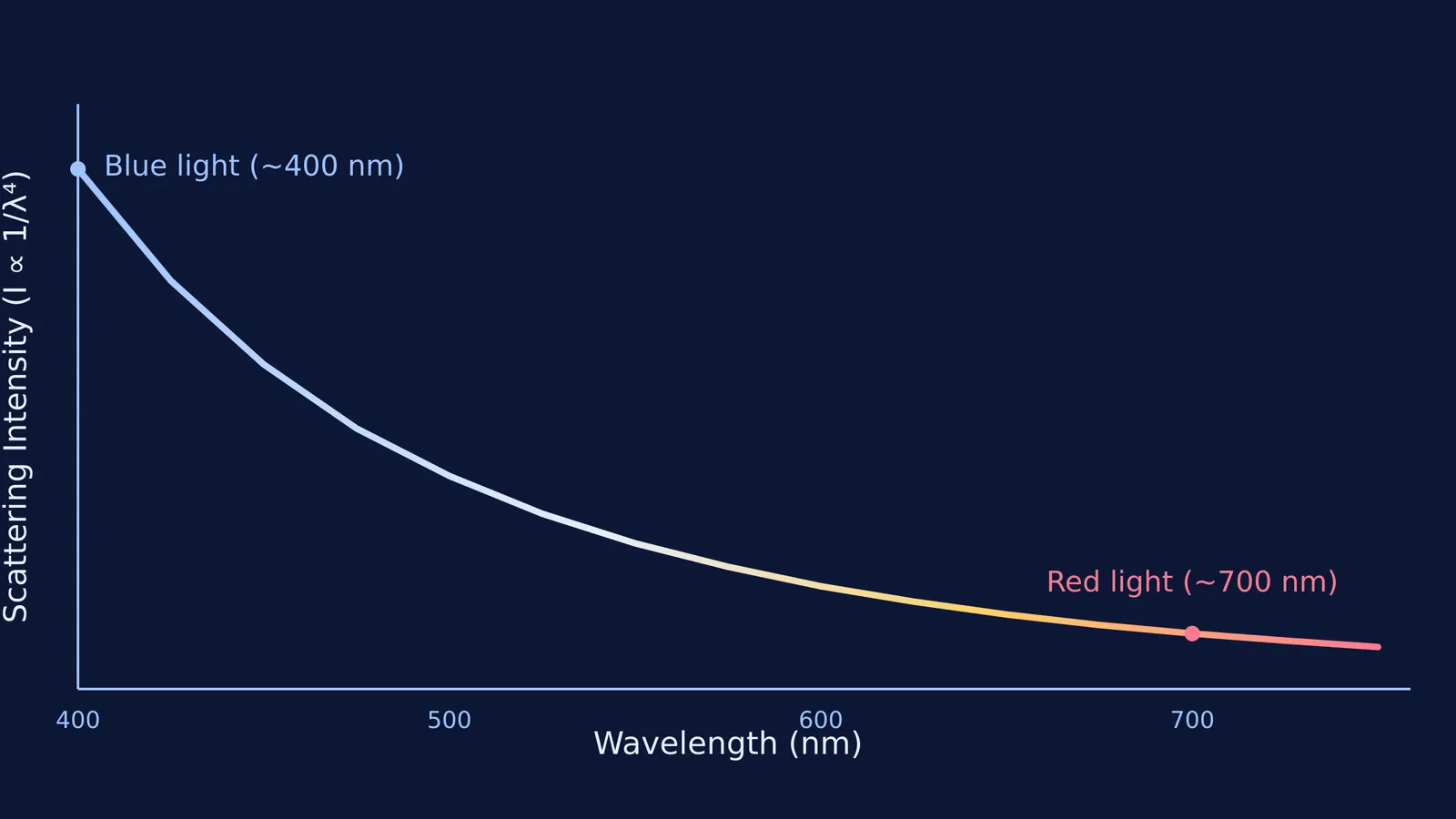
Red is used for danger signals because it has the longest wavelength in the visible spectrum. When light travels through the atmosphere, it strikes air molecules, dust and water droplets that scatter it in different directions. Because of its long wavelength—around 700 nanometres—red light is scattered the least (Rayleigh Scattering).
This means that a red signal can cut through thick fog, heavy rain and smoke without losing its intensity. A blue or green light would scatter quickly and become a blurry haze, but a red light travels in a relatively straight line to reach your eyes.
The use of red for "stop" began on the railways long before cars existed. In December 1868, railway signaling engineer John Peake Knight invented the first traffic signal in London, applying the railway convention of red gas lamps to road use (Traffic Light History). Engineers needed a signal that a heavy train could see from far away, and red provided the maximum visibility through steam and fog. Following its success in the 19th century, the convention of using red for danger spread globally. The 1968 Vienna Convention on Road Signs and Signals eventually standardised the red-at-the-top configuration used internationally today. This ensured that drivers everywhere would universally recognise the warning, reinforcing the natural psychological association humans have between red, fire and danger.
How does Rayleigh scattering work?
The physics behind this effect is called Rayleigh scattering. It describes how light interacts with particles that are much smaller than its own wavelength, such as nitrogen and oxygen molecules in the air.
Rayleigh's law states that the intensity of scattered light is inversely proportional to the fourth power of its wavelength (I ∝ 1/λ⁴). Because blue light has a shorter wavelength (~400 nm) than red light (~700 nm), blue light is scattered about 10 times more efficiently (Rayleigh Scattering).
This is also why the sky is blue: the atmosphere scatters the short blue wavelengths from sunlight in all directions. If you want to see this effect in action, you can read Why Sunsets Are Red: The Rayleigh Scattering Simulation to understand what happens when light travels through a thicker layer of air at dusk.
A framework for solving scattering problems
In board exams and competitive tests, you are often asked to connect the colour of light to its scattering behaviour. It is easy to confuse frequency, wavelength and the correct formula. Here is a step-by-step checklist to ensure you never lose marks on these questions:
Check the particle size. Rayleigh scattering (I ∝ 1/λ⁴) only applies when the atmospheric particles are much smaller than the wavelength of light.
Identify the large particles. If the particles are large—such as water droplets in clouds—they scatter all colours equally. This is why clouds look white, not blue.
Link wavelength to frequency. Remember that red light has a long wavelength but a low frequency, while blue light has a short wavelength and a high frequency.
Relate distance to scattering. If a question asks why a colour is chosen for long-distance visibility, point directly to its long wavelength and minimal scattering.
Visualising the physics
If you find it hard to picture how light interacts with different media, the Fermi Simulation Lab provides interactive simulations for the ideas that are easier to see than to read. Instead of just reading a textbook, you can test how different wavelengths behave. Here, Fermi's AI tutor can work out what you already know and build a plan for the session, so you sit down to a clear next step.
Understanding the physics of light also helps explain human vision, as detailed in How Do Our Eyes See So Many Different Colours?. By linking the formulas of wave optics to the everyday world, you can rely on reasoning rather than rote memory in the exam hall. When you know why a stop sign is red, you never have to memorise the scattering rules again.


