On this page
On a flat road at racing speed, a cyclist's biggest opponent is the air, not the road. A review of drag-measurement methods in Sports Biomechanics reports that on level ground above about 14 m/s (roughly 50 km/h), about 90% of a rider's mechanical power goes into overcoming air resistance. Riding close behind someone is the cheapest way to cut that.
Why do cyclists in a race ride close behind each other?
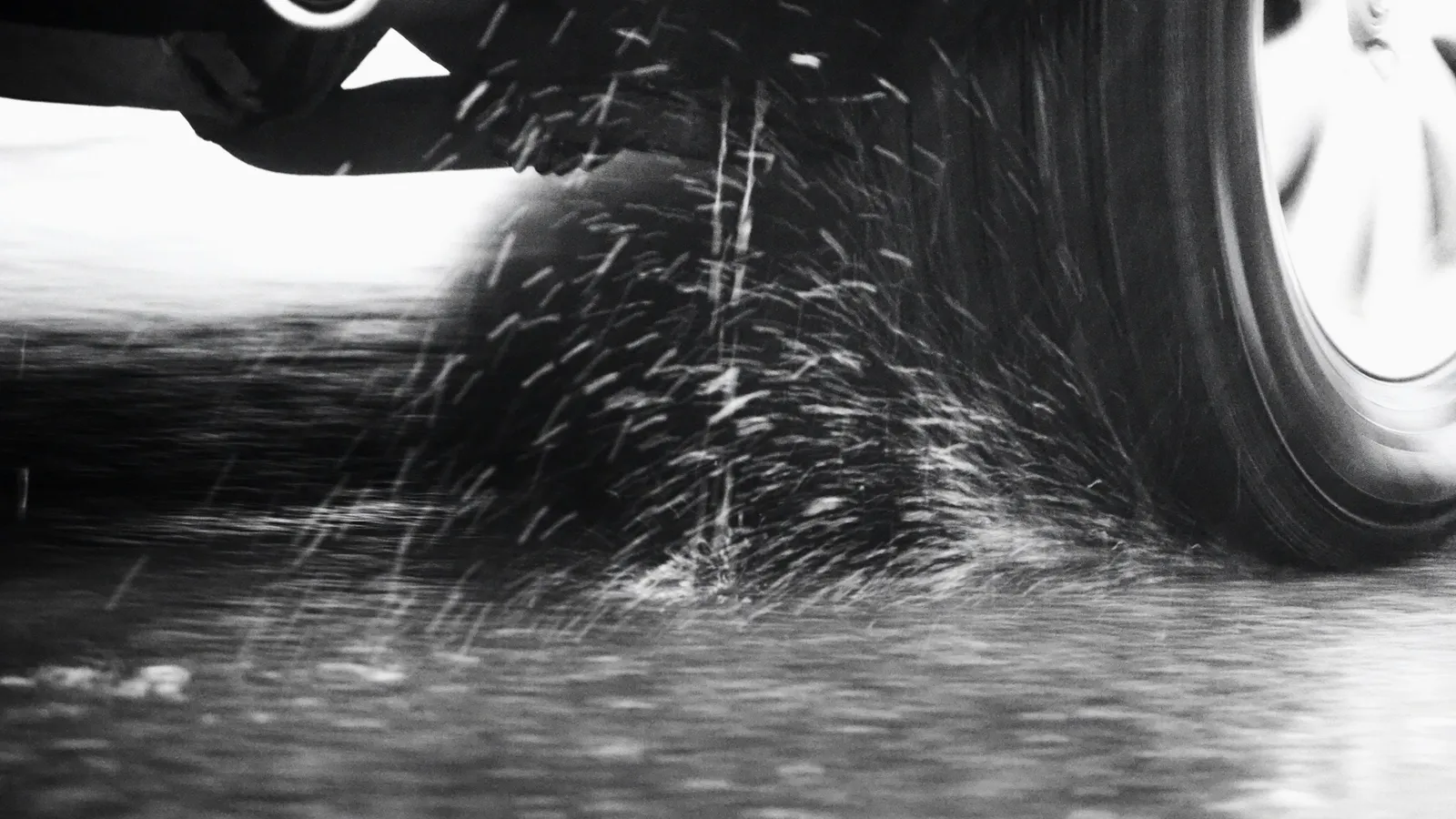
The rider in front pushes air out of the way. Behind them is a wake: a region of lower pressure where the air has been dragged along with the rider and is swirling, instead of rushing head-on at the next person. A rider who sits inside that wake meets air at a lower relative speed, so they feel less drag. Racers call this drafting, or riding in someone's slipstream.
The effect is large because drag grows fast with speed. NASA's drag equation gives drag as D = Cd × ρ × V² × A / 2, where Cd is the drag coefficient (set by shape), ρ is air density, V is the speed of the air relative to the body and A is the reference area. Because V is squared, a small drop in the air speed you meet gives a bigger drop in drag.
How much drag does the rider behind actually save?
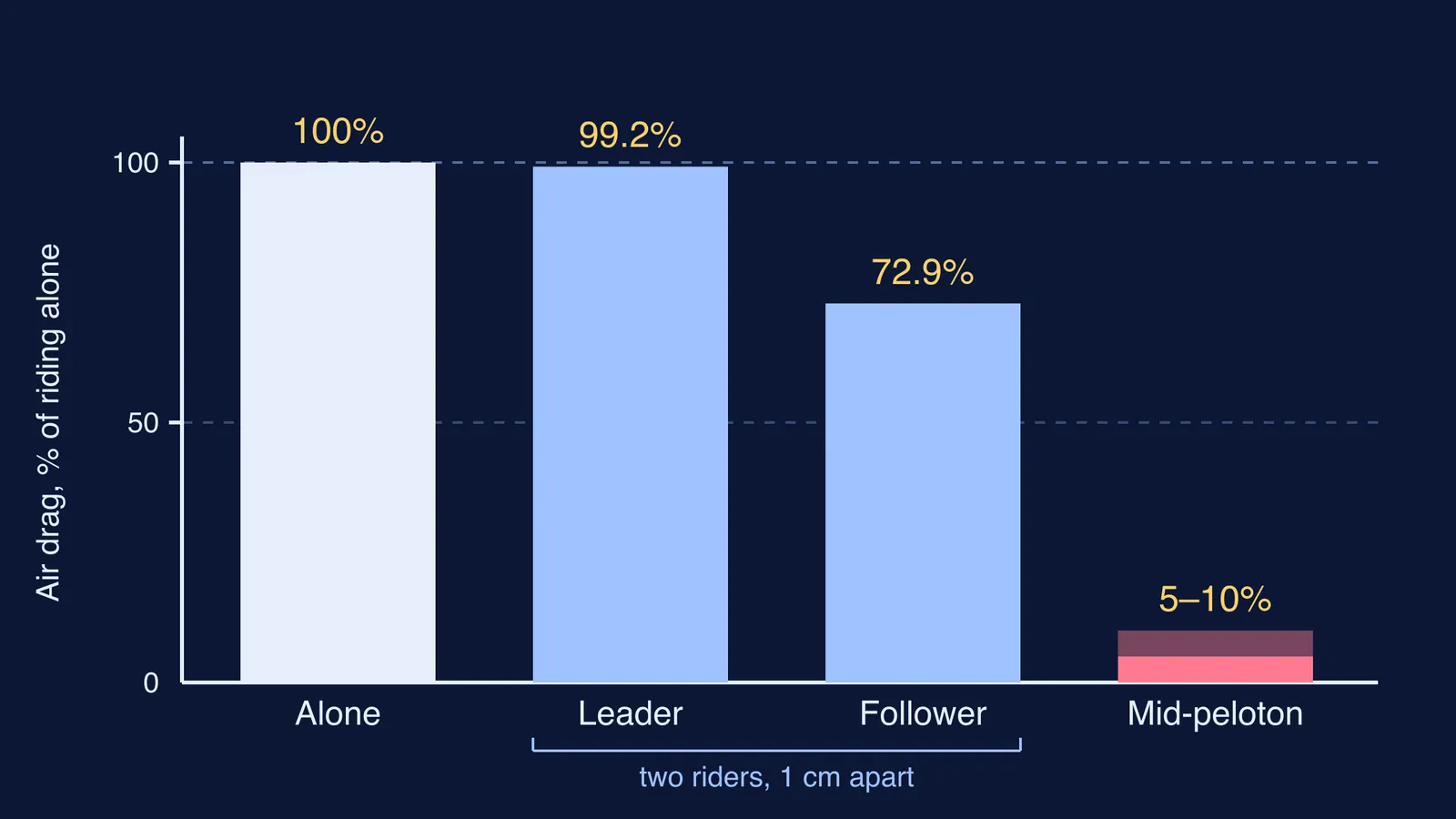
A team led by engineer Bert Blocken measured this with computer flow simulations backed by wind-tunnel tests. For two riders only 1 cm apart, the trailing cyclist's drag fell by 13.8% to 27.1% depending on body position, with the 27.1% cut in the upright position (Blocken et al., Computers & Fluids, 2013).
A bigger group shelters far more. In a 2018 study of 121-rider pelotons, riders in the mid-rear of the bunch felt only 5% to 10% of the drag of an isolated rider at the same speed (Blocken et al., Journal of Wind Engineering and Industrial Aerodynamics, 2018).
Does the leader get anything out of it?
A little. The same 2013 study found the leading cyclist's drag also fell, by 0.8% to 2.6%, and traced the effect to the air pressure in the gap between the two riders (Blocken et al., 2013). Part of a cyclist's drag comes from the low-pressure pocket behind them pulling back; a follower partly fills that pocket.
Still, a saving of under 3% for the leader against up to 27% for the follower is lopsided, so riders share the front. In a paceline, each rider takes a short turn in the wind and then drops back into shelter.
What does 5 to 10% of normal drag feel like?
Drag goes as V², so if drag is 5% of normal, the effective air speed is √0.05 ≈ 0.22 of the real speed, about 4.5 times lower. At 10%, √0.10 ≈ 0.32, about 3.2 times lower. The 2018 paper's abstract gives the same range: riders deep in the peloton feel drag as if they were riding 3.2 to 4.5 times slower than the bunch (Blocken et al., 2018).
Now put in a number:
Peloton speed: 54 km/h.
Deep in the bunch, the air feels like 54 ÷ 4.5 = 12 km/h to 54 ÷ 3.2 ≈ 17 km/h.
Effort: if about 90% of power goes to air drag at racing speed (Debraux et al., 2011) and that part drops to 5 to 10% of normal, the total is roughly 10% + (90% × 0.05 to 0.10), which is about 15% to 19% of the power needed alone.
That last step is our own rough estimate and ignores hills, wind and bike differences, but it shows why a rider can sit in the bunch for hours and still sprint.
How do you explain drafting in an exam answer?
A clear answer on air resistance takes three steps:
The leading cyclist pushes the air aside, leaving a slower-moving, low-pressure wake behind.
A cyclist inside that wake meets air at a lower relative speed, and since drag is proportional to the square of relative speed, the drag on them is much smaller.
Less drag means less work done against air resistance, so the rider behind uses less energy at the same speed.
Drafting is the group version of streamlining, which keeps drag low for fish, birds and planes. For why speed is so costly, see why the power to beat air drag grows with the cube of speed; for a similar trick in nature, read why birds fly in a V shape.
Wakes are hard to picture from a textbook. The Fermi Simulation Lab has interactive simulations for ideas that are easier to see than to read. If a step like the V² reasoning trips you up, Fermi's AI tutor can work out what you already know and build a plan for the session.