On this page
Watch a crab on a wet beach and you will often see it scuttle left, then right, without turning its body. That follows from how its legs are built.
Why do crabs walk sideways?
A crab's walking legs stick out from the sides of a wide body, and each leg is a chain of stiff segments linked by joints. Most of these joints behave much like hinges, each swinging in one plane. So an animal should walk most easily in the direction its leg joints swing most.
That idea has been tested. In a 2008 study in Arthropod Structure & Development, Andrés Vidal-Gadea, M. D. Rinehart and Jim Belanger compared the skeletons, stance and leg movement of a sideways-walking green shore crab, a forward-walking crayfish and a spider crab, *Libinia emarginata*, which walks forward 80% of the time. They found that animals tended to have greater ranges of motion for joints that move in their preferred direction of travel, and that thorax shape, leg length and resting leg position also reflected how each species walks.
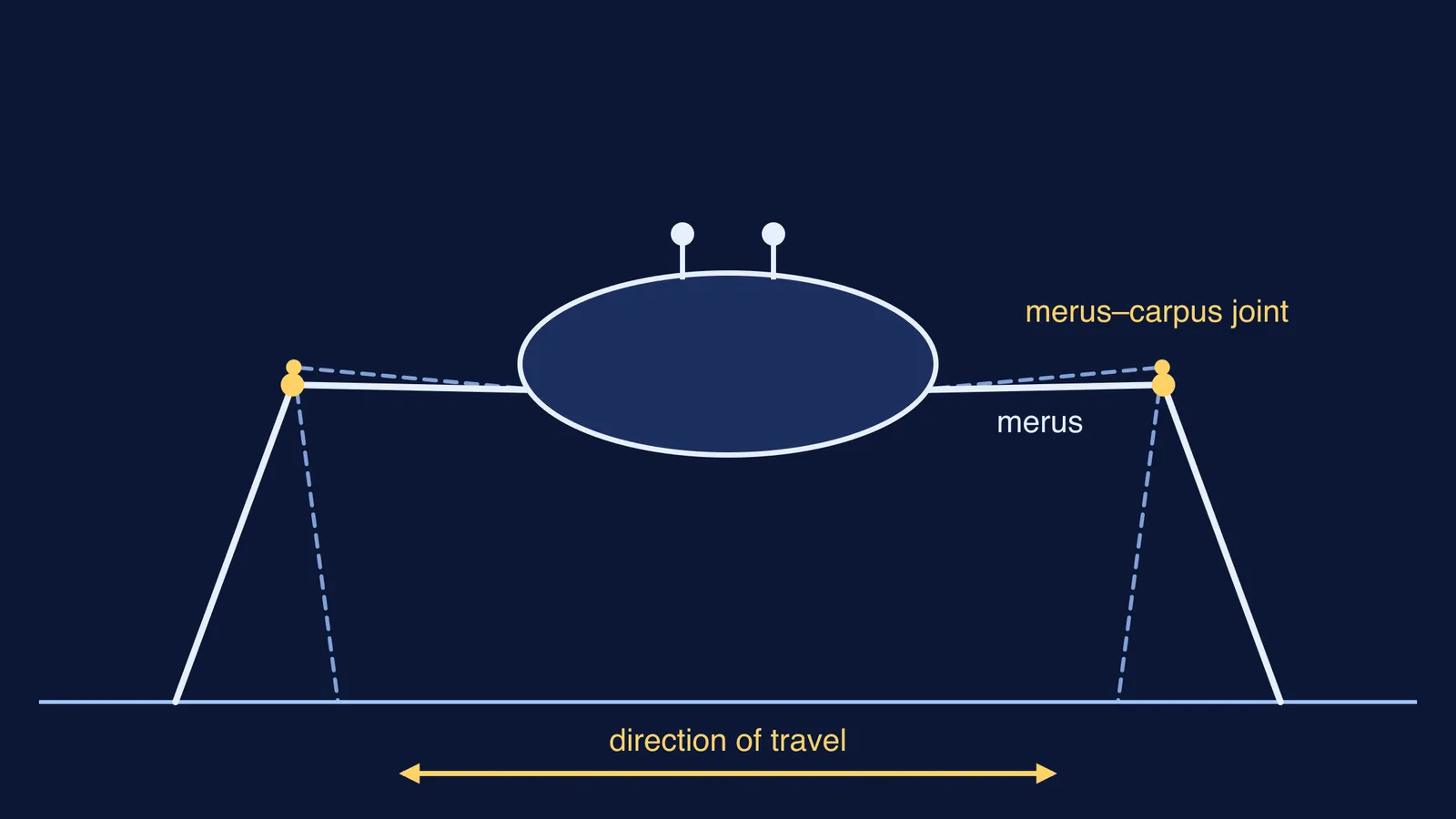
A 2013 follow-up by Vidal-Gadea and Belanger looked at the nerves. The spider crab has more motor neurons supplying muscles near the body than its sideways-walking relatives, and the authors proposed that the switch to sideways walking gave a bigger role to a joint further down the leg, the merus–carpus joint, roughly the crab's knee. In a sideways walker the leg points along the line of travel, so when that joint opens and closes, the foot sweeps sideways along the ground.
Is walking sideways actually faster?
For a crab, one gain is speed in two directions. It can dash left or right without first turning its body. Junya Taniguchi and colleagues in eLife suggest these fast two-way movements may help crabs escape predators, partly by making the escape direction unpredictable.
Engineers have tested the speed question with a robot. Yang Chen, Kathryn Daltorio and colleagues gave Sebastian, a six-legged robot, forward and sideways gaits with matched body and step heights. With the common three-joint leg design, sideways walking gave 75% greater walking speed and 40% lower cost of transport, a measure of the energy spent to travel a distance. It did better on both a hard floor and dry play sand.
A robot is not a crab, but the geometry is similar: legs out to the sides, joints swinging in that plane.
When did crabs start walking sideways?
The 2026 eLife study by Taniguchi, Yuuki Kawabata and colleagues analysed the movement of 50 live crab species and sorted it into two main modes: 35 species were classed as sideways movers and 15 as forward movers. Mapping these onto the crab family tree showed that sideways walking arose only once, from a forward-walking ancestor. Using published divergence times, the authors place that origin around 200 million years ago, in the earliest Jurassic.
Some groups later went back to walking forward, among them spider crabs, frog crabs and soldier crabs. The lineage in which sideways walking began holds far more species than its closest relatives, which the authors say is consistent with sideways walking being a key innovation for true crabs. For the group itself, see crab and prawn crustacean features.
How can you predict how an animal moves from its joints?
Ask three questions about any jointed limb.
Where are the main joints of the limb?
In which plane does each joint swing most freely?
Which way does the foot sweep when that joint moves? That is the animal's easy direction.
Worked example, your own leg. Your knee is a hinge joint (see our guide to ball and socket, hinge and pivot joints). It swings forward and back, so your foot sweeps forward and back, and you walk forwards. Now cross a room sideways: your knee barely helps, so your hip must swing the whole leg out, and the steps tend to come out shorter.
Now the crab. Its legs point out to the sides and the merus–carpus joint swings in the side-to-side plane, so the foot sweeps sideways and the crab walks sideways. Same rule, different joint layout. Try the three questions on the six legs in our post on how a cockroach moves with its exoskeleton and jointed legs.
In an exam answer on arthropod locomotion, use the same order: jointed appendages, the plane each joint moves in, the direction of travel. If joint motion is hard to picture from a textbook drawing, the Fermi Simulation Lab has interactive simulations for ideas that are easier to see than to read. To revise joints and arthropods side by side, the Fermi Concept Library gives each concept its own lesson and its place in the map.
Next time you see a crab, watch its legs, not its body: the knee-like joints open and close out to the sides.