On this page
Being cold does not give you a cold; a virus does. But winter changes how long viruses last, how well your nose fights them, and how close together people sit.
Why do we catch more colds in winter?
The US Centers for Disease Control and Prevention (CDC) says more than 200 respiratory viruses can cause colds, and rhinoviruses are the most frequent cause in the United States. Most respiratory viruses spread through droplets from coughs and sneezes, which you can breathe in or pick up by touching a contaminated surface and then your eyes, nose or mouth. You can catch a cold any time of year, but CDC notes that viruses such as influenza and RSV usually circulate in winter. Winter may help them in three ways:
Air: cold, dry air helps some viruses survive and spread.
Your body: a cooler nose may fight infection less well.
Behaviour: with windows shut, people spend more time close together indoors.
For why a cold is not a chest infection, see how a common cold differs from pneumonia.
Does cold air really help cold viruses?
Most rhinovirus strains copy themselves better at the cooler temperature inside the nose than at the 37 °C of the lungs. In a 2015 study using mouse airway cells and a mouse-adapted rhinovirus, Ellen Foxman, Akiko Iwasaki and colleagues at Yale found part of the reason: at lung temperature, the cells released more interferon, a signal that switches on antiviral defences, and responded to it more strongly.
A 2022 study of human nasal cells and tissue by Di Huang and colleagues found that nasal cells release a swarm of tiny particles, called extracellular vesicles, that help block viruses, partly by binding to them. Cold exposure reduced how many were released and how well they worked.
Dry air matters too. In a 2007 experiment with guinea pigs, Anice Lowen and colleagues showed that both relative humidity and temperature affected how influenza spread. At 20 °C, transmission was most efficient at 20% and 35% relative humidity and was completely blocked at 80%. Transmission happened more often at 5 °C than at 20 °C, and infected animals kept at 5 °C shed virus at peak levels for about 40 hours longer.
A 2019 mouse study by Eriko Kudo and colleagues found that breathing dry air impaired mucociliary clearance, the moving layer of mucus and tiny hairs that sweeps germs out of the airways, and weakened antiviral defence against influenza. That layer is one of the four barriers of innate immunity.
Why is winter air so dry, even on a misty morning?
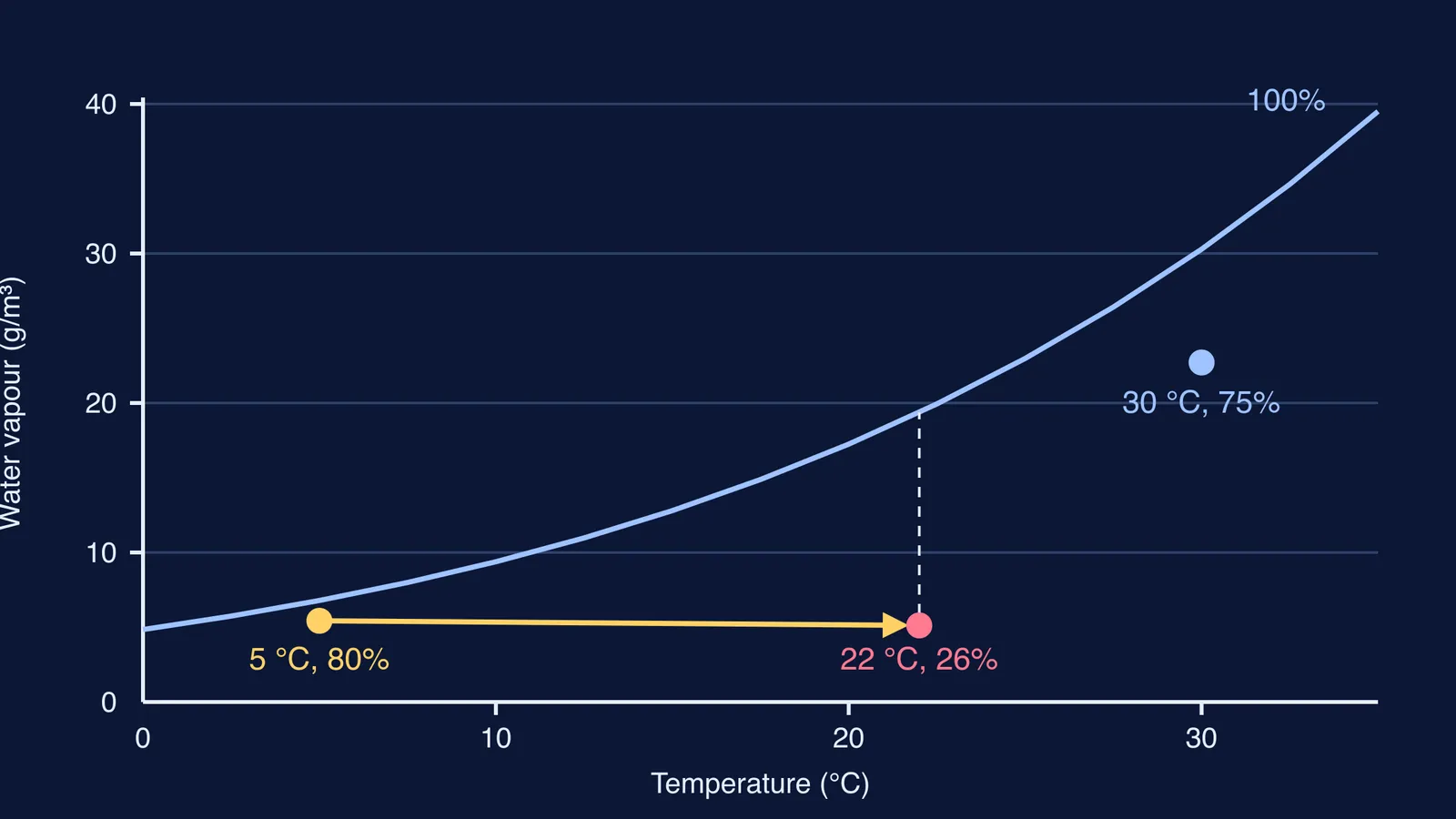
Relative humidity compares the water vapour in air with the most it could hold at that temperature, and warm air can hold far more. Jeffrey Shaman and Melvin Kohn reanalysed earlier experiments and found that absolute humidity, the actual amount of water vapour in the air, explained 90% of the variation in influenza virus survival, compared with 36% for relative humidity.
A worked example, using the Magnus formula for saturation vapour pressure with coefficients from Alduchov and Eskridge035%3C0601:IMFAOS%3E2.0.CO;2):
A 5 °C winter morning at 80% relative humidity holds about 5.4 g of water vapour per cubic metre.
Heat that air indoors to 22 °C. No water is added, so relative humidity falls to about 26%.
Compare a 30 °C monsoon afternoon at 75% relative humidity: about 22.7 g per cubic metre, roughly four times as much water.
That heated room sits in the dry range where influenza spread most easily in the guinea-pig study. To watch humidity change as you vary the temperature, try the Fermi Simulation Lab, which has interactive simulations for ideas that are easier to see than to read.
Is winter the cold and flu season in India too?
Not everywhere. A study of influenza surveillance at ten sites across India from 2009 to 2013 by Mandeep Chadha and colleagues tested 44,127 patients with flu-like or severe respiratory illness and found that 14.0% were positive for influenza. Cities including Delhi, Lucknow, Pune, Nagpur, Kolkata and Dibrugarh peaked during the monsoon, from July to September. Chennai and Vellore peaked in October and November, their own monsoon months. Srinagar, in the far north, peaked in winter, from January to March.
So for flu in much of India, the rainy months matter as much as the cold ones. Either way, our difference table on bacteria and viruses explains why antibiotics do not cure a viral cold.
What can you do during cold season?
These are everyday habits from CDC's respiratory virus prevention guidance, not medical treatment:
Wash your hands regularly.
Cover coughs and sneezes.
Open a window when a room is crowded.
Stay home and away from others when you are ill.
If immunity still feels like a list of terms, the Fermi Concept Library gives each biology concept its own lesson and its place in the map.