On this page
Pack a glass jar in newspaper, drop the box, and you may hear a crack. Pack it in two layers of bubble wrap and its odds improve. The bubbles change how long the stop takes, and physics says that changes the force.
How does bubble wrap protect fragile items?
When a falling parcel hits the floor, the item inside must lose all its momentum. Packaging cannot change that; it can only change how long the stop takes.
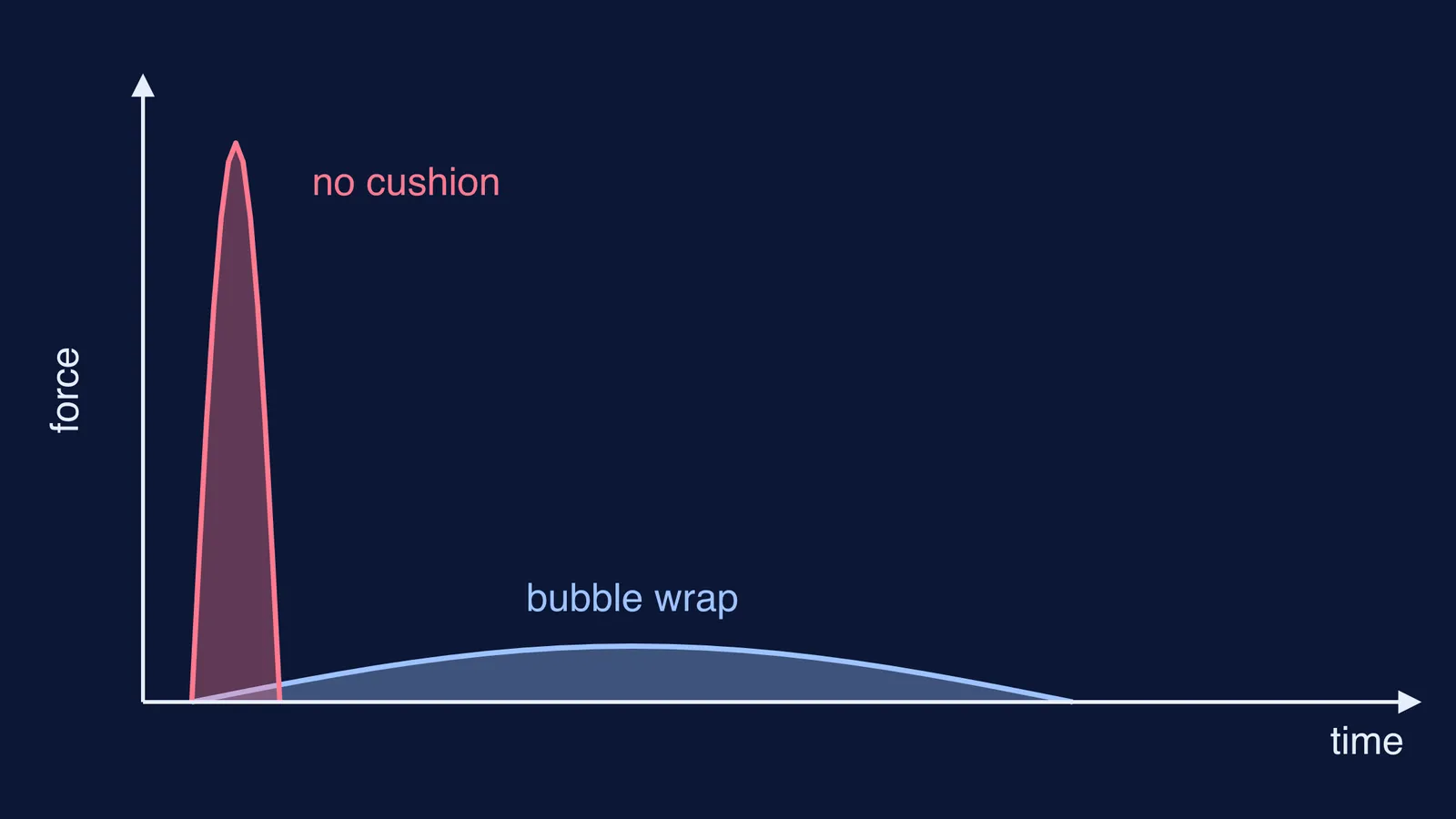
Impulse is the product of a force and the time over which it acts, and it equals the change in momentum (OpenStax University Physics, section 9.2). With average values, F × Δt = Δp. If the fall fixes Δp, a longer Δt means a smaller F.
OpenStax shows this with a car crash: the momentum change is the same with or without an airbag, but a driver brought to rest over about 2.5 s feels roughly 1.1 times their weight, while one stopped by the steering wheel in about 0.20 s feels about 14 times their weight. Bubble wrap does the same job for a mug in a courier box, only over milliseconds. It is also the idea behind how a bike helmet protects your head.
Why does the air in bubble wrap matter?
Air is a gas, and gases are easy to squeeze. Boyle's law says the volume of a fixed amount of gas at constant temperature is inversely proportional to its pressure (OpenStax Chemistry 2e, section 9.2). Press on a bubble and its volume shrinks while the pressure inside climbs, the same property that lets us fill LPG and CNG cylinders.
That climbing pressure is the cushion. At first touch a bubble pushes back gently; as it flattens, it pushes harder. The item slows over the whole squash distance instead of being stopped dead by cardboard and floor, which give very little.
The cushion works only while there is air left to squash. A cushion must deform under shock to work, and if its load-bearing area is too small, the product may bottom out, so the shock is not cushioned (Wikipedia, Package cushioning).
How much force does bubble wrap save?
Here is a calculation you can check with the impulse-momentum theorem. The mug, height and squash distances are our assumptions, chosen to be realistic, not measurements.
A 0.3 kg mug in a parcel falls 1.0 m. It lands at v = √(2gh) = √(2 × 9.8 × 1.0) ≈ 4.4 m/s, so its momentum is about 1.33 kg m/s.
With no cushion, say box, floor and mug give only 1 mm. If it slows evenly, the stop takes t = 2d/v ≈ 0.45 ms. Average force = Δp/Δt ≈ 2,900 N, about 1,000 times the mug's weight.
With bubble wrap that squashes by 10 mm, the stop takes about 4.5 ms. Average force ≈ 290 N, about 100 times its weight.
Ten times the stopping distance, ten times the stopping time, one tenth of the force, with the same impulse. Our post on why a cushion stops an egg breaking shows the same trade on a force-time graph.
Real drop tests point the same way. In a study in the Journal of Packaging, Siripong Malasri and colleagues at Christian Brothers University taped a medicine box to the bottom of a plastic tote, dropped it 30 times from each of five heights between 12 and 24 inches, and measured peak acceleration. From 24 inches, the box hit about 294 g with no cushion and about 184 g on 5/16-inch bubble wrap, a 37% reduction. Averaged over all heights, 3/16-inch wrap cut the peak by 23%, 5/16-inch wrap by 34%, and half-inch viscoelastic foam by only 9%.
How should you pack a fragile parcel?
Use the physics as a checklist:
Put bubbles between the item and every face of the box, including the bottom and corners.
Use thicker wrap or more layers for heavy or brittle items, to give more squash distance.
Fill empty space so the item cannot rattle, pick up speed and hit a wall. The same study found that air pillows at the top of the tote limited bouncing and lowered peak acceleration.
Do not crush the wrap to close the lid: flat wrap has no squash left.
Skip popped or flattened wrap for anything fragile.
How does this show up in physics exams?
JEE Main and board questions use the same idea in other clothes: a fielder pulling the hands back to catch a ball, a jump onto sand rather than concrete, an airbag. Ask what is fixed (Δp) and what changes (Δt), and the answer follows.
If impulse as the area under a force-time graph is hard to picture, the Fermi Simulation Lab has interactive simulations for ideas that are easier to see than to read. When a numerical goes wrong, the Fermi Problem Library has worked problems with a step-by-step solver that explains the reasoning rather than printing an answer.
Next time a parcel arrives, press one bubble slowly and feel it push back harder as it flattens.