

On this page
When you order a 14.2 kg cooking gas cylinder in India, you are taking delivery of thousands of litres of gas packed into a knee-high steel bottle.
Why is this possible for fuels but impossible for water? If you fill a syringe with water, block the nozzle and push the plunger, it stops immediately. But if you fill it with air, you can push the plunger almost all the way down. The reason comes down to the submicroscopic structure of the states of matter.
Why can gases be compressed?
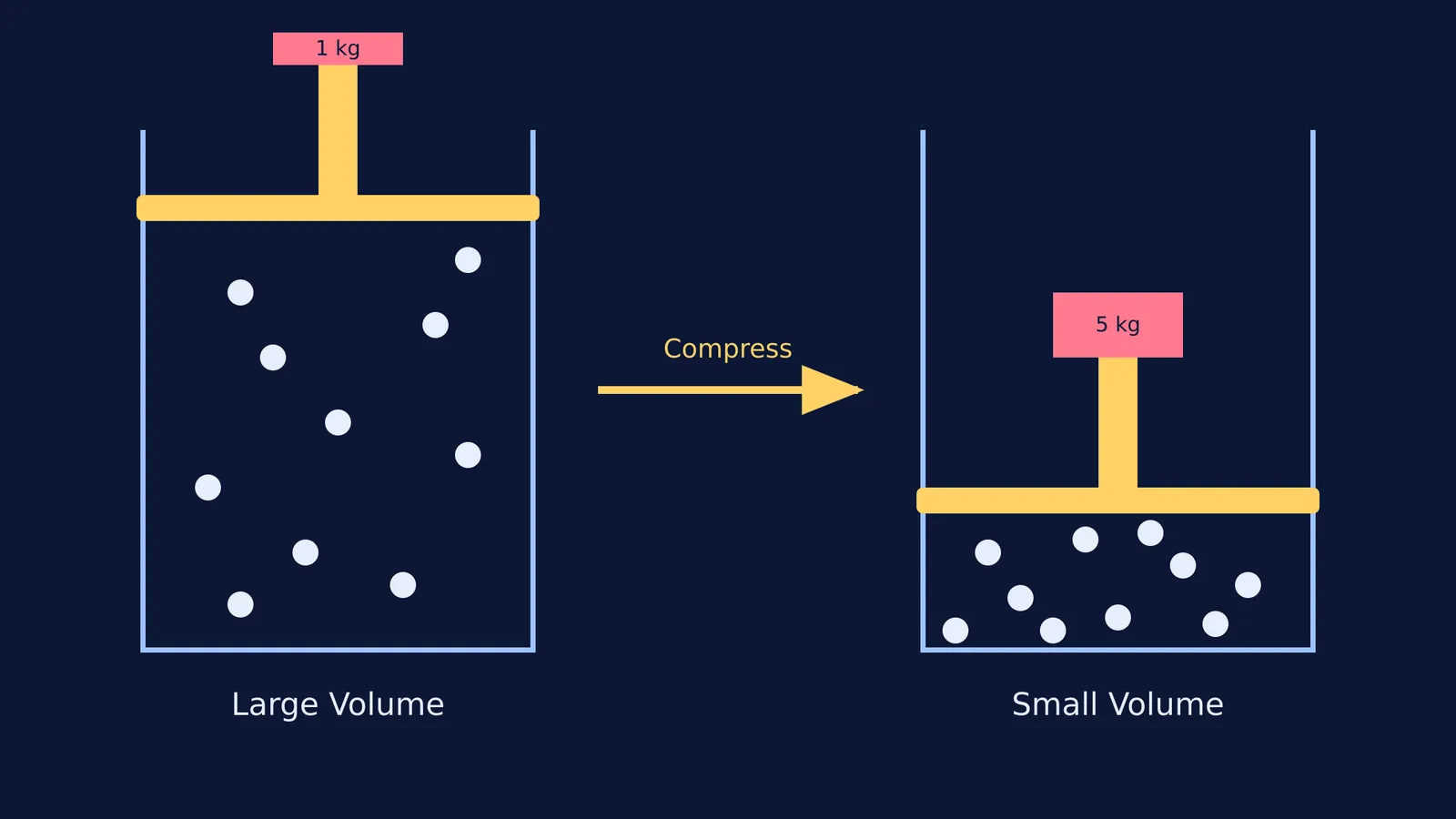
The Kinetic-Molecular Theory explains that gases consist of tiny particles separated by vast distances. The actual volume of the gas molecules is negligible compared to the total volume they occupy. In short, most of a gas is simply empty space.
When a pump forces gas into a cylinder, the pressure pushes these particles closer together, decreasing the total volume. They just fill the empty space that was already there.
Liquids and solids cannot be compressed this way. Their molecules are already touching, so increasing the pressure cannot squeeze them much closer. You can see this visually by checking Adiabatic vs isothermal: compress a gas and read the PV graph — as the volume decreases, the pressure spikes because the molecules bounce off the walls more frequently.
Can you test this with a syringe experiment?
You can prove this property of gases with a simple plastic syringe (without the needle) from a pharmacy.
Pull the plunger back to fill the syringe with air.
Block the nozzle tightly with your thumb.
Push the plunger down.
You will find that you can compress the air to a fraction of its original volume. You are forcing the air molecules into a smaller space. The moment you let go, the pressure inside pushes the plunger back out.
Now, fill the exact same syringe with water. Block the nozzle and push. The plunger will not move at all. Water molecules are practically touching each other, leaving no empty space to squeeze out.
How does this connect to Boyle's Law?
In physics and chemistry, this relationship between pressure and volume is described by Boyle's Law. It states that at a constant temperature, the volume of a given mass of gas is inversely proportional to its pressure.
When a compressor pumps CNG into a car's tank, it increases the pressure to 3,600 psi, which is over 240 times normal atmospheric pressure. Because the pressure goes up by a factor of 240, the volume the gas takes up drops by roughly the same factor. This is precisely how CNG is compressed to less than 1% of its normal volume (US Department of Energy).
If you are dealing with numerical problems on these gas laws, keeping track of your units is where most mistakes happen. For a refresher on converting container sizes, see Converting Cubic Centimetres to Litres for Tank Problems.
What is the difference between LPG and CNG?
While both fuels rely on the compressibility of gases, they react differently as pressure climbs.
Liquefied Petroleum Gas (LPG): LPG is mostly made of propane and butane. When you compress these gases at room temperature, they do not just get squeezed closer together; they change state entirely and condense into a liquid. As a liquid, LPG has a density roughly 250 times greater than its gas form. This 250:1 expansion ratio means that 250 litres of gas shrink down into just 1 litre of liquid inside the red domestic cylinder (Wikipedia).
Compressed Natural Gas (CNG): Natural gas is primarily methane. Unlike propane, methane does not liquefy at room temperature, no matter how hard you squeeze it. Instead, it remains a gas. It is simply compressed to very high pressures, packing tightly into the strong steel cylinders found in the boots of cars.
How do you answer compressibility questions in exams?
Questions on the states of matter usually ask you to explain an everyday observation—like an LPG cylinder—using the Kinetic-Molecular Theory.
A common assertion-reason question in competitive exams looks like this:
Assertion: Large volumes of natural gas can be supplied in small cylinders. Reason: Gases are highly compressible because the intermolecular forces are weak and the spaces between particles are very large.
Here, both the assertion and the reason are true, and the reason correctly explains the assertion. The trick is to always trace the macroscopic property (a small cylinder) back to the microscopic reality (vast empty spaces).
If you get stuck picturing how gas laws map to these real-world examples, you can look up the topic in the Fermi Concept Library. The AI tutor can run simulations to show you what happens to the particles when pressure increases, helping you understand the 'why' rather than just memorising the theory.
By understanding the large gaps between particles, it becomes clear why thousands of litres of fuel can sit safely and quietly in the corner of your kitchen.


