On this page
Put your hand near the back of a running fridge and it feels warm. Nothing is wrong. That warmth is heat that used to be in your milk, dal and leftovers, now being thrown out into the room.
Why is the back of the fridge hot?
A fridge does not make cold. It moves heat out of a box. The catch is that heat does not flow from cold to hot on its own: the Clausius statement in NCERT Class 11 Physics, Chapter 11 (Thermodynamics) says no process is possible whose sole result is the transfer of heat from a colder object to a hotter object.
So the fridge has to pay. It uses electrical work in a compressor to push heat "uphill" from the cold inside to the warmer kitchen, and the place where that heat leaves is the set of coils at the back. An engineering textbook chapter on refrigerators/Energy_Conservation_for_Environmental_Protection_(Pisupati)/05:_Appliances/5.04:_New_Page) describes the condenser as located at the back of the refrigerator, where it gives off heat to the air in the kitchen, and notes that most refrigerators reject heat from the bottom and/or back.
How does the refrigerant carry heat out of the fridge?
The refrigerant is a fluid that runs round a sealed loop, changing between liquid and gas. The OpenStax University Physics section on refrigerators/University_Physics_II_-_Thermodynamics_Electricity_and_Magnetism_(OpenStax)/04%3A_The_Second_Law_of_Thermodynamics/4.04%3A_Refrigerators_and_Heat_Pumps) sums it up: the coolant extracts heat from the refrigerator at the evaporator, causing it to vaporise; it is then compressed and sent through the condenser, where it exhausts heat to the outside.
Follow one bit of refrigerant round the loop:
Evaporator (inside, cold). Low-pressure liquid boils at a temperature below the food's. Boiling needs latent heat, so it soaks heat out of the air and food.
Compressor (usually low down at the back). The vapour is squeezed to high pressure, which also makes it hotter than your kitchen.
Condenser coils (back or bottom, hot). Because the gas is now hotter than the room, heat flows out of it into the air, and it condenses back to liquid.
Expansion device. The liquid passes through a narrow tube or valve, its pressure drops, it turns cold again, and it goes back to the evaporator.
If you would rather see ideas like this than read them, the Fermi Simulation Lab has interactive simulations for ideas that are easier to see than to read.
How much heat comes out of the back? A worked example
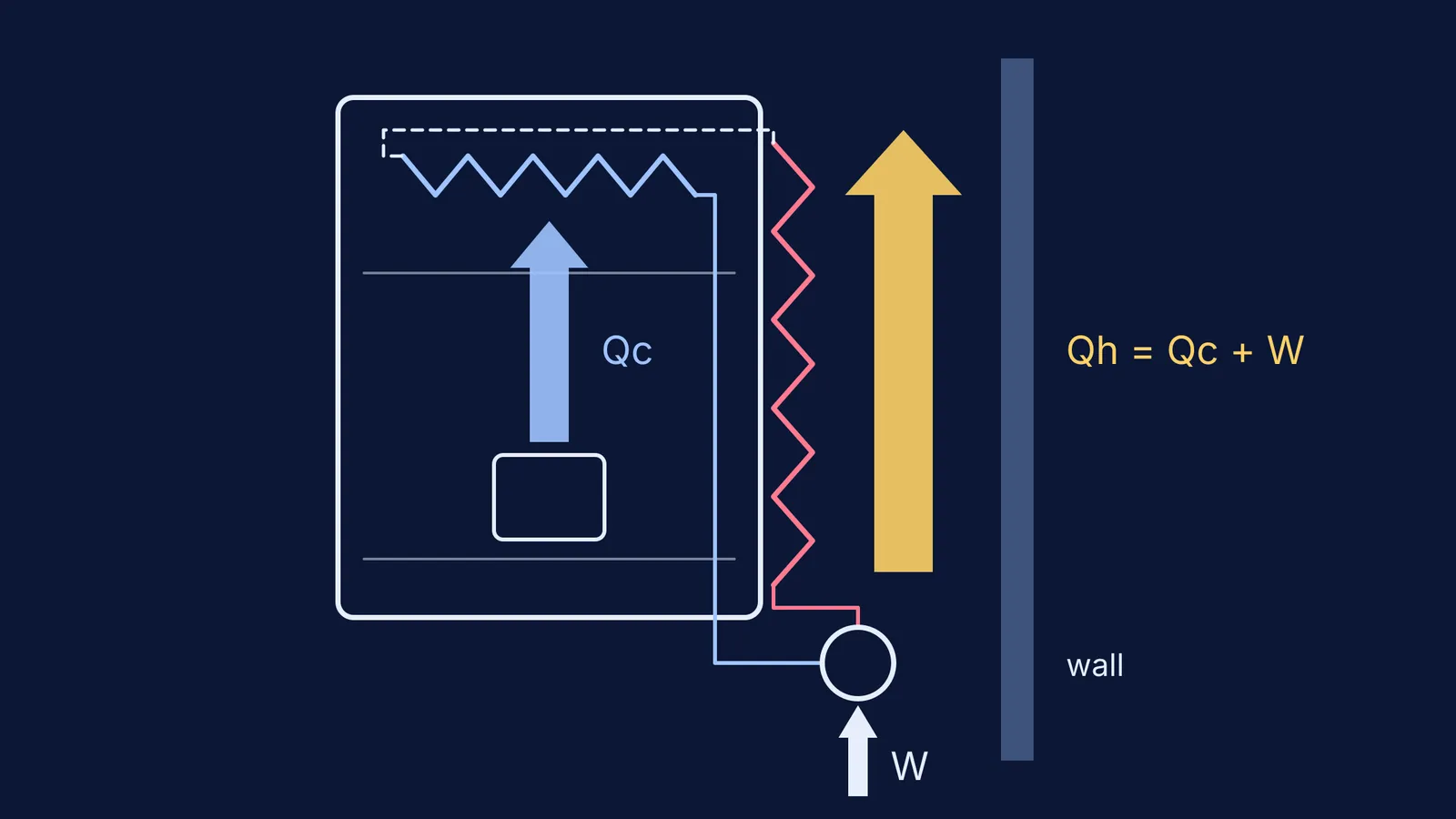
Energy is conserved, so the heat released at the back equals the heat taken from inside plus the compressor's work. In the OpenStax notation, W = Qh − Qc, which rearranges to Qh = Qc + W.
Take illustrative numbers. Suppose that while it runs, the compressor does 100 J of work on the refrigerant every second (100 W) and the evaporator removes 200 J of heat from inside every second.
Heat removed from inside, Qc: 200 J each second
Work put in by the compressor, W: 100 J each second
Heat released at the back, Qh = 200 + 100 = 300 J each second
The back gives out more heat than the inside lost, which is why an open fridge door cannot cool a room overall; see can an open fridge door cool a room?, and the ratio Qc/W, the coefficient of performance, is covered in why a fridge's COP depends on the temperature gap.
If the signs in problems like this keep tripping you up, the Fermi Problem Library has worked problems with a step-by-step solver that explains the reasoning rather than printing an answer.
How far should a fridge be from the wall?
The coils can only shed heat if air moves past them. With too small a gap, heat leaves more slowly and the compressor runs longer. LG's support page asks for a minimum gap of 10 cm around its refrigerators and warns that a narrow gap can reduce cooling performance and raise electricity bills. Your own model's manual is the final word.
Use this placement checklist when you set up or move a fridge:
Leave a gap at the back, sides and top, as your manual says (LG's figure is at least 10 cm). ENERGY STAR also advises leaving a few inches between the wall and the refrigerator.
Do not drape cloth, plastic covers or bags over the top or back, and do not stack boxes on top. They trap the warm air the coils are trying to lose.
Keep it away from heat sources such as an oven, a dishwasher or direct sunlight, as ENERGY STAR recommends.
Brush or vacuum the coils at the back or bottom from time to time, after unplugging; your manual explains how to do it safely.
Do not set it colder than you need. The Chennai consumer group CAG notes that energy use can rise by about 10% for each degree you lower the temperature.
Check the door seal closes fully all round.
A warm back is normal. If the fridge runs almost nonstop, the coils are very hot, or it is not cooling, call a qualified service technician rather than opening the sealed refrigerant loop yourself. For the full cycle from the inside out, read how a refrigerator makes things cold.