On this page
Every winter in north India, families carry an angithi (a coal or charcoal brazier) indoors, shut the doors against the cold and go to sleep. Some do not wake up. By 30 January 2024, smoke from angithis had killed 15 people in Delhi that month, IANS reported; the Delhi Fire Service director put the wider Delhi-NCR toll above 20. The reason is in your Class 8 science book.
What does Class 8 science say about burning coal in a closed room?
The NCERT chapter Combustion and Flame defines combustion as a chemical process in which a substance reacts with oxygen to give off heat. A few pages later it warns: "Incomplete combustion of these fuels gives carbon monoxide gas. It is a very poisonous gas. It is dangerous to burn coal in a closed room. The carbon monoxide gas produced can kill persons sleeping in that room."
With plenty of air, coal (mostly carbon) burns completely: C + O2 → CO2. When oxygen runs short, each carbon atom gets only one oxygen atom: 2C + O2 → 2CO. That is incomplete combustion. A heap of glowing coal always makes some CO, and in a closed room it cannot escape while the fire keeps using up oxygen. Atul Garg, the Delhi Fire Service director, put it simply in the same IANS report: "Whatever you ignite inside a closed room, be it a heater, angithi, or coil -- they all consume oxygen."
A quiet, glowing angithi is not safer than a flaming one. Coal that glows without much flame is burning at its surface, and the US Centers for Disease Control and Prevention warns that burning charcoal, "red, gray, black, or white", gives off CO.
If incomplete combustion still feels fuzzy before your exam, the Fermi Concept Library has a lesson for every chemistry concept, so you can check the idea quickly.
Why does carbon monoxide give no warning smell?
Carbon monoxide is a colourless, tasteless, odourless and non-irritating gas, according to UK government guidance on carbon monoxide. CO gives your nose and eyes nothing to react to, so a room can fill with it while the air seems clean.
CO enters through the lungs and attaches to haemoglobin, the body's oxygen carrier, cutting the oxygen carried round the body. UK public health toxicology guidance states that haemoglobin's affinity for carbon monoxide is 245 times higher than for oxygen. Our explainer on why carbon monoxide is poisonous to haemoglobin goes through the binding step by step.
Sleep makes it worse. The CDC notes that people who are sleeping can die from CO poisoning before they have symptoms.
A worked example: how little CO it takes
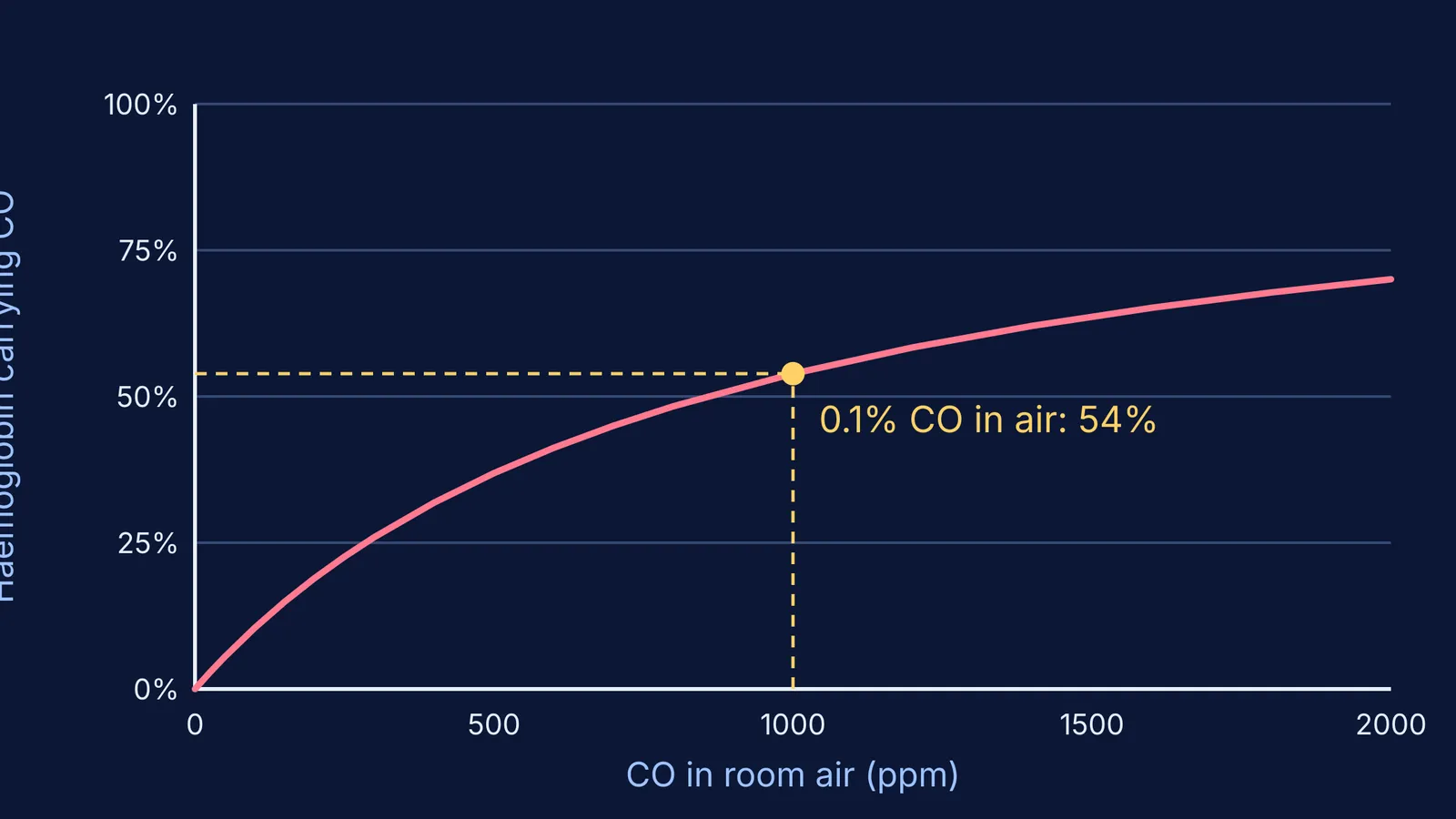
Use the 245 figure from the UK guidance and the fact that air is 20.95% oxygen by volume (NASA Earth fact sheet). At equilibrium, the ratio of haemoglobin carrying CO to haemoglobin carrying oxygen is roughly 245 × (CO fraction) ÷ (oxygen fraction).
Take air with just 0.1% CO, one molecule in a thousand: 245 × 0.001 = 0.245, against 0.2095 for oxygen. Then 0.245 ÷ (0.245 + 0.2095) is about 54%, so more than half the loaded haemoglobin would end up carrying CO. The body takes hours to approach this balance, and it is a chemistry estimate, not a medical threshold, but it shows why a trace of odourless gas matters.
How can you keep warm safely in winter? A home checklist
Do not bring an angithi, sigri or charcoal fire indoors at all. The CDC says plainly: never burn charcoal indoors.
If one has been lit inside anyway, put it out completely and carry it outside before anyone sleeps. NCERT's advice is never to sleep in a room with burning or smouldering coal.
Treat gas and kerosene heaters with the same care. UK guidance lists oil, gas and kerosene heaters among indoor sources of CO.
An electric heater burns no fuel, so it makes no CO, though it can make the air feel dry.
If you can, fit a battery-operated CO alarm near every sleeping area and check its batteries twice a year, as the CDC advises.
Learn the signs: headache, dizziness, weakness, upset stomach, vomiting, chest pain and confusion are the most common, per the CDC.
If a grandparent has used an angithi for decades, try this: "Nani, it's not the smoke that's the danger. Coal in a shut room makes a gas you can't smell. Let's keep the angithi outside and use an extra quilt instead."
What should you do if someone feels unwell near an angithi?
Get everyone out into fresh air straight away and open doors and windows.
Put out the fire only if you can do it quickly; do not stay inside.
Call 112, India's single emergency number that connects police, fire and ambulance (Onmanorama), if anyone struggles to breathe, is suddenly confused, weak or in pain, or has passed out (NHS emergency signs).
Get medical advice as soon as possible, even if they feel better. The NHS notes that symptoms which ease when you go outside are a clue to carbon monoxide.
Tonight, check that no fire burns in any room where someone sleeps.