On this page
You open the weather app before school and see "UV 11, Extreme" sitting next to 34°C. That number is not about heat. It tells you how quickly the sun's ultraviolet light can harm your skin today.
What does the UV index on a weather app actually measure?
The Global Solar UV Index describes the level of solar UV radiation at the Earth's surface: the higher the value, the greater the potential for damage to skin and eyes, and the less time it takes for harm to occur, according to the WHO Global Solar UV Index practical guide. WHO developed it with the World Meteorological Organization and two other international bodies, so the same scale can be reported everywhere.
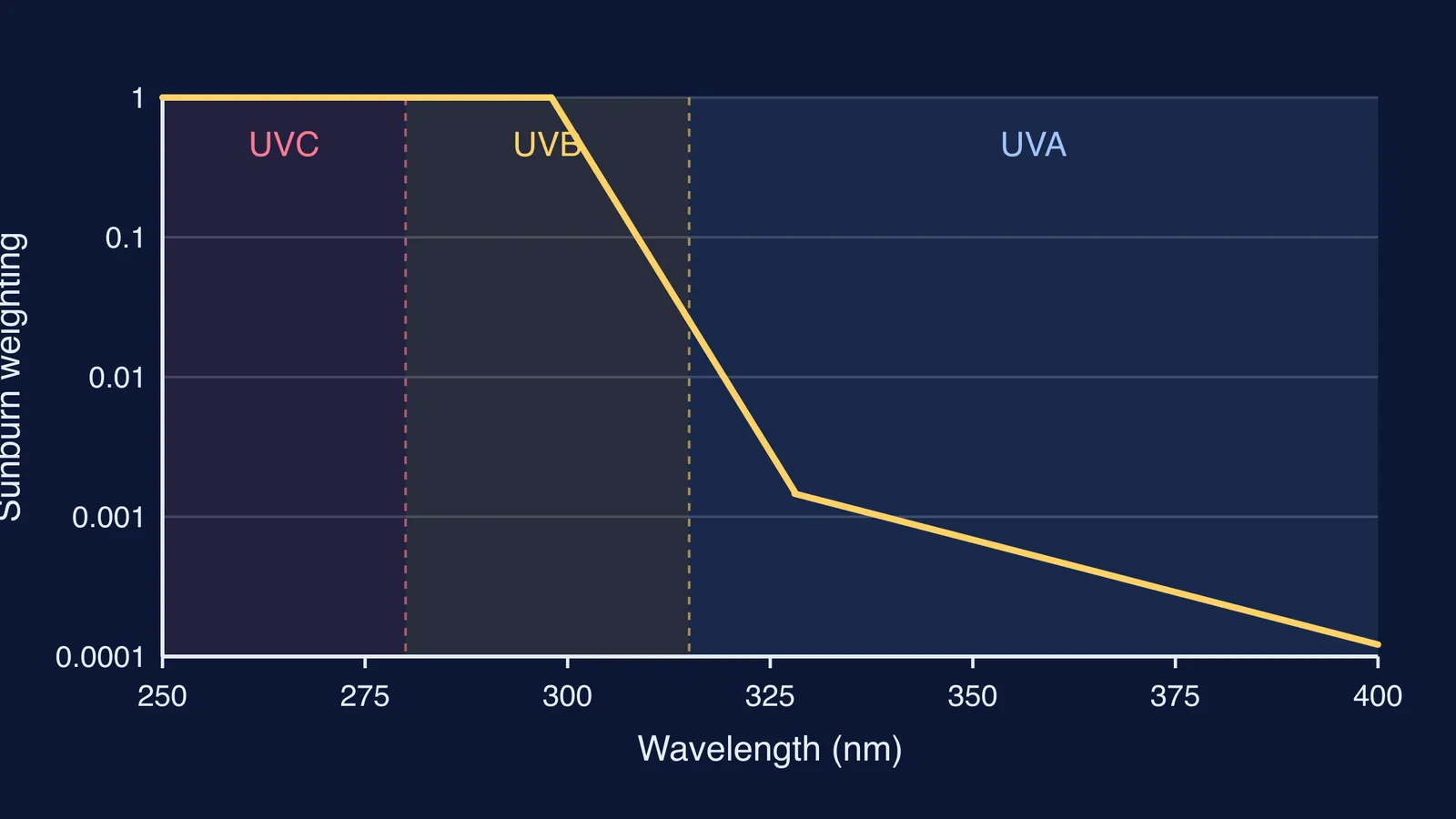
Ultraviolet lies just beyond violet light in the spectrum. The same WHO guide splits it into UVA (315–400 nm), UVB (280–315 nm) and UVC (100–280 nm). The atmosphere absorbs all UVC and about 90% of UVB. Our explainer on why the ozone layer matters for UV-B covers that filter in more detail.
The index is not raw brightness. Each wavelength is weighted by how well it reddens skin, using the CIE erythema action spectrum, and the total is multiplied by 40 m²/W (WHO guide, Annex C). So one point on the UV index equals 25 mW/m² of sunburn-weighted ultraviolet.
That weighting, listed by the World Ozone and Ultraviolet Radiation Data Centre, stays at 1 up to 298 nm and then falls by a factor of 10 for roughly every 10.6 nm, so by 328 nm it is about 660 times weaker. WHO notes that the UV reaching the ground is mostly UVA with a small UVB component, but each watt of UVB counts for far more in the index.
What do the UV index numbers mean?
The WHO guide groups the numbers into five categories:
1–2, low: you can safely stay outside.
3–5, moderate, and 6–7, high: seek shade during midday hours, and wear a shirt, sunscreen and a hat.
8–10, very high, and 11+, extreme: avoid being outside during midday hours; shirt, sunscreen and hat are a must.
WHO says that below 3 the risk is limited even for very fair skin. It recommends reporting at least the daily maximum, averaged over 30 minutes and rounded to a whole number, which is why your app may show one figure for the whole day. Darker skin burns less easily but, the guide notes, is still susceptible to UV damage, especially to the eyes and immune system. For what happens inside, see our guide to the structure of human skin: epidermis and dermis.
Why is the UV index highest at noon, even on hazy days?
The higher the sun, the higher the UV level. The WHO guide says the daily maximum falls in the four hours around solar noon, which arrives between local noon and 2 p.m. depending on where you are. Its diagram adds that 60% of the day's UV arrives between 10 a.m. and 2 p.m.
Haze and light cloud do less than you would think. The same guide says up to 80% of solar UV can get through light cloud, and that haze can even increase exposure. A year of measurements in Pune found that each unit increase in aerosol optical depth cut harmful UV-B by about 40–56%, yet model estimates for the site still put the UV index at 10.1 to 13.5 before the monsoon, 8.5 to 11 after it, and 7 to 10 in winter (Panicker et al., Geophysical Research Letters, 2009).
Height and surfaces matter too: WHO says UV rises 10–12% for every 1,000 m of altitude, and fresh snow can reflect up to 80% of it. For how forecasters build the numbers behind your app, read how IMD forecasts the weather.
How should you use the UV number before going out?
Say the app shows 12 on a pre-monsoon day in Pune.
Read the day's peak, not the current reading. 12 is in the extreme band.
Turn it into physics: 12 × 25 mW/m² = 300 mW/m² of sunburn-weighted UV, twelve times a UV index 1 day.
Check the clock. The US EPA's shadow rule helps: if your shadow is shorter than you, you are getting higher UV exposure, so seek shade.
Move what you can. The EPA advises extra care from late morning through mid-afternoon, so put football practice or the walk to tuition outside that window.
Cover up for what you cannot move: shade, clothing, a broad-brimmed hat, wrap-around sunglasses and broad-spectrum SPF 15+ sunscreen applied liberally and reapplied, as the WHO guide lists.
If the step from wavelength to weighting is hard to picture, the Fermi Simulation Lab has interactive simulations for ideas that are easier to see than to read. To revise the electromagnetic spectrum itself, the Fermi Concept Library gives every physics concept its own lesson.
Next time you check the weather, read the UV number first.