On this page
Water Resources is a short chapter, but it raises three big questions for the board paper: why water runs short, whether big dams are worth it, and how people harvest rain. It also supplies the dams for the map question. Here is the chapter, then how to turn it into marks.
Is Water Resources in the CBSE Class 10 syllabus for 2026-27?
Yes. The CBSE Class X Social Science curriculum for 2026-27 lists Water Resources as Geography Chapter 3, with no note limiting it to internal assessment, so it is examined in the board paper. Geography carries 17 marks plus 3 for map pointing in the 80-mark theory paper. CBSE's learning outcomes: examine why India needs to conserve water, and analyse how multipurpose projects help meet the demand for it.
The textbook is NCERT Contemporary India II, Chapter 3 (Reprint 2026-27). Everything below comes from it.
Why does India face water scarcity?
Water is renewable because it keeps moving through the hydrological cycle, NCERT explains. Scarcity, it says, is mostly caused by over-exploitation, excessive use and unequal access among social groups, not by low rainfall alone. The causes to expand in an answer:
Growing population: more water for homes and for growing food.
Irrigation: the largest consumer of water; private tube-wells can lower groundwater levels.
Industry: heavy water use, plus power that often comes from hydroelectricity.
Cities: housing societies pump their own groundwater and deplete it.
Pollution: domestic and industrial waste, chemicals, pesticides and fertilisers can make even plentiful water unsafe.
That last point catches students out: a region can have enough water and still face scarcity because it is polluted.
What are multipurpose river projects?
A dam is a barrier across flowing water that obstructs, directs or slows the flow, often creating a reservoir. Dams once served mainly irrigation; now one project may also generate electricity, supply homes and industry, control floods, aid inland navigation and fish breeding, and offer recreation. Combining these uses makes it a multipurpose project. NCERT's examples: Bhakra-Nangal (Sutlej-Beas basin) gives hydel power and irrigation; Hirakud (Mahanadi basin) combines water conservation with flood control.
Jawaharlal Nehru called dams the "temples of modern India", because he saw them linking farm and village development with fast industrial and urban growth, according to NCERT.
Why are big dams opposed?
NCERT lists the costs:
Altered river flow traps sediment in the reservoir, leaving rockier stream beds and poorer habitat for aquatic life.
Dams fragment rivers, blocking fish migration, especially for spawning.
Reservoirs submerge vegetation and soil, which decompose.
Floodplains lose silt, a natural fertiliser.
Sedimentation has triggered floods, and big dams often fail to control floods in very heavy rain.
Projects have been linked to induced earthquakes, water-borne diseases, pests and pollution.
Irrigation pushed farmers towards water-hungry commercial crops, causing soil salinisation.
The chapter's exercise also names large-scale displacement and loss of livelihood.
What is rainwater harvesting, and how is it done?
As opposition to multipurpose projects grew, many came to see rainwater harvesting as a practical alternative on social, economic and environmental grounds, NCERT notes. Know the examples by region:
Western Himalayas: guls or kuls, channels diverting water for farming.
Rajasthan (Bikaner, Phalodi, Barmer): rooftop water piped into underground tankas. The first rain washed the roof and pipes and was let go; later showers were stored as drinking water, called palar pani.
Rajasthan fields: khadins in Jaisalmer and johads elsewhere hold rain so it soaks into the soil.
Bengal floodplains: inundation channels to irrigate fields.
Shillong: nearly every household harvests rooftop water; the city faces acute shortage although Cherapunjee and Mawsynram, 55 km away, get the highest rainfall in the world.
Meghalaya: a 200-year-old bamboo drip irrigation system carries stream and spring water downhill in bamboo pipes, ending as drops near the plant's roots.
Tamil Nadu: the first state to make rooftop harvesting compulsory for all houses.
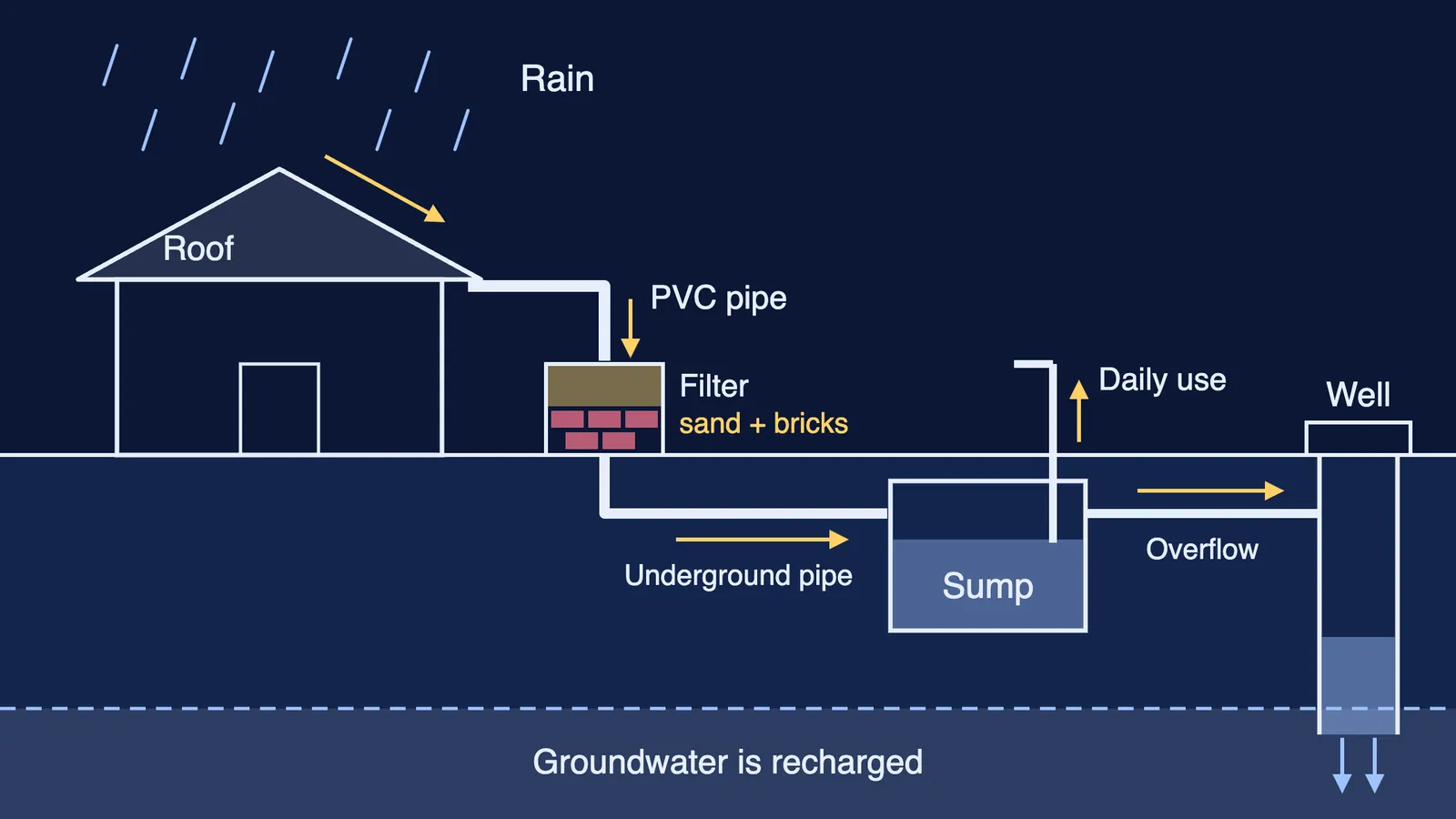
The diagram above follows NCERT's figure of a modern rooftop system: roof, PVC pipe, sand-and-brick filter, a sump for daily use, and overflow into a well that recharges groundwater. Our post on how a borewell draws on the water table shows why recharge matters.
How do you revise this chapter for the board exam?
A three-day plan:
Day 1: write the causes of scarcity and the uses and costs of dams from memory; check against NCERT.
Day 2: draw the rooftop flow from memory and match each traditional method to its region.
Day 3: mark the eight dams CBSE lists (Salal, Bhakra Nangal, Tehri, Rana Pratap Sagar, Sardar Sarovar, Hirakud, Nagarjuna Sagar, Tungabhadra) on a blank map, using our Class 10 geography map work plan, then answer the NCERT exercises within their word limits.
If you are not sure where to begin, Fermi's AI tutor can work out what you already know and build a plan for the session. Next, read our notes on Resources and Development Class 10.