

On this page
The water in a borewell is not an underground lake. It sits in the tiny gaps between grains of sand and in cracks in rock. Three ideas explain why one well keeps flowing and another goes dry: the water table, the two kinds of aquifer, and the balance between pumping and recharge.
How does a borewell work?
A borewell is a narrow hole drilled into an aquifer, a layer of rock or sediment whose pores and cracks are full of water and let it flow. Casing pipe lines the upper part so loose soil cannot collapse in; the lower part, inside the aquifer, is slotted or open so water can seep in. A pump lifts the water out.
Water rises in the pipe to a level set by the aquifer's energy. The US Geological Survey calls this hydraulic head, measured by the height to which a column of water will stand above a reference elevation, and groundwater always flows from higher head to lower head.
What is the water table?
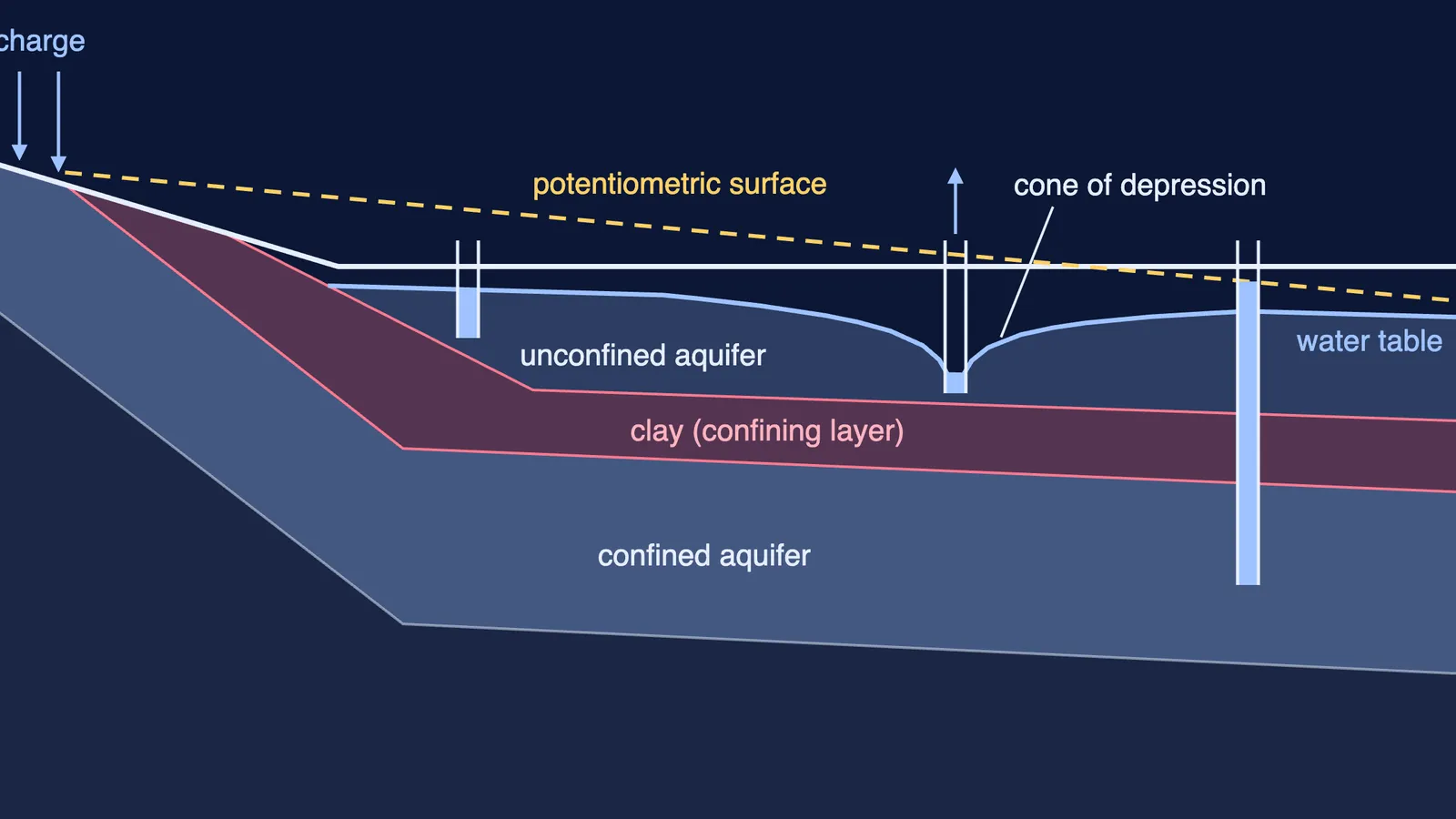
The water table is the top of the saturated zone, the ground whose pores and cracks are full of water, as defined in the USGS report on groundwater levels. A shallow well stands at the water table, so when the water table falls, the water in the well falls with it.
What is the difference between confined and unconfined aquifers?
An unconfined aquifer has no lid. Its water table rises and falls freely with recharge and discharge, according to the same USGS report.
A confined aquifer is sealed above by a layer much less permeable than itself, such as clay, so the water inside is under pressure. Drill a tightly cased borewell through that clay and the water often rises above the top of the aquifer. The level it reaches is called the potentiometric surface. Confined aquifers are also called artesian aquifers, and the USGS notes that many real aquifers sit somewhere between the two types.
Why do deep borewells need submersible pumps?
Here is a worked example. A pump at the surface works by suction: it lowers the pressure at the top of the pipe, and the atmosphere pushes water up. That push has a limit. Standard atmospheric pressure is 101,325 pascals, according to NIST. The tallest water column it can hold up is h = P/(ρg) = 101,325 / (1,000 × 9.8), which is about 10.3 m.
Real suction pumps manage less, because of pipe friction and because water boils at very low pressure. So once the water level sits deeper than a suction pump can reach, a pump at the top cannot pull it up. A submersible pump sits down the hole, below the water, and pushes instead; pushing has no 10-metre ceiling. For the power that lift takes, see our worked example on pump power for a rooftop tank, and for pressure ideas that are easier to see than to read, try the Fermi Simulation Lab.
Why do borewells run dry?
The USGS explains the rule: when pumping and other discharge take water out faster than recharge puts it back, the water stored in the aquifer becomes depleted and water levels fall. Pumping also creates a cone of depression, a funnel-shaped dip in the water table around the well. Where many wells pump close together, several cones form and can overlap, so a neighbour's new borewell can lower the water in yours. Building over open land also cuts recharge.
In India's 2025 national groundwater assessment, summarised on the government's Vikaspedia portal, the stage of groundwater extraction for the country was 60.63%. Annual extraction for all uses was about three-fifths of the water that can be extracted each year. Of 6,762 assessment units (blocks, taluks and mandals), 730 (10.80%) were classed as over-exploited, meaning extraction exceeds the annual replenishable recharge.
Rain helps only where it soaks in. A recharge pit or rooftop rainwater harvesting that feeds a borewell puts water back into the ground near the well.
Our borewell has gone dry: what should we check?
Before paying to drill deeper, work through these questions as a family:
Does the yield drop in dry months and return after the rains? Then the water table is following recharge, and the aquifer is behaving normally.
Does water come back after the motor rests? Then you are seeing the cone of depression, not an empty aquifer. Run the motor in shorter spells.
Has a new borewell been drilled nearby? Overlapping cones can lower your level; ask neighbours about staggering pumping times.
Has the pump been lowered year after year? That points to depletion, and drilling deeper chases the same falling level.
Is any rain going back in? A recharge structure near the well tackles the cause.
What category is your block? Your state groundwater department or the Central Ground Water Board can tell you.
If a borewell is abandoned, cap it securely: an open borehole is dangerous for small children.
Groundwater is also a career: read how to become a hydrologist in India. For the pressure and flow ideas underneath all this, the Fermi Concept Library has a lesson for every concept in physics, chemistry, biology, mathematics and computing.


