On this page
Textbooks list water's life-giving properties, but every item comes from one fact: a water molecule is polar, with a slightly negative oxygen end and slightly positive hydrogen ends, so neighbouring molecules hold each other by hydrogen bonds (OpenStax Biology 2e, section 2.2). Below, each property gets its cause, its biological example and the numbers you can use in an answer.
Why is water called a good solvent for life?
Because water is polar, ions and polar molecules readily dissolve in it (OpenStax Biology 2e). When you drop salt into water, NaCl separates into Na+ and Cl- ions, and water molecules gather around each ion in a sphere of hydration, with their negative ends facing Na+ and their positive ends facing Cl-.
The biological example is your own blood. Plasma is about 92 percent water (OpenStax Anatomy and Physiology 2e). Dissolved in it are sodium, potassium and calcium ions, gases such as oxygen and carbon dioxide, nutrients such as glucose and amino acids, and metabolic wastes.
What does water's high specific heat do for living things?
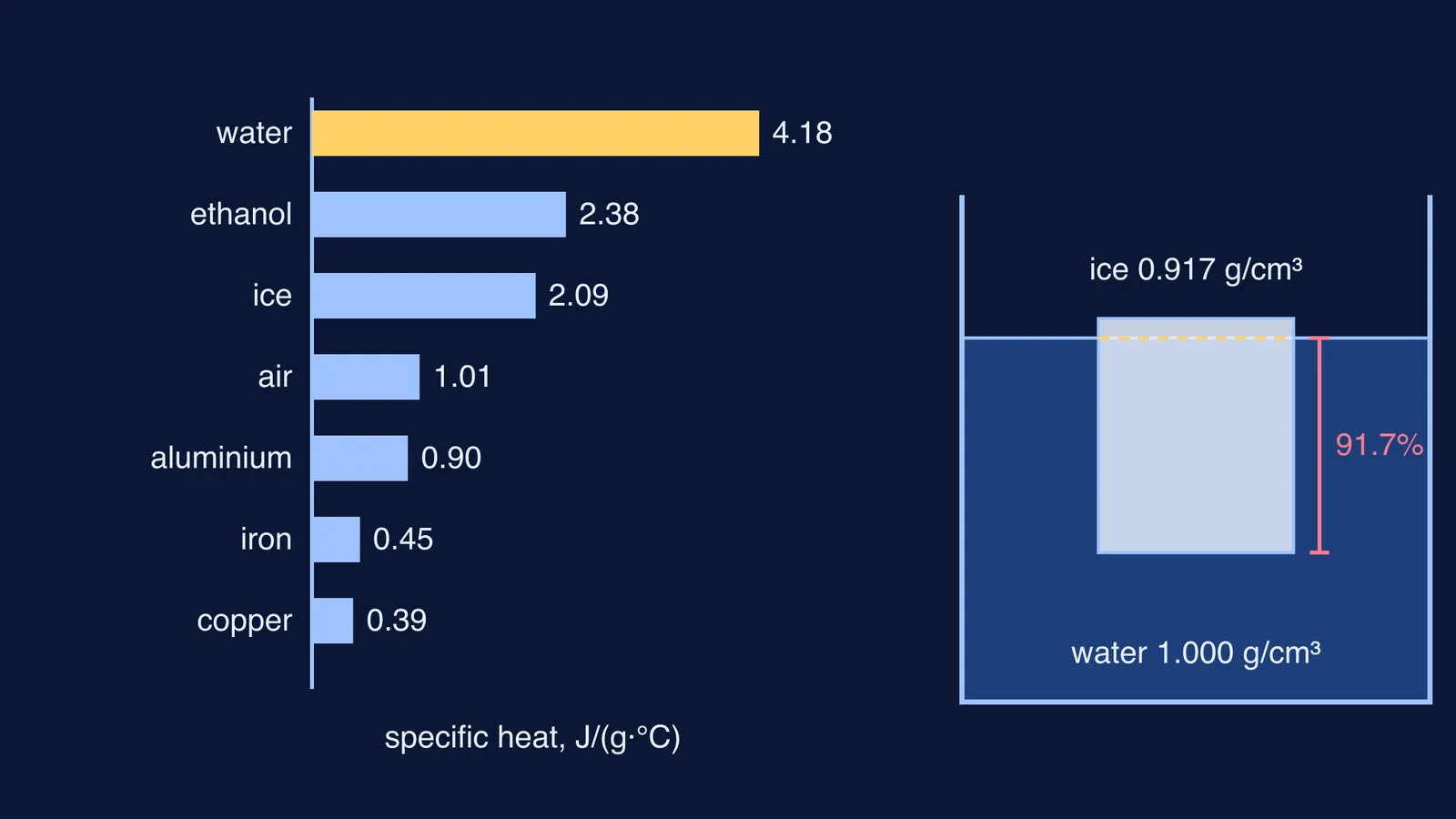
Specific heat is the heat one gram of a substance must absorb or lose to change its temperature by one degree Celsius (OpenStax Biology 2e). Liquid water's specific heat is 4.184 J/g °C, against 1.007 for air, 0.449 for iron and 0.385 for copper (OpenStax Chemistry 2e, table 5.1). The heat has to break hydrogen bonds before the molecules can move faster, so water warms and cools slowly.
In living things this works as a buffer. OpenStax describes warm-blooded animals using water to spread heat evenly through the body, much like a car's cooling system (OpenStax Biology 2e). The same section notes that sweat is 90 percent water, and its evaporation carries heat away from the skin.
How much faster does iron warm than water?
Give 100 g of water and 100 g of iron 1,000 J each, using the specific heats from the OpenStax table, and find the rise from Q = mcΔT.
Water: ΔT = 1000 / (100 × 4.184) = 2.4 °C.
Iron: ΔT = 1000 / (100 × 0.449) = 22.3 °C.
Ratio: 4.184 / 0.449 = 9.3, so the iron warms about nine times as much.
A body made mostly of water behaves like the first sample, not the second. To keep the two terms apart, read specific heat vs heat capacity.
How does cohesion help plants and insects?
Cohesion is water sticking to water, through the same hydrogen bonds; adhesion is water sticking to other surfaces. OpenStax explains that cohesive and adhesive forces move water from roots to leaves: molecules evaporating from the leaf stay connected to the molecules below and pull them along (OpenStax Biology 2e). The story of how this was worked out is in Dixon and Joly's cohesion-tension theory.
Cohesion at the surface shows up as surface tension. Insects such as the water strider use it to stay on the surface and even mate there, according to the same OpenStax section.
Why does ice float, and why does that matter for life?
When water freezes, hydrogen bonds lock the molecules into a lattice that holds them farther apart than in the liquid (OpenStax Biology 2e). Ice at 0 °C has a density of 0.917 g/cm³, while water at 4 °C has 1.000 g/cm³ (OpenStax College Physics 2e, table 11.1). Divide one by the other and you get roughly the share of a floating block that sits below the surface in fresh water: 0.917, or about 91.7 percent.
For a pond, that means ice forms on top, and OpenStax notes that this surface layer acts as an insulating barrier protecting the plants and animals below from freezing. The same expansion has a cost: ice forming inside living cells damages them. For the 4 °C part of the story, see why water expands on freezing and is densest at 4 °C.
How do you write this up in an exam?
Use the same three-part frame for each property: cause, property, biological example. The numbers come from the OpenStax Chemistry and OpenStax College Physics tables cited above.
Polar molecule, hydration shells: good solvent. Blood plasma carries ions, glucose and gases.
Hydrogen bonds absorb heat: high specific heat (4.184 J/g °C). Body temperature changes slowly.
Hydrogen bonds between water molecules: cohesion and surface tension. Water columns in xylem; water striders.
Open hydrogen-bond lattice: ice less dense (0.917 g/cm³) and floats. Pond life survives winter under the ice.
To self-check, cover everything after the cause and say the rest aloud. The line you stall on is the one to revise.
If the ΔT calculation is where you slip, the Fermi Problem Library has worked problems with a step-by-step solver that explains the reasoning rather than printing an answer. If the gap is hydrogen bonding itself, the Fermi Concept Library gives each concept in chemistry and biology its own lesson.
Next time you see ice in a glass, notice how little of it sits above the water line.