On this page
Water hyacinth is a floating plant from the Amazon basin with glossy leaves and lilac flowers, and a review in Freshwater Biology calls it one of the world's most invasive aquatic plants. In India you meet it in the NCERT Class 12 biodiversity chapter, which names water hyacinth, carrot grass and Lantana as alien species whose introduction caused environmental damage and threatened native species.
Why is water hyacinth called the terror of Bengal?
Because in the early 1900s it took over the waterways of the Bengal delta. Historian Iftekhar Iqbal of the University of Dhaka traced the story in a 2009 paper in Environment and History. One account he gives says a Scottish jute merchant, George Morgan, brought the plant to East Bengal around the turn of the twentieth century because he liked its flowers and leaves; another says it reached the Calcutta Botanic Garden from Brazil in the 1890s.
In 1936, a conservative estimate put the weed's cover at over 4,000 square miles, Iqbal reports, about a ninth of the 35,000 square miles of East Bengal's active delta. Cultivators in Mymensingh were reported to have given up cropping an area of about a hundred square miles. In 1946, crops and fish worth at least 10 million rupees were estimated to be lost to it every year.
The Water Hyacinth Act of 1936 barred householders from keeping or tolerating the plant on their land, and by 1947 the weed had come under control, according to Banglapedia. The nickname itself is folk usage: the plant is known anecdotally as the "terror of Bengal", and botanists now often place it in the genus Pontederia rather than Eichhornia.
How do its swollen leaf stalks keep it afloat?
Each leaf sits on a spongy petiole (leaf stalk) that can be up to 5 cm across and 30 to 50 cm long, according to the IUCN Global Invasive Species Database.
Inside, the petiole is mostly air: hexagonal air spaces separated by bands of cells one layer thick, a tissue called aerenchyma (Mahmood and colleagues, 2005). The same study notes that oxygen made in photosynthesis is apparently stored in these spaces and reused in respiration.
The physics is Archimedes: a body floats when its average density is less than that of water. Air-filled stalks pull the plant's average density below water's, so it rides on the surface with its leaves in full sun. Our guide to how hydrophytes survive compares this with other water plants.
How does a mat block sunlight and oxygen?
A dense mat is a roof. The IUCN database says water hyacinth mats reduce dissolved oxygen levels and light, and that low oxygen harms native fish. The Freshwater Biology review describes one route: less light means less phytoplankton, and less phytoplankton can mean lower dissolved oxygen and fewer plankton-eating fish.
One nuance from the review: the tangle of roots and leaves can shelter more small invertebrates. The damage comes when the mat covers everything. If you have read how fertiliser runoff triggers algal blooms, the pattern is familiar: too much growth at the surface starves the water below.
Why does water hyacinth spread so fast?
It mostly clones itself. The plant sends out runners (stolons) that grow into daughter plants, and it also sets seed: up to 450 seeds per capsule, and long-lived, says the IUCN database. The same source gives the key number: water hyacinth can double its biomass every 6 to 18 days, depending on place and season. For the wider pattern, see why invasive alien species win in India.
How fast could it cover a village pond?
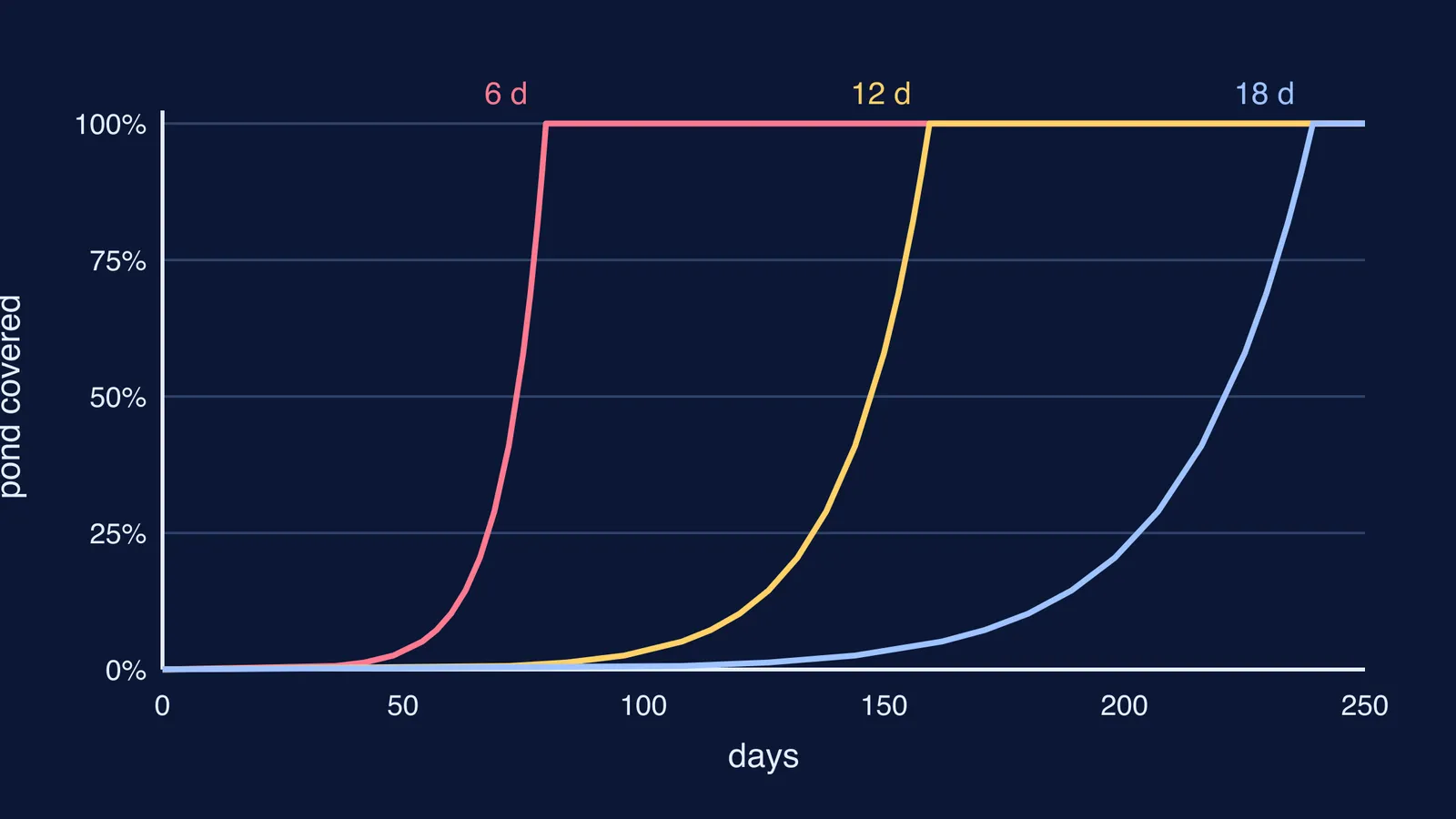
Take a pond of 1 hectare (10,000 square metres) and a 1 square metre clump that doubles every 12 days, the middle of the IUCN range. The pond and clump sizes are illustrative.
Doublings to cover the pond: 2^n = 10,000, so n = log2(10,000), about 13.3.
Time to full cover: 13.3 x 12, about 160 days.
On day 100 the mat is 2^(100/12), about 322 square metres, or 3% of the pond. It looks harmless.
Half cover arrives around day 148, just one doubling before the end.
The chart at the top runs the same sum for 6, 12 and 18-day doublings. Real growth varies with place and season, so treat this as a sketch, not a forecast. To practise log-and-exponent problems like this step by step, the Fermi Problem Library has a solver that explains the reasoning rather than printing an answer.
How do you answer this in an exam?
Use four points:
Name: water hyacinth (Eichhornia crassipes), a free-floating plant reportedly brought to Bengal for its flowers.
Spread: fast vegetative propagation by runners that form daughter plants, plus seeds.
Damage: mats block light and lower dissolved oxygen, harming fish, and choke rivers and fields.
Context: an alien species invasion, listed in NCERT alongside carrot grass and Lantana.
If aerenchyma or eutrophication feels shaky, look it up in the Fermi Concept Library, where every concept has its own lesson and its place in the map.