On this page
If a question asks which metal is present in vitamin B12, the answer is cobalt. It is a standard fact from the Class 12 chapter on coordination compounds, and the reason behind it is worth knowing too. B12 is a coordination compound, built on the same idea as the complexes in that chapter, and it belongs to a small family of biological molecules that hold a metal at the centre of a ring.
Which metal is present in vitamin B12?
Cobalt. The NCERT Class 12 chapter on coordination compounds states that vitamin B12, cyanocobalamine, the anti-pernicious anaemia factor, is a coordination compound of cobalt (NCERT Chemistry Part I, Coordination Compounds). The same paragraph names two molecules to learn alongside it: chlorophyll, the pigment of photosynthesis, is a coordination compound of magnesium, and haemoglobin, the oxygen carrier in blood, is a coordination compound of iron.
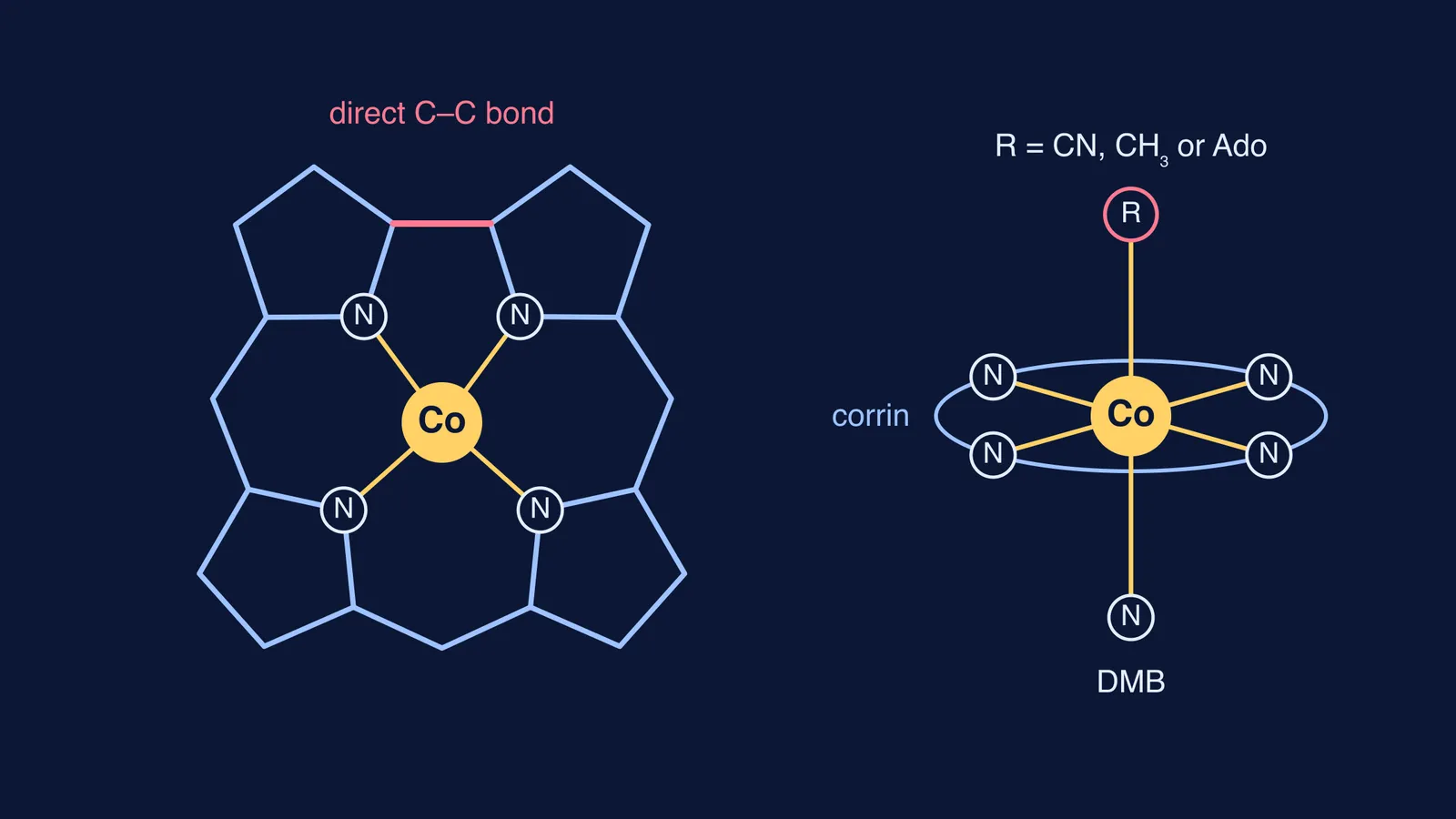
The cobalt in B12 is a low-spin Co3+ ion held by the four nitrogens of a large ring, according to a 2012 study in Inorganic Chemistry (Reig, Conrad and Brunold, 2012). That paper adds that in cobalamins the lower axial site is taken by a dimethylbenzimidazole (DMB) base, and that ligands such as CN−, H2O, CH3− and 5′-deoxyadenosyl can bind at the upper axial site.
The structure was solved by X-ray crystallography. Dorothy Crowfoot Hodgkin and colleagues published "Structure of Vitamin B12" in Nature in 1956 (Hodgkin et al., 1956). Hodgkin received the 1964 Nobel Prize in Chemistry "for her determinations by X-ray techniques of the structures of important biochemical substances" (Nobel Prize in Chemistry 1964).
What is a corrin ring?
A corrin ring is the large ring that holds the cobalt in B12: four nitrogens from it bind the metal at the equator, as a 2009 crystal-structure paper describes (Hannibal et al., 2009). It is built from four pyrrole-type units, like the ring in haem, but with one important change.
In corrin, one of the bridging (meso) carbon atoms that join the units has been removed, which leaves a macrocycle "both contracted and lop-sided" compared with the ring frameworks of heme and chlorophylls (Osman et al., 2021). With that bridge gone, two of the units join directly, which is the pink bond in the diagram above.
The same review notes that making B12 has stayed a prokaryotic job, never taken up by plants or animals, and that people get it from food, generally dairy and meat. It also notes that people on vegetarian, and especially vegan, diets are prone to B12 deficiency.
How is vitamin B12 like haemoglobin and chlorophyll?
NCERT groups all three as coordination compounds of importance in biological systems. Each also holds its metal at the centre of a tetrapyrrole-derived ring: corrin in B12, haem in haemoglobin, and the chlorophyll ring. Learn them as three pairs:
Vitamin B12: cobalt, held in a corrin ring
Haemoglobin: iron, carries oxygen in blood
Chlorophyll: magnesium, absorbs light for photosynthesis
The chlorophyll story has its own history; our piece on how Richard Willstätter found magnesium at the heart of chlorophyll tells it.
How do you find the coordination number of cobalt in B12?
Count the donor atoms bonded directly to the metal, using the structure described above. For cyanocobalamin:
The corrin ring gives four nitrogen atoms, around the equator.
The DMB base gives one nitrogen atom, below the ring.
The cyanide group gives one donor atom, above the ring.
Total: 4 + 1 + 1 = 6, so the coordination number is 6 and the arrangement around cobalt is roughly octahedral.
The oxidation state is +3, as the 2012 paper above states. If you want to practise the general method on simpler ions first, our guide on finding oxidation state and coordination number in a complex walks through it, and why Co2+ is easily oxidised to Co3+ in the presence of ligands explains why cobalt so often turns up as Co3+ in complexes.
What should you write in the exam?
NCERT Exercise 5.27 asks you to discuss briefly, with an example, the role of coordination compounds in biological systems (NCERT). A short answer can follow this script:
Say what they do: coordination compounds are of great importance in biological systems.
Give the three examples with their metals: chlorophyll (magnesium), haemoglobin (iron), vitamin B12 (cobalt).
Add one function each: photosynthesis, oxygen transport, the anti-pernicious anaemia factor.
If you have room, name the enzymes NCERT mentions: carboxypeptidase A and carbonic anhydrase.
If terms like ligand, donor atom or coordination number still feel loose, the Fermi Concept Library gives every concept in chemistry and biology its own lesson and its place in the map, so you can see how coordination compounds connect to the biology. For practice, the Fermi Problem Library has worked problems with a step-by-step solver that explains the reasoning rather than printing an answer.