

On this page
"Co²⁺ is easily oxidised to Co³⁺ in the presence of ligands" is a common "give reason" question. Weigh two energies: removing a third electron costs a lot, and a strong ligand field gives a lot back.
Why is Co²⁺ stable in water but not with ammonia?
Start with what the electrode potentials say. Table 4.2 of the NCERT Class 12 chapter on d- and f-block elements gives E°(Co³⁺/Co²⁺) = +1.97 V. The same chapter says Mn³⁺ and Co³⁺ are the strongest oxidising agents in aqueous solution. So in plain water, cobalt stays as Co²⁺.
Now swap water for ammonia. The standard reduction potential table in Harvey's Analytical Chemistry 2.1/16:_Appendix/16.13:_Standard_Reduction_Potentials) lists [Co(NH₃)₆]³⁺ + e⁻ → [Co(NH₃)₆]²⁺ at E° = 0.1 V. The same table gives oxygen in basic solution, O₂ + 2H₂O + 4e⁻ → 4OH⁻, at 0.401 V. Oxygen's potential is now the higher one, so dissolved air can oxidise the cobalt(II) ammine complex.
How does CFSE pay for the third ionisation enthalpy?
The cost is real. In Table 4.2 of the NCERT d- and f-block chapter, cobalt's third ionisation enthalpy is 3243 kJ/mol, compared with 1644 kJ/mol for the second. Going from Co²⁺ (3d⁷) to Co³⁺ (3d⁶) means paying that bill.
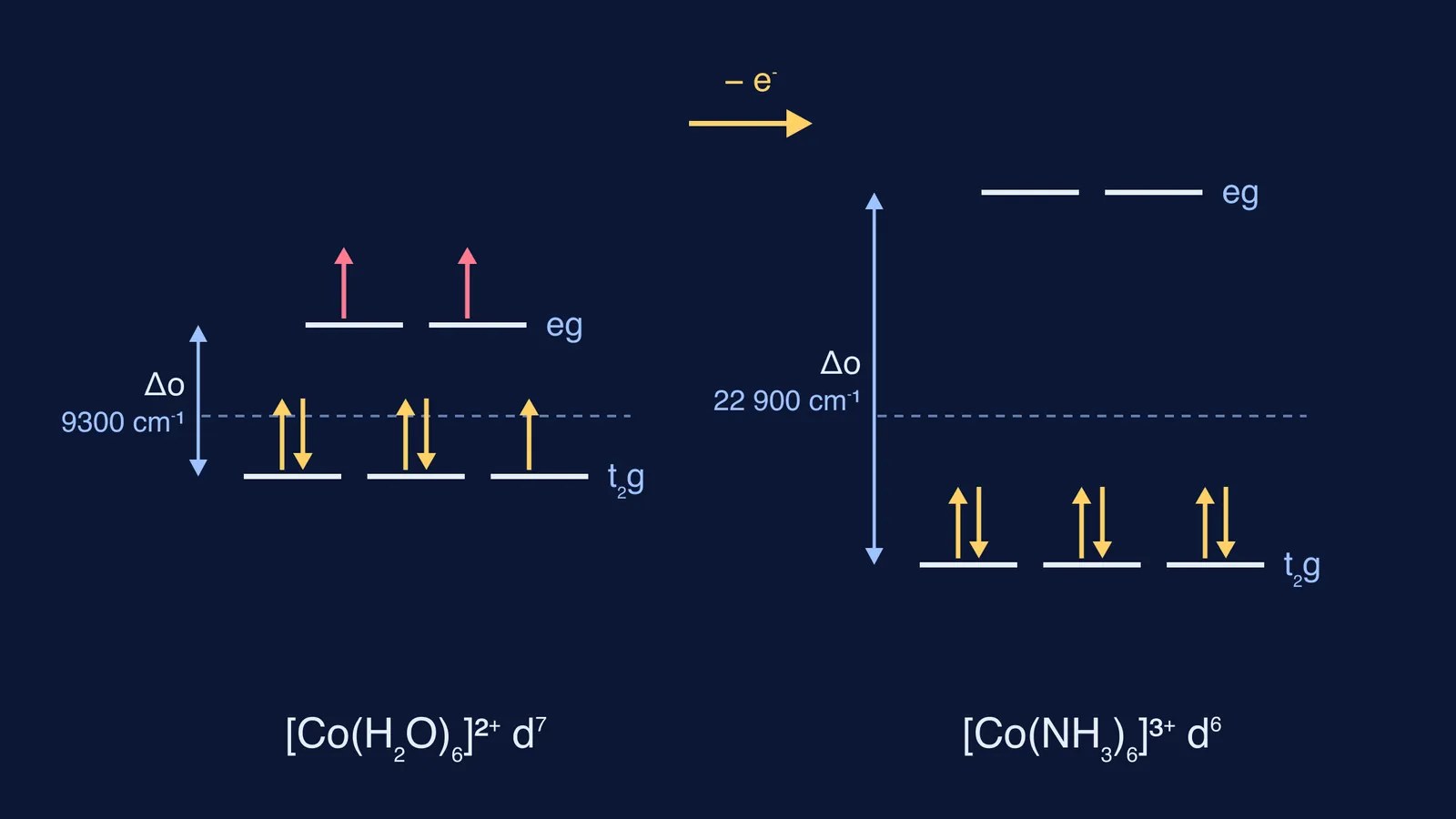
The payback comes from crystal field theory. The NCERT coordination compounds chapter explains that in an octahedral field the eg orbitals rise by 3/5Δo and the t2g orbitals fall by 2/5Δo. When Δo is larger than the pairing energy P, electrons pair up in t2g and the complex is low spin. Ammonia sits well up the spectrochemical series in that chapter (I⁻ < Br⁻ < ... < H₂O < ... < NH₃ < en < CN⁻ < CO).
Two facts make Co³⁺ the winner:
A 3+ ion feels a much bigger split. The LibreTexts crystal field theory chapter/22:_The_d-Block_Elements/22.05:_Crystal_Field_Theory) notes that Δo for a tripositive ion is typically about 50% greater than for the dipositive ion of the same metal.
Six d electrons fill t2g exactly. The same chapter lists Δo = 9300 cm⁻¹ for [Co(H₂O)₆]²⁺ and 22,900 cm⁻¹ for [Co(NH₃)₆]³⁺. It also notes that low-spin d⁶ complexes have the highest CFSE, which accounts in part for the very large number of known Co(III) complexes.
For a refresher, see our guide to deciding between high spin and low spin.
Worked example: putting numbers on it
Configurations. Co²⁺ is 3d⁷ and Co³⁺ is 3d⁶ (NCERT Table 4.2).
Co²⁺, high spin: t2g⁵eg². CFSE = 5(−0.4Δo) + 2(+0.6Δo) = −0.8Δo.
Co³⁺ with a strong-field ligand, low spin: t2g⁶eg⁰. CFSE = 6(−0.4Δo) = −2.4Δo, minus a pairing cost.
Scale for charge. Using the LibreTexts rule of thumb/22:_The_d-Block_Elements/22.05:_Crystal_Field_Theory) that Δo is about 50% larger for the 3+ ion, −2.4 × 1.5 ≈ −3.6 in units of the Co²⁺ Δo, against −0.8 before oxidation. Ignoring the pairing cost, that is a rough gain of about four and a half times.
Check against real energies. Using ΔG° = −nFE° with the Faraday constant from NIST (96,485 C/mol), reducing aqueous Co³⁺ releases about 190 kJ/mol (1.97 V), while reducing [Co(NH₃)₆]³⁺ releases only about 9.6 kJ/mol (0.1 V). Ammonia makes the +3 state about 180 kJ/mol more stable relative to +2.
CFSE is not the whole story. The same LibreTexts table gives Δo = 27,000 cm⁻¹ for [Co(H₂O)₆]³⁺, so aqueous Co³⁺ is low spin too, yet it is still a strong oxidant. The 180 kJ/mol in step 5 measures how much more strongly ammonia binds Co³⁺ than Co²⁺, and the t2g⁶ stabilisation is one part of that. To practise step 2, see how to calculate CFSE for octahedral and tetrahedral complexes.
How do you write this in a board or JEE answer?
A three-point model answer:
Co²⁺ is 3d⁷; Co³⁺ is 3d⁶.
In the presence of strong-field ligands such as NH₃ or CN⁻, Δo > P, so Co³⁺ forms a low-spin t2g⁶eg⁰ complex with CFSE = −2.4Δo, and Δo is larger for the higher charge.
This crystal field stabilisation outweighs the extra third ionisation enthalpy, so Co²⁺ is easily oxidised to Co³⁺ in complexes. Air can oxidise [Co(NH₃)₆]²⁺ to [Co(NH₃)₆]³⁺.
Common slips to check for:
Writing Co²⁺ as 3d⁵4s² instead of 3d⁷.
Calling Co³⁺ "more stable" in general. In water it is a strong oxidant.
Skipping the cost side: name the ionisation enthalpy, then what outweighs it.
Leaving out "low spin".
If the jump in ionisation enthalpy itself confuses you, read why the ionisation enthalpy trend in the 3d series is irregular. For more "give reason" questions, the Fermi Problem Library has worked problems with a step-by-step solver that explains the reasoning rather than printing an answer. If crystal field splitting itself feels shaky, the Fermi Concept Library gives each concept in chemistry its own lesson.


