On this page
Snap a green leaf and the colour comes from a molecule with a single metal atom at its centre. That metal is magnesium, and the chemist who proved it was Richard Willstätter. He also showed that the green pigment is really two pigments. Here is what he found, how, and a short calculation that lets you check his key number with a pencil.
Who was Richard Willstätter?
Willstätter was born in Karlsruhe, Germany, in 1872 and studied chemistry in Munich under Adolf von Baeyer, according to his Nobel Prize biography. He took a professorship in Zurich in 1905, then moved in 1912 to a new institute in Berlin-Dahlem, where his team rounded off the chlorophyll research.
The 1915 Nobel Prize in Chemistry went to him alone, "for his researches on plant pigments, especially chlorophyll". He then succeeded Baeyer in Munich. In 1924 he retired from that post as a gesture against rising antisemitism, and in 1938 he fled the Gestapo to Switzerland.
How did Willstätter show chlorophyll contains magnesium?
Chlorophyll is hard to purify: it changes easily and sits among yellow pigments and many colourless substances. So Willstätter first studied what it breaks down into, as he explained in his Nobel lecture of 3 June 1920.
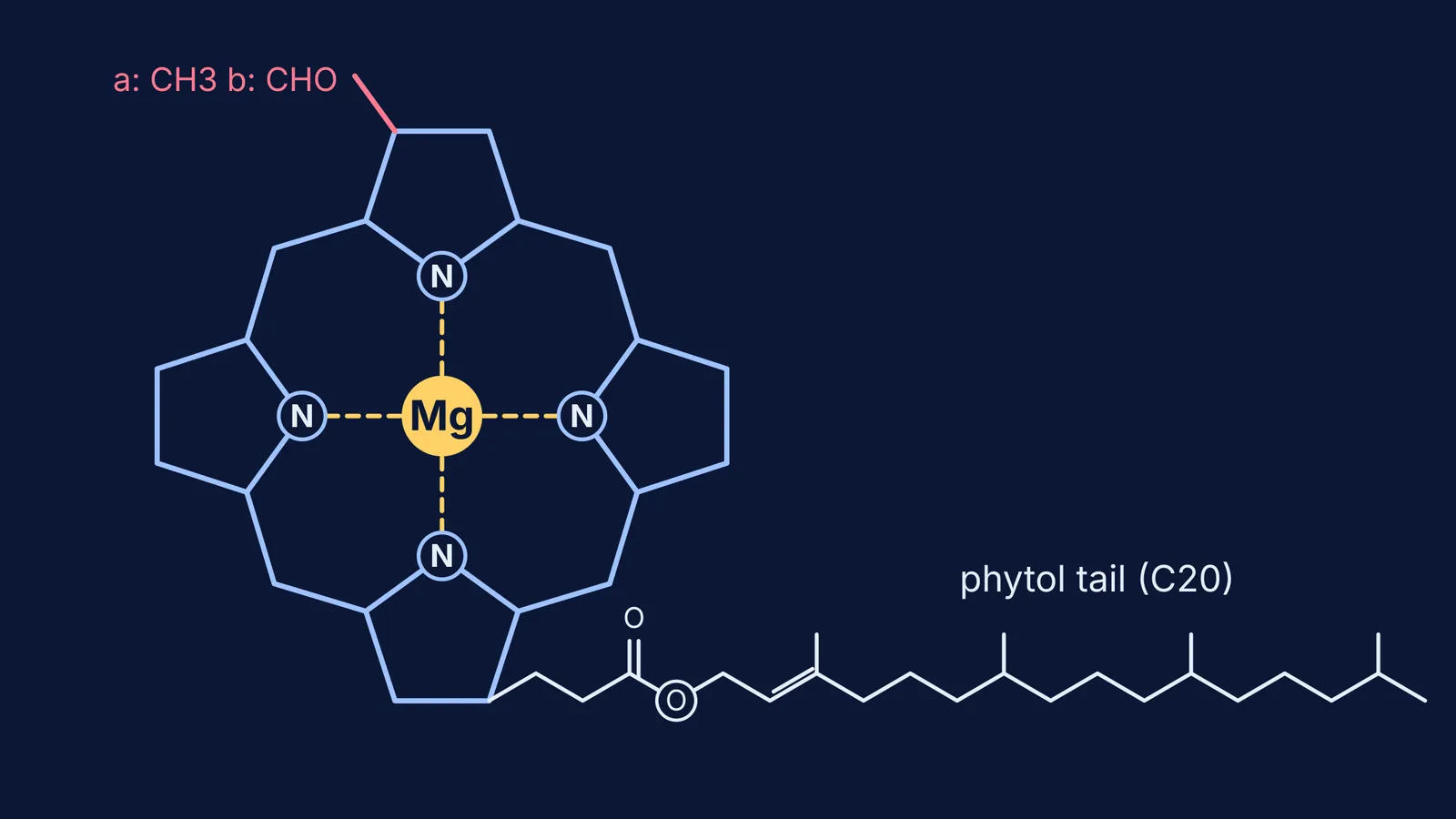
With alkali, chlorophyll gave green acids, the chlorophyllins. Analysis showed they are magnesium compounds, holding the metal tightly, "as haemoglobin contains iron", bound to nitrogen.
With mild acid, the colour turned olive and the product, phaeophytin, left no ash: the metal was gone. The magnesium group is sensitive to acid but stable in alkali.
Counting atoms, the magnesium-containing breakdown products called phyllins all had one atom of magnesium to four atoms of nitrogen, a group he called "the essential feature of chlorophyll".
He also found a long alcohol, phytol (C20H39OH), attached as an ester and forming about a third of the molecule. He wrote: "The magnesium content of the chlorophyll is constant, close to 3%." When he compared preparations from more than 200 plants, the magnesium and phytol content were among his tests that it was the same pigment.
How did he separate chlorophyll a and b?
He purified chlorophyll by shaking extracts between solvents that do not mix, such as petroleum ether and watery alcohol. But even the pure pigment behaved like a mixture. As the physicist Stokes had noticed in 1864, it has two components that differ in colour and split unequally between methyl alcohol and petroleum ether, the lecture records. Repeating that split many times gave both pure:
Chlorophyll a is blue-green, C55H72O5N4Mg.
Chlorophyll b is yellow-green, C55H70O6N4Mg.
Leaves hold almost three molecules of a for every one of b.
Notice that b is a with two hydrogens swapped for one oxygen. Modern structures show exactly that: the two differ only at carbon 7, a methyl group (CH3) in chlorophyll a and a formyl group (CHO) in b (Merchant and Sawaya, The Plant Cell, 2005).
His method was solvent partition, not a column. For the column route, read how Mikhail Tsvet ran the first chromatography of leaf pigments, or separate spinach pigments yourself.
Can you check his 3% figure yourself?
Yes, with his formulas and the standard atomic weights from CIAAW: C 12.011, H 1.008, N 14.007, O 15.999, Mg 24.305.
Chlorophyll a: 660.605 + 72.576 + 79.995 + 56.028 + 24.305 = 893.51 g/mol.
Magnesium share: 24.305 ÷ 893.51 = 2.72%.
Chlorophyll b is 907.49 g/mol, so its share is 2.68%.
A leaf mix of 3 a to 1 b: 4 × 24.305 ÷ (3 × 893.51 + 907.49) = 2.71%. "Close to 3%" holds.
Bonus: free phytol, C20H40O, is 296.54 g/mol, 33% of chlorophyll a. That is his "third".
Testing a published number against its formula takes five lines, and it is a useful exam habit too.
What came after Willstätter?
Much of the ring structure was worked out later by Hans Fischer, who won the 1930 Nobel Prize in Chemistry "for his researches into the constitution of haemin and chlorophyll and especially for his synthesis of haemin". Chlorophyll's yellow partners have their own story: what carotenoids do in photosynthesis.
If ring compounds and metal-nitrogen bonds feel shaky, the Fermi Concept Library covers every concept in chemistry and biology, each with its own lesson. For percentage-composition practice like the one above, the Fermi Problem Library has worked problems with a step-by-step solver that explains the reasoning rather than printing an answer.
Next time you pick a leaf, remember the sum you just did: a mole of chlorophyll a weighs about 894 grams, and only about 24 of those grams are magnesium.