On this page
Walk into a thick forest and the sunlight you felt in the open is mostly gone, caught by leaves stacked above you. That stacking has a name in your Class 12 textbook, and it is worth knowing for short-answer questions.
What is vertical stratification in a forest ecosystem?
NCERT's Class 12 Biology textbook, in Chapter 12 (Ecosystem), defines it in one sentence: "Vertical distribution of different species occupying different levels is called stratification" (NCERT, Ecosystem chapter). The same paragraph gives the example you are expected to reproduce: trees occupy the top vertical stratum of a forest, shrubs the second, and herbs and grasses the bottom layers. NCERT places it under ecosystem structure, so it is about how a community is arranged in space, not who eats whom.
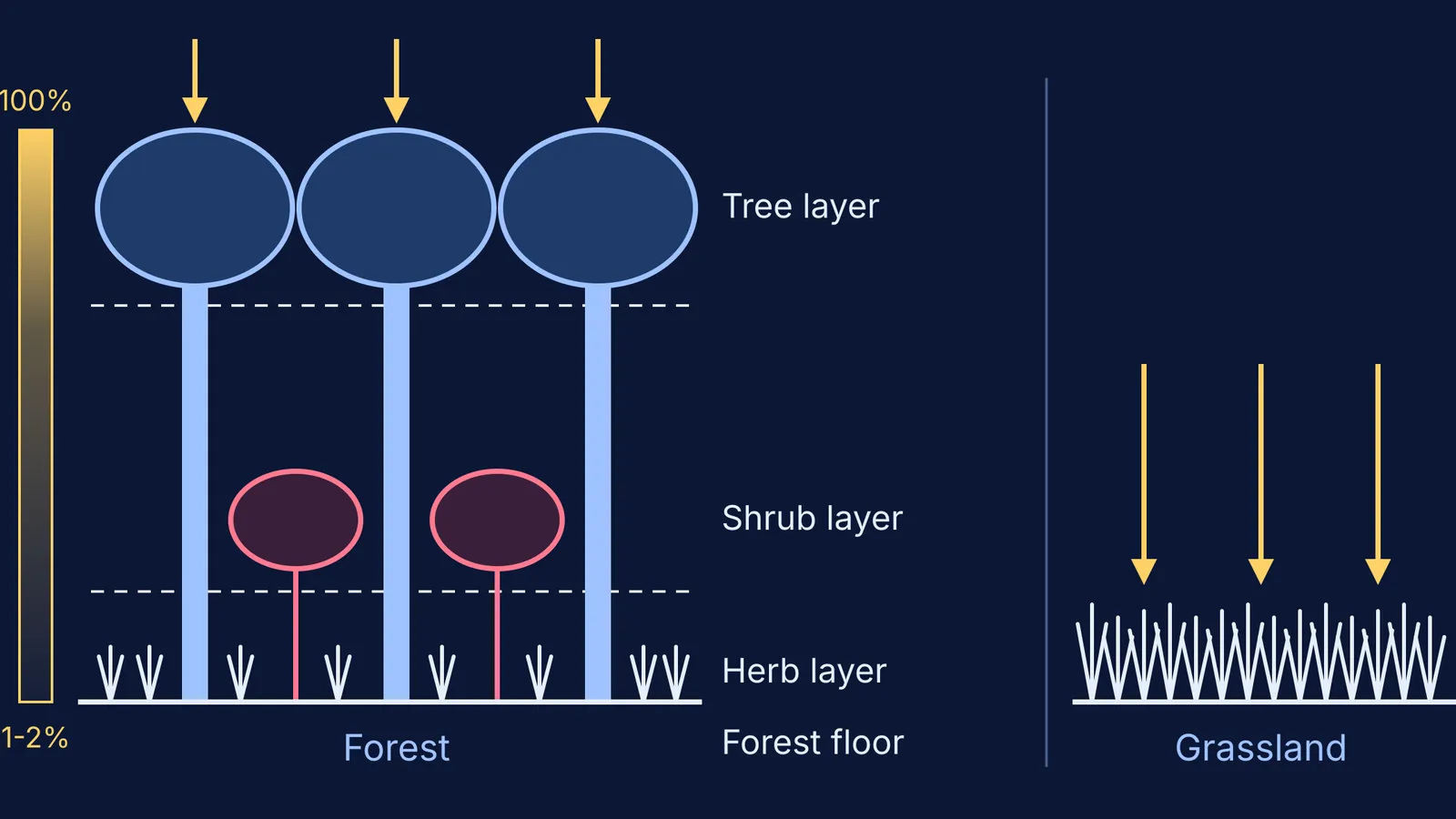
From top to bottom, the layers are:
Tree layer (canopy): the crowns of tall trees, which catch sunlight first.
Shrub layer: woody plants shorter than trees, living in the light that filters through gaps.
Herb layer: herbs, grasses, ferns and tree seedlings close to the ground.
Forest floor: leaf litter, fungi and decomposers. It is not one of NCERT's plant layers, but it belongs on your diagram.
Why does light decide which plant grows in which layer?
Light is the energy every layer runs on, and each layer of leaves absorbs some of it before it reaches the plants below. A 2017 study in the journal Ecosphere measured how light changes with height inside Atlantic forest in south-east Brazil. Its introduction, citing earlier field studies, notes that the share of light reaching the forest floor in tropical forests is typically low, about 1-2% (Fauset et al., Ecosphere 2017). The study also found that in some cases the upper canopy layer, or heavy cover of climbing lianas, can severely limit how far light gets down.
That gradient sorts the plants. Trees invest years in height to win the light at the top. Shrubs and herbs below cannot outgrow them, so the ones that survive are those that can photosynthesise on a small fraction of full sun. That is why shade plants have a low light compensation point, and why even a single tree can grow different sun and shade leaves.
If light compensation point or photosynthesis is the shaky link here, the Fermi Concept Library covers every concept in biology, each with its own lesson and its place in the map, so you can see how this topic connects to the ones it depends on.
How is a forest different from a grassland?
In a grassland the tallest plants are grasses and herbs, so the vertical structure is short and simple. Compare:
Tallest plants: trees in a forest; grasses and herbs in a grassland.
Number of plant layers: several in a forest; essentially one herb layer in a grassland.
Light near the ground: in a forest, only a small fraction reaches the floor; in a grassland, the only shade at ground level comes from the grass itself.
Light still matters in a grassland. In an experiment published in Science, researchers added light to the understory of experimental grassland communities given extra nutrients, and their results supported the idea that competition for light is the main reason plant diversity falls after fertilisation (Hautier, Niklaus and Hector, Science 2009).
For the grassland food chain and components, see our grassland ecosystem guide.
How do you draw a labelled stratification diagram?
The image at the top of this post is the version to copy. Build it in this order:
Draw a long ground line and three arrows coming down from the sun.
Draw three tall trunks with large crowns filling the top third.
Draw two rounded shrubs in the middle third, between the trunks.
Draw small grass tufts and herbs along the ground.
Add dashed lines between the bands and label them on the right: Tree layer, Shrub layer, Herb layer, Forest floor.
On the left, draw a strip that is bright at the top and dark at the bottom, to show light decreasing towards the floor.
Beside it, draw a grassland with one layer of tufts, so the contrast shows at a glance.
Worked example: is a grassland unstratified?
Question: "Stratification is absent in grassland. Comment."
Define: stratification is the vertical distribution of different species at different levels (NCERT).
Compare: a forest has distinct tree, shrub and herb layers because light falls sharply from canopy to floor; a grassland lacks trees and shrubs, so it has essentially one herb layer.
Conclude: stratification is poorly developed in grassland rather than strictly absent, because grasses of different heights still shade shorter plants and compete for light.
When you are ready to see the animals that live in each band, read our post on forest layers from canopy to floor.