

On this page
Walk from a sunny road into a tall evergreen forest and the light drops within a few steps. That change is the whole story of forest layers: the plants are stacked by height, each layer gets a different share of sunlight, and the animals sort themselves to match.
What are the layers of a forest?
The NCERT Class 12 Biology chapter on ecosystems gives the exam definition: "Vertical distribution of different species occupying different levels is called stratification" (NCERT Ecosystem chapter text). The same passage says trees occupy the top layer, shrubs the second, and herbs and grasses the bottom.
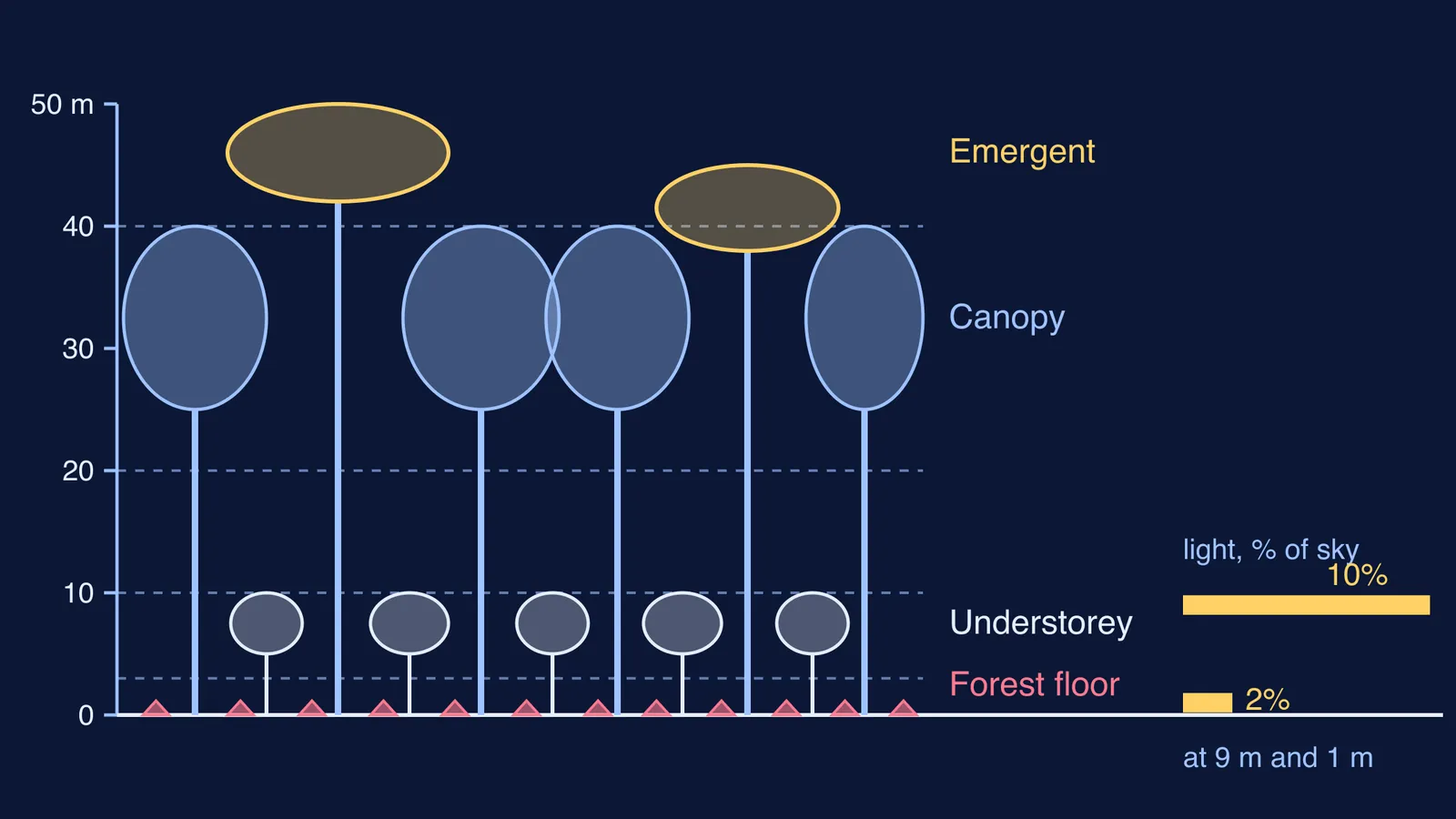
Rainforest guides split this into four named layers. The NSW National Parks rainforest layers fact sheet gives these heights for Sea Acres, a rainforest in New South Wales, Australia:
Emergent layer (up to 50 m): tall, straight trees that rise above the general canopy and branch at the top, where their leaves get plenty of sun.
Canopy (20 to 40 m): interwoven crowns that keep the forest moist and cool and shield it from dry winds and sudden temperature changes.
Understorey (3 to 10 m): trees held back by the shade of the canopy, plus epiphytes such as ferns that grow on other trees without being parasites.
Forest floor: ground ferns, herbs, seedlings, mosses and fungi, all shade tolerant.
Heights vary between forests. In the tropics, Mongabay's guide to rainforest structure notes that some emergents exceed 65 m and lists a separate shrub layer below the understorey.
Which animals live in the canopy, understorey and forest floor?
The Rainforest Alliance's lesson on rainforest layers pairs each layer with typical animals:
Emergent: the highest, sunniest layer, where eagles soar.
Canopy: leafy branches where monkeys and birds thrive.
Understorey: shady and full of shrubs and vines, home to frogs and insects.
Forest floor: dark and damp, with animals such as jaguars and anacondas.
Much of the life is up high: an estimated 50 to 90 percent of rainforest life exists in the trees, above the shaded floor, according to Mongabay.
India has its own canopy specialist. The lion-tailed macaque is found only in the evergreen forests of the Western Ghats and is highly arboreal, depending on complex rainforest canopies to move and feed, as Down To Earth reports. If you want to know why the Ghats matter so much, read our piece on Madhav Gadgil and the science of saving the Western Ghats.
How much light reaches the forest floor?
Very little, and it depends on the forest. In lowland rainforests in Costa Rica, mean diffuse light rose from 2% of open-sky light at 1 m above the ground to over 10% at 9 m (Montgomery and Chazdon, Ecology, 2001). By contrast, the NSW fact sheet says only about 20 percent of sunlight gets through the canopy to the forest floor.
How does layering reduce competition for light?
Picture sunlight as a resource used up on its way down. If every plant needed full sun, all would fight for the same top slice. A layered forest shares the light out instead: each layer is made of plants built to live on what the layers above leave over.
The NSW fact sheet lists how plants manage this:
Many tree saplings stay small for years, waiting for a gap in the canopy.
Strangler figs germinate high in the fork of a tree and send roots down, so they start life near the light.
Vines climb fast and put most of their leaves and flowers in the canopy.
Cunjevoi grows very large leaves to catch short bursts of sun through canopy gaps.
Mosses, lichens and ferns photosynthesise in low light.
Research suggests that even deep shade can be divided up. Montgomery and Chazdon grew seedlings of three canopy tree species at 0.2 to 6.5% of full sun in Costa Rica; all grew faster with more light, but the species' growth ranking changed as light increased (Oecologia, 2002). The authors say this means species could partition the light gradient even in deep shade, so they need not all compete for exactly the same light.
How to write this in an exam
Use this five-line plan for an "Explain stratification in a forest" question:
Define stratification in one line (NCERT wording).
Name the layers from top to bottom: emergent, canopy, understorey and shrubs, forest floor.
Give one plant and one animal for each layer.
State the light gradient: light falls sharply from canopy to floor.
Explain the payoff: each layer is adapted to a different light level, which reduces competition for light.
Then draw the profile: a height axis, four bands, a sun arrow at the top that gets thinner as it goes down.
If the link between light, photosynthesis and community structure still feels shaky, the Fermi Concept Library has a lesson for each biology concept and shows its place in the map, so you can see what stratification connects to. For the bigger picture, see why the tropics have more biodiversity and the ecosystem services forests provide.


