

On this page
A leaf is always respiring, day and night. It only makes a profit when photosynthesis takes in more carbon than respiration gives out. The light level where those two exactly cancel is the light compensation point.
What is the light compensation point?
The light compensation point is "the light intensity corresponding to a net photosynthesis equal to zero", where CO2 taken in by photosynthesis equals CO2 released by respiration, as defined by Francini and colleagues in Frontiers in Plant Science (2023).
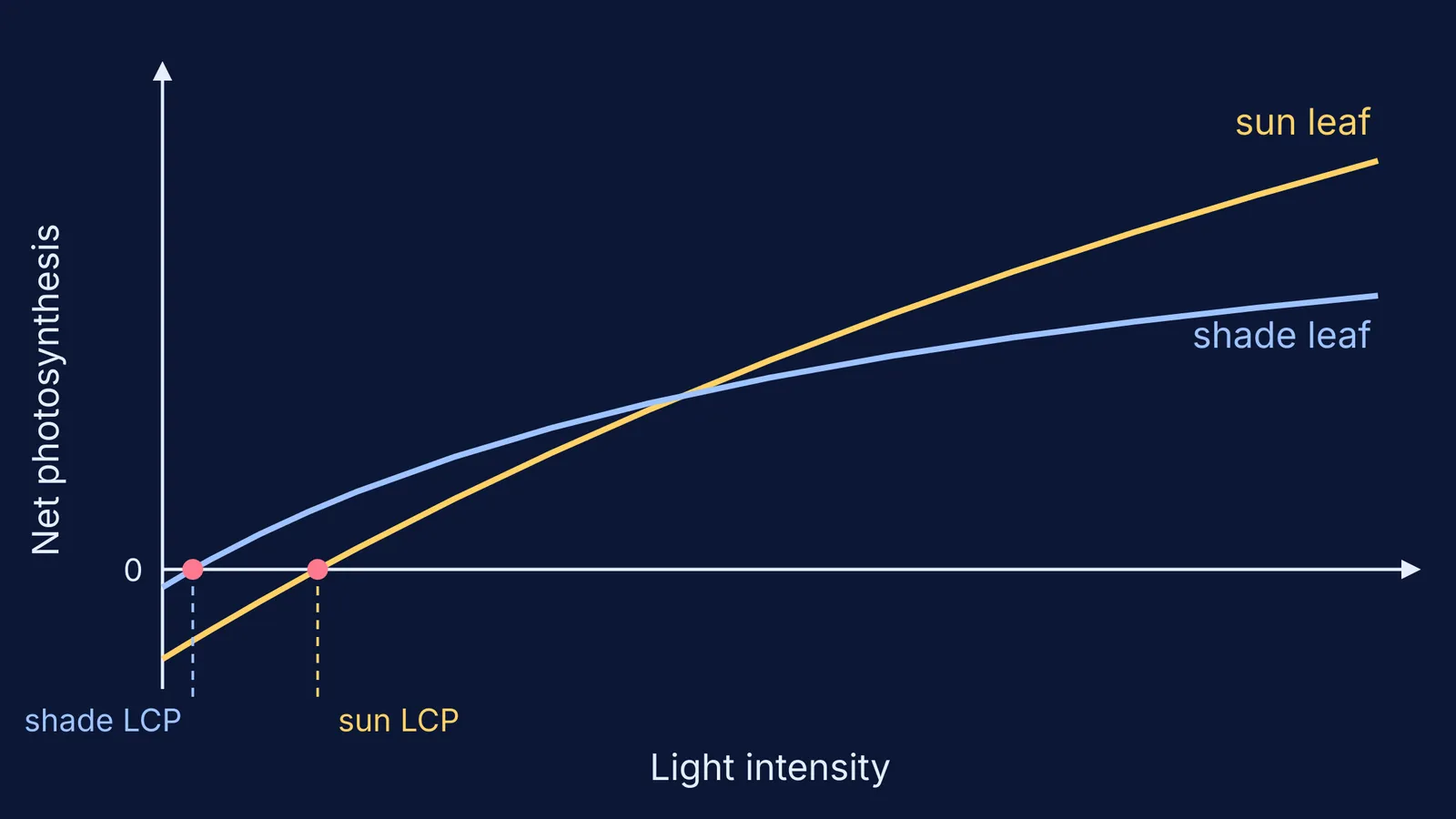
You find it on a light response curve: a leaf's net CO2 uptake measured in darkness, then in brighter and brighter light. LI-COR's guide to light response curves explains that the curve gives the dark respiration rate (the value at zero light), the compensation point, the initial slope and the maximum rate. The curve starts below zero, crosses zero at the compensation point and levels off in bright light.
Below the compensation point the leaf loses carbon, because respiration is bigger than photosynthesis.
At the compensation point there is no net exchange of CO2 (or of O2).
Above it the leaf gains carbon and can grow.
Do not confuse it with the CO2 compensation point, the CO2 level where the same balance is reached.
Why do shade plants have a lower compensation point?
The short answer is that they spend less. LI-COR's LI-6400 notes on light response sum up the pattern: "Shade adapted species tend to have lower dark respiration rates, lower compensation points, and lower maximum photosynthetic rates than sun adapted leaves." The same page notes that quantum efficiency, the initial slope of the curve, "tends to be conservative". In other words, sun and shade leaves tend to fix a similar amount of carbon per photon in dim light.
If the slope is about the same, the leaf with the smaller respiration bill pays it off with less light.
Seedling experiments point the same way.Kitao and colleagues (Plant Biology, 2016) measured shade-grown seedlings of four tree species from northern Japan. The shade-tolerant maple *Acer mono* had lower dark respiration than the oak *Quercus mongolica*, and the authors linked its shade tolerance to losing less carbon at night. Growing seedlings in extra CO2 also lowered the compensation point in all four species.
The spread between species is large. In a table of earlier measurements compiled by Francini et al., *Heuchera americana* broke even at about 3.5 to 5 µmol m⁻² s⁻¹, while *Leea rubra* needed about 67 to 84 µmol m⁻² s⁻¹. For scale, full sunlight is about 2,000 µmol m⁻² s⁻¹.
How do you calculate a compensation point?
This worked example uses round numbers we have chosen to make the arithmetic clear. They are not measurements. Near zero light, the response curve is almost a straight line:
net photosynthesis ≈ (slope × light) − dark respiration
Set net photosynthesis to zero, and the compensation point is the dark respiration divided by the slope.
Give both leaves the same slope: 0.05 mol of CO2 fixed per mol of photons absorbed.
Sun leaf: dark respiration of 1.5 µmol CO2 m⁻² s⁻¹. Compensation point = 1.5 ÷ 0.05 = 30 µmol photons m⁻² s⁻¹.
Shade leaf: dark respiration of 0.3 µmol CO2 m⁻² s⁻¹. Compensation point = 0.3 ÷ 0.05 = 6 µmol photons m⁻² s⁻¹.
Compare with full sunlight at about 2,000 µmol m⁻² s⁻¹: the sun leaf breaks even at 1.5% of full sunlight and the shade leaf at 0.3%.
Now put both leaves in a dim spot at, say, 15 µmol m⁻² s⁻¹ (another number we picked). The shade leaf makes a small profit. The sun leaf runs at a loss all day and a bigger loss all night. That is why a sun-loving plant fades in a dark corner of a flat, while a money plant (*Epipremnum aureum*), listed by Francini et al. at about 10 µmol m⁻² s⁻¹, can manage.
This is Blackman's law of limiting factors at the bottom of the curve: in dim light, light limits, so only the slope and the respiration bill matter.
What do students get wrong about it?
At the compensation point, photosynthesis has not stopped. It is happening, but it only just covers respiration.
Respiration does not switch off in light. Compare them in our photosynthesis vs respiration comparison table.
A lower compensation point means more shade-tolerant, not "photosynthesises faster". Shade leaves usually have a lower maximum rate.
If temperature rises, respiration usually rises too, so the compensation point moves up.
If CO2 rises, photosynthesis rises at the same light, so the compensation point moves down, as Kitao's seedlings showed.
If a graph question still trips you up, it often comes down to one missing link, such as respiration or the limiting factor. The Fermi Concept Library gives each biology concept its own lesson and shows where it sits in the map. If you would rather move the light slider yourself, try the curve in our photosynthesis rate and limiting factors simulation.
Next time you see a light response graph, find where it crosses zero first.


