

On this page
If you are preparing for biology board exams, you will likely need to contrast how plants capture energy with how cells release it. Because one process essentially reverses the other, studying them side by side is the most effective way to remember the raw materials, products, and organelles involved.
While glucose is the main energy currency, cellular respiration also functions as an amphibolic pathway where fats and proteins can enter the cycle to be broken down. Conversely, photosynthesis relies heavily on environmental conditions and is governed by limiting factors like CO₂ concentration and light intensity.
Here is a clear breakdown of their differences to help you structure your exam answers without relying on memorisation alone.
What is the difference between photosynthesis and cellular respiration?
Because these two pathways serve opposite purposes, their core features mirror each other. Here is the step-by-step comparison for your notes.
Primary purpose: Photosynthesis is an anabolic process that builds complex organic molecules. It captures solar energy and stores it as chemical energy in the bonds of glucose. Cellular respiration is a catabolic process that breaks down those organic molecules to release energy. The cell uses this released energy to synthesize ATP, which powers almost all cellular work.
Organelles involved: In eukaryotic cells, photosynthesis takes place entirely within the chloroplasts, utilizing the thylakoid membranes for light-dependent reactions and the stroma for the Calvin cycle. Cellular respiration begins in the cell's cytoplasm with glycolysis, but it completes its major energy-producing steps—the Krebs cycle and electron transport chain—inside the mitochondria.
Raw materials (Reactants): Photosynthesis requires carbon dioxide (CO₂) absorbed from the air, water (H₂O) drawn from the soil, and light energy from the sun. Cellular respiration requires glucose (C₆H₁₂O₆) and oxygen (O₂).
End products: Photosynthesis produces glucose to be used as food and releases oxygen as a vital by-product. Cellular respiration produces carbon dioxide, water, and usable cellular energy in the form of ATP molecules.
Timing of the process: Photosynthesis can only occur in the presence of light, meaning it happens primarily during the day for most plants. Cellular respiration occurs continuously, day and night, in all living cells to maintain basic life functions.
Electron carriers: In photosynthesis, NADP⁺ acts as the primary electron acceptor, becoming NADPH during the light-dependent reactions to carry high-energy electrons into the Calvin cycle. Cellular respiration relies on NAD⁺ and FAD, which become NADH and FADH₂ during glycolysis and the Krebs cycle to shuttle electrons to the electron transport chain.
Organisms: Photosynthesis is restricted to photoautotrophs such as plants, algae, and cyanobacteria. Cellular respiration occurs in all aerobic organisms, including plants themselves, animals, fungi, and many microorganisms. Plants must perform both to survive, producing glucose during the day and metabolizing it continuously.
If you are struggling to map out how these organelles function, the Fermi Concept Library maps out every concept in biology with interactive lessons to help you visualize the cell's machinery.
What are the equations for photosynthesis and cellular respiration?
The chemical equations perfectly illustrate how these processes are opposites. The products of one serve as the reactants of the other OpenStax Biology.
The balanced equation for photosynthesis is: 6CO₂ + 6H₂O + light energy → C₆H₁₂O₆ + 6O₂
For photosynthesis, the reaction is powered by photons captured by chlorophyll. The energy splits water molecules (photolysis), releasing oxygen gas as a consequence while the hydrogen and electrons move forward to reduce carbon dioxide into glucose.
The balanced equation for aerobic cellular respiration is: C₆H₁₂O₆ + 6O₂ → 6CO₂ + 6H₂O + ATP
For cellular respiration, the breakdown of a single glucose molecule in the presence of oxygen is highly exergonic. The energy released is coupled to the phosphorylation of ADP, synthesizing ATP molecules, alongside the gradual release of carbon dioxide during the Krebs cycle and the formation of water at the end of the electron transport chain.
In nature, this relationship creates a perfect biological loop. Plants, algae, and some bacteria use photosynthesis to make their own food. Then, almost all living organisms—including those same plants—use cellular respiration to harvest that stored energy. The balance is delicate; when plants fail to capture carbon efficiently due to high oxygen levels and heat, they may undergo photorespiration, a process that wastes energy instead of generating it.
How do you study biological cycles effectively?
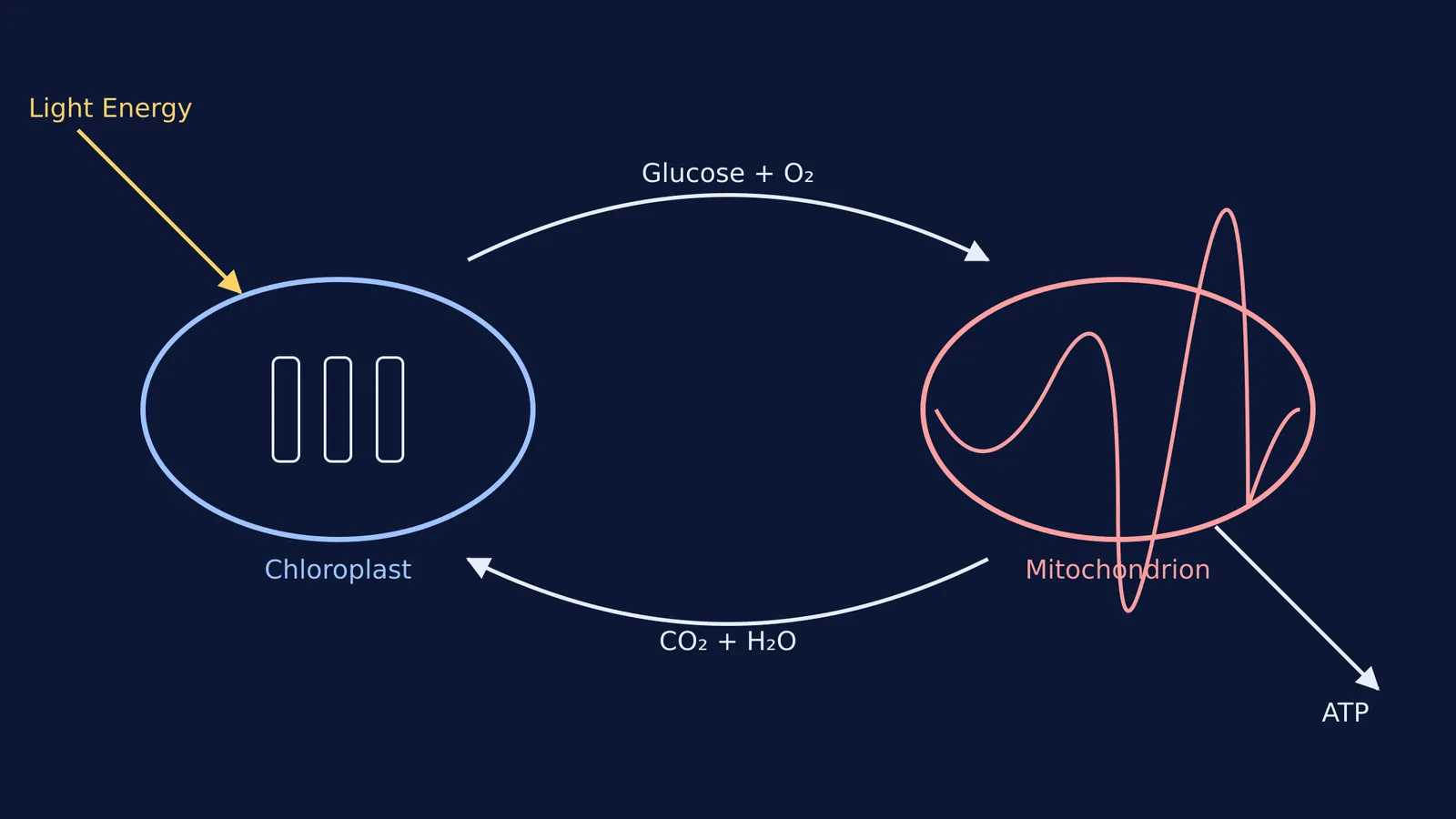
Memorizing equations out of context often leads to exam-day blanks. Instead, practice writing out the cycle as a single continuous loop. Draw a chloroplast on the left and a mitochondrion on the right, and draw arrows showing how oxygen and glucose flow to the mitochondrion, while carbon dioxide and water flow back to the chloroplast.
Active recall and drawing are powerful tools here. Start with a blank page and position a chloroplast on one side and a mitochondrion on the other. Draw the pathway of carbon first: atmospheric CO₂ enters the chloroplast, gets fixed into glucose, and then that glucose moves to the mitochondrion where it is broken down back into CO₂. Next, trace the flow of oxygen and water. H₂O enters the chloroplast and is split, releasing O₂. That O₂ travels to the mitochondrion where it accepts electrons at the end of the chain, forming H₂O once more.
Fermi's AI tutor is designed to help you with exactly this kind of active learning. Rather than just giving you a completed comparison, it asks you to build the connections step by step, notices where you get stuck, and works out a plan to clear your confusion.
By understanding the flow of carbon and oxygen rather than memorising isolated facts, you will be prepared for straightforward differences, cycle diagrams, and complex application-based questions alike.


