On this page
Brush one trigger hair inside a Venus flytrap and nothing happens. Brush it again a few seconds later and the two lobes clap shut. The plant has no brain, yet it counts to two.
What are the trigger hairs on a Venus flytrap?
The trap is a single leaf with two lobes. Sensory hairs stand on the inner faces of the lobes, and a 2020 study counts "six sensory hairs distributed on the two lobes of the trap" (Burri et al., PLOS Biology, 2020).
When an insect bends a hair, the hair fires an action potential. This is an electrical pulse, similar to the signals your nerve cells use. Jennifer Böhm, Rainer Hedrich and colleagues sum up the basic rule: after a moving object triggers two action potentials, the trap snaps shut (Böhm et al., Current Biology, 2016). Why a pulse fires fully or not at all is explained in our piece on Edgar Adrian and the all-or-none nerve impulse.
How does a Venus flytrap close after two touches?
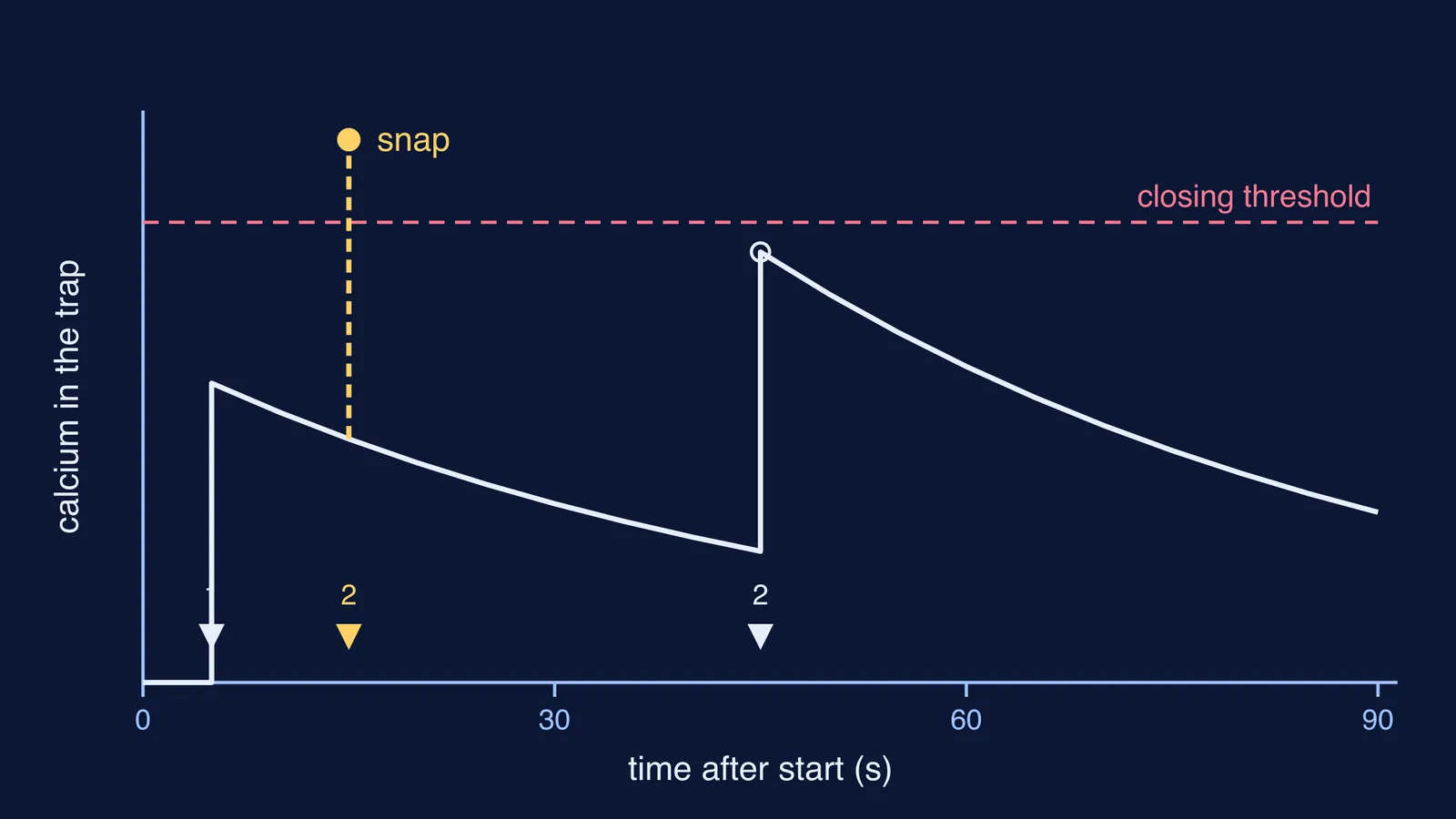
Trap closure usually needs two touches of the sensory hairs within about 30 seconds (Suda et al., Nature Plants, 2020). To find where the first touch is remembered, Suda, Hasebe and colleagues at Japan's National Institute for Basic Biology bred transgenic flytraps whose cells glow when calcium rises. Here is what they saw:
The first touch raised calcium in the sensory hair, and the rise spread across the leaf blade.
A second touch pushed calcium even higher, meeting a threshold that the researchers linked to leaf closure.
After the first touch, calcium slowly fell. If the second touch came after about 30 seconds, the new rise was not enough to reach the threshold.
Once the threshold is crossed, the trap shuts in about 100 milliseconds, which makes it one of the fastest movements in the plant kingdom (Forterre et al., Nature, 2005). Using high-speed video, that team showed the snap is a snap-buckling instability, which the plant controls: the curved lobes flip suddenly, a bit like a bent plastic lid popping inside out.
Why does a Venus flytrap ignore a single touch?
One touch keeps calcium below the threshold, so the trap stays open. A common explanation is that waiting for a second touch helps the trap avoid snapping shut on a raindrop or debris.
The two-touch rule is a strong pattern, though, not an absolute law. Burri and colleagues used a force-sensing microrobot to bend single hairs. They found that one deflection could trigger closure at intermediate speeds, between 0.03 and 4 radians per second, because a single bend at those speeds can fire the two action potentials the trap needs (Burri et al., 2020). In their fast-bending tests, the trap shut once the bend reached a median of 0.18 radians, about 10 degrees.
What happens after the trap shuts?
The plant keeps counting. Böhm and colleagues found that signalling by the touch hormone jasmonic acid switched on after the second stimulus. The genes for prey-digesting enzymes needed more than three action potentials, and how strongly they switched on depended on the number of touches (Böhm et al., 2016). The same study found a sodium channel, DmHKT1, that lets the trap take in sodium from its prey. In short, a struggling insect tells the plant it has caught real food.
For why these plants need insects at all, see why insectivorous plants hunt for nitrogen.
Worked example: will the trap close?
Here is the simple leaky-bucket model behind the diagram at the top of this post. Each touch adds 0.65 of the closing threshold. Calcium then decays exponentially with a time constant of 48.5 seconds, which is chosen so that two touches exactly 30 seconds apart just reach the threshold, matching the roughly 30-second window reported by Suda et al. (2020).
Touches at 0 s and 10 s. At 10 s, the first touch's calcium is 0.65 × e^(−10/48.5) ≈ 0.53. Add 0.65 to get 1.18, which is above 1. The trap closes.
Touches at 0 s and 40 s. At 40 s, the first touch has decayed to 0.65 × e^(−40/48.5) ≈ 0.29. Add 0.65 to get 0.94, which is below 1. The trap stays open.
One touch. The level peaks at 0.65 and then drains away. The trap stays open.
The numbers are illustrative, not measured. What the model gets right is the logic: quick inputs add up, slow or single ones fade.
Now test yourself without notes:
In one line, explain what stores the "memory" of the first touch.
Explain why a touch at 45 seconds fails when one at 10 seconds works.
Name one finding that shows the two-touch rule has exceptions.
Compare this with how touch-me-not (Mimosa) leaves fold, and list one similarity and one difference.
If action potentials or thresholds still feel fuzzy, look them up in the Fermi Concept Library, which has a lesson for every concept in biology. Then explain the leaky bucket out loud to Fermi's AI tutor, which checks understanding as it goes and notices where you are stuck.