

On this page
What is thigmonasty?
When you touch the leaves of a *Mimosa pudica* (touch-me-not or *chhui-mui*) plant, they fold together and the entire stalk droops within seconds. In the NCERT Class 10 science curriculum, this is taught as an example of thigmonasty (or seismonasty)—a rapid, non-directional response to a mechanical stimulus.
Unlike phototropism (where a stem grows toward light), nastic movements do not involve growth. Because the leaf folds no matter which direction you touch it from, the movement is independent of the direction of the stimulus.
What are the pulvinus and turgor pressure?
If the plant has no muscles or nervous system, how does it move? The secret lies in a swollen, joint-like structure at the base of each leaf and leaflet called the pulvinus.
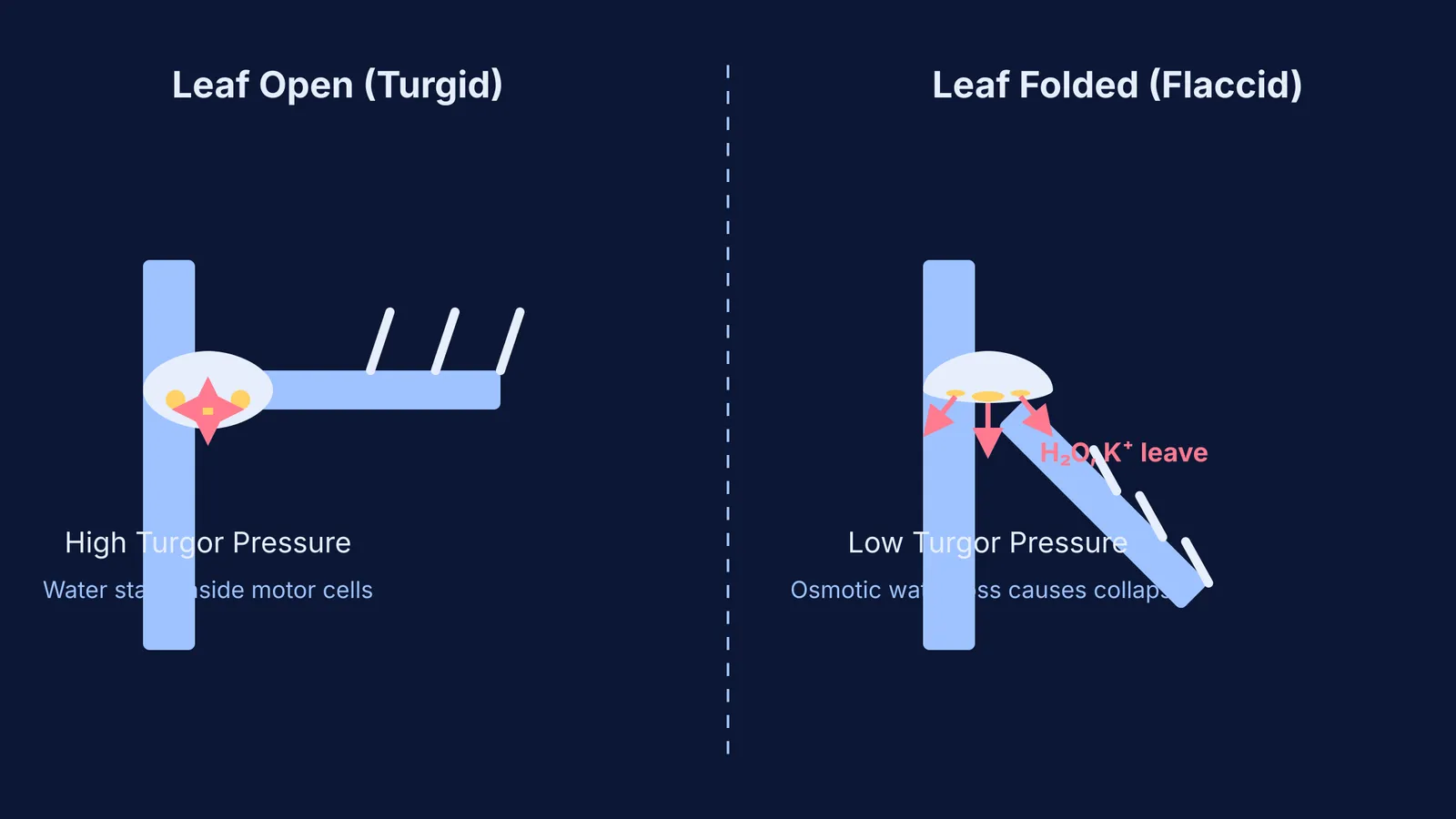
Inside the pulvinus are flexible, thin-walled motor cells. Normally, these cells are full of water. This creates high turgor pressure—an internal outward force against the cell walls that keeps the cells firm (turgid) and holds the leaf upright.
How do the leaves fold?
Even though you might only touch the tip of a leaflet, the folding happens at the base. The plant communicates the touch using an electrical-chemical signal, similar to an action potential in animals, which travels rapidly down the leaf to the pulvinus.
When the signal arrives, it triggers the motor cells on the lower side to release potassium (K⁺) and chloride (Cl⁻) ions into the surrounding spaces. Through a process called osmosis, water rapidly follows the ions out of the cells.
The sudden loss of water causes a sharp drop in turgor pressure.
The lower cells become flaccid (deflated).
With these motor cells no longer able to support the weight of the leaf, the pulvinus acts like a collapsing hinge, and the leaf folds down.
It typically takes a few minutes for the plant to actively pump the ions back into the cells, drawing the water back in to restore the turgor pressure and reopen its leaves.
What is the chemistry of osmosis?
To fully grasp how the pulvinus works, you need to understand osmosis. Osmosis is the movement of water molecules across a semi-permeable membrane from a region of high water concentration to a region of low water concentration.
When the electrical signal reaches the pulvinus, the motor cells actively pump ions into the intercellular space. This sudden build-up of ions outside the cell creates a high solute concentration (and therefore a lower water concentration). To balance this out, water rapidly flows out of the cells and into the surrounding space.
This efflux of water immediately drops the turgor pressure. Without this internal hydrostatic pressure pushing against the rigid cell wall, the cells lose their firmness. Because this happens specifically in the lower half of the pulvinus, the structure gives way, causing the entire leaf stalk to drop.
Why do these plants fold their leaves?
Scientists classify the *Mimosa pudica*'s rapid movement as a highly evolved defence mechanism against herbivores and environmental stressors.
When an insect lands on a leaf, the sudden collapse of the structure can startle the pest or simply dislodge it, causing it to fall off.
To larger grazing animals, a fully open, lush green leaf looks appetising. However, when the leaves fold and the stalk droops, the plant suddenly looks shrivelled, dead, and less nutritious.
The drooping motion also exposes the sharp thorns located along the plant's main stem, providing a physical barrier against being eaten.
During heavy rainstorms or strong winds, folding its leaves tightly helps the plant reduce its surface area, preventing physical damage to its delicate foliage.
How does this connect to your exams?
In exams like the CBSE Class 10 board or NEET, you will often be asked to compare plant and animal coordination. Remember that while animals use specialised nervous tissues and muscle proteins to move, plants like the touch-me-not rely on electrical-chemical means and change their shape by altering the amount of water in their cells.
If you find it difficult to picture how osmosis and turgor pressure drive these physical changes, the Fermi Concept Library contains interactive lessons for every concept in biology, showing how they fit into the bigger map of plant physiology.
Checklist: Tropic vs nastic movements
When answering questions on plant coordination, use this checklist to tell the two types of movement apart:
Direction: Is the movement directional? (Tropic is directional; nastic is non-directional).
Growth: Does it involve cell growth? (Tropic movements like geotropism involve uneven growth; nastic movements like folding rely on turgor pressure).
Speed: How fast is it? (Tropic changes take days; nastic changes take seconds).
Read more about plant coordination:


