

On this page
Sundews (*Drosera*) and pitcher plants (*Nepenthes*) catch and digest small animals, yet they are green, carry chlorophyll and make their own sugar. Both facts are true at once, and the reason is the soil they grow in.
Why do insectivorous plants eat insects?
Insectivorous (carnivorous) plants are plants that capture and digest animal prey, absorb the nutrients from it and use them to grow, as defined in a 2021 review in Annals of Botany by Lubomír Adamec, Ildikó Matušíková and Andrej Pavlovič. The same review counts about 810 such species.
They live where the soil is poor. In soils typical of carnivorous plants, available nitrogen, phosphorus and potassium are usually 5 to 100 times lower than in soils dominated by ordinary plants, the review reports.
So an insect is fertiliser, not fuel. Across dozens of species from nine genera, prey supplies 7 to 100% of the plant's nitrogen and phosphorus, and usually 30 to 60%, according to the same review.
Why don't all plants do this? Traps are costly. Aaron Ellison and Nicholas Gotelli, in a 2009 review in the Journal of Experimental Botany, describe a cost-benefit model: carnivory should evolve only when the extra nutrients give the plant an energetic advantage over the cost of its traps. That trade pays off in habitats that are bright and wet but very low in nutrients. Plants have found this solution more than once: carnivory evolved independently in at least ten plant lineages, Adamec and colleagues note.
How does a pitcher plant trap insects?
The pitcher is a modified leaf, like tendrils and spines (see our guide to leaf modifications such as phyllodes and pitchers).
The key part is the rim, called the peristome. Holger Bohn and Walter Federle showed in PNAS in 2004 that the peristome has radial ridges of smooth, overlapping cells that step down towards the inside. Nectar and rain wet the surface completely, forming a thin film. Only when wet is the rim slippery, and then most visiting ants fall in. The researchers called it insect "aquaplaning": the water film defeats the soft adhesive pads on an insect's feet, while the ridged surface works against its claws.
Inside, the pitcher fluid becomes more acidic soon after prey is caught. That helps hold the prey, kills it faster by suffocation and lets it be broken down chemically, Adamec and colleagues write.
How does a Drosera (sundew) trap work?
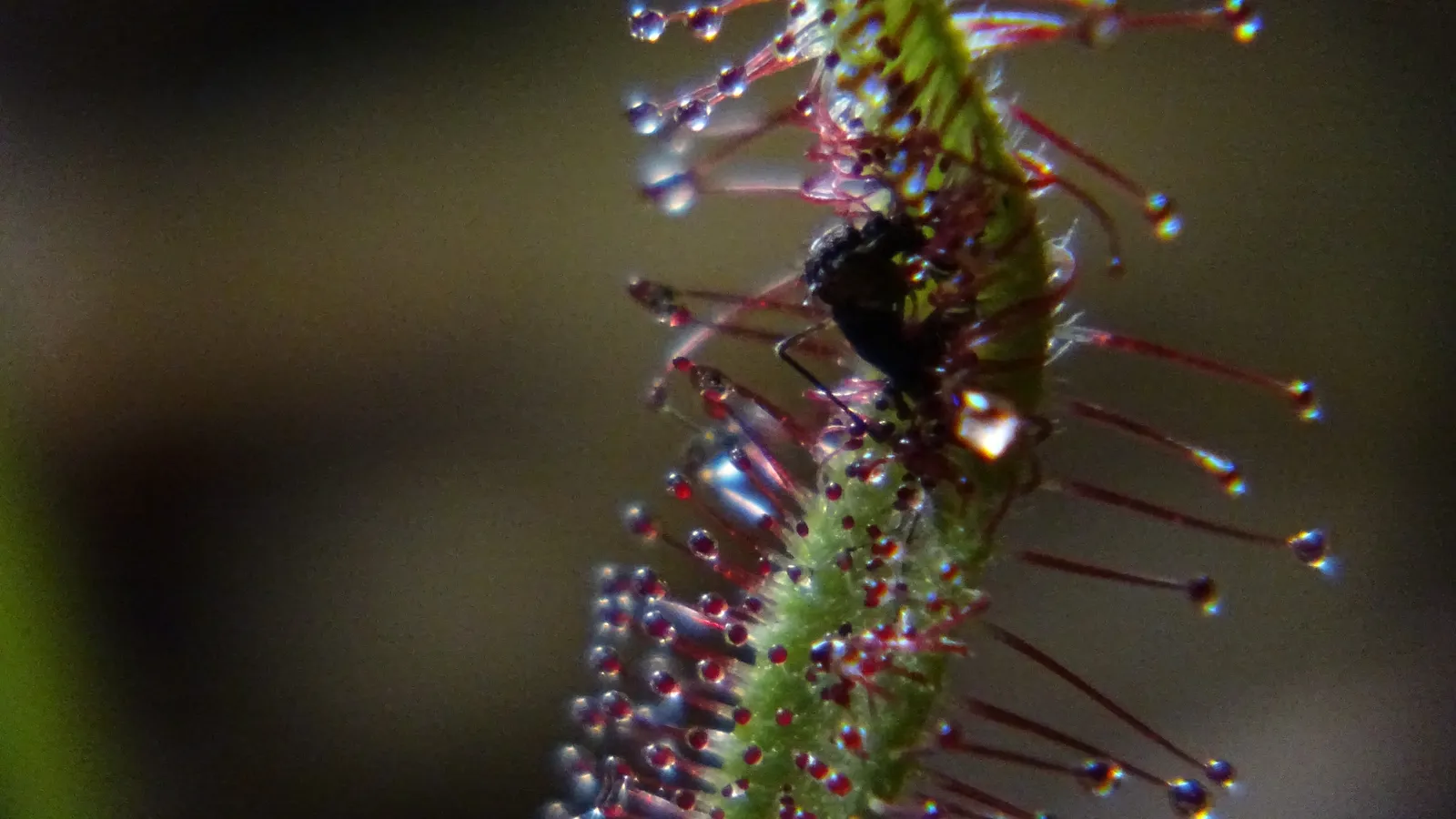
A sundew is a sticky trap that moves. Each leaf carries tentacles tipped with glue. A 2023 study in Plants by Pavlovič, Vrobel and Tarkowski explains the sequence:
An insect lands and sticks to the gland heads.
Its touch fires electrical signals (action potentials) in the tentacle, and the outer tentacles bend inward to hold the prey on the leaf.
Plant hormones called jasmonates switch on the bending and the release of digestive enzymes, including proteases, chitinase and phosphatase.
The leaf absorbs the dissolved nutrients.
The study also helps explain a puzzle Charles Darwin recorded in his book *Insectivorous Plants*: a drop of water does not set the trap off. In the Cape sundew, water caused the fewest action potentials and no significant jasmonate rise, while real insect prey caused the largest jasmonate response. Water did not switch on the protein-digesting enzymes either, so the plant does not spend them on rain.
Do insectivorous plants still photosynthesise?
Yes. Prey gives them minerals, but their sugar still comes from photosynthesis in green leaves. Plants need nitrogen and phosphorus to build chlorophyll, proteins and the molecules that carry energy.
That is why prey helps photosynthesis rather than replacing it. Prey-derived nitrogen and phosphorus increase the photosynthetic rate of the leaves, which lets the plant grow faster, the 2021 review concludes.
So these plants are autotrophs that top up their minerals from animals. If the difference between the two modes is fuzzy, our explainer on autotrophic vs heterotrophic nutrition sets it out, and the nitrogen cycle and the bacteria that run each step shows where ordinary plants get their nitrogen instead.
How should you write this in an exam?
Take a typical short-answer question that asks why a pitcher plant is green yet traps insects. A three-point answer:
It grows in soil poor in minerals, especially nitrogen.
It traps and digests insects to obtain nitrogen (and phosphorus); the pitcher is a modified leaf.
It is green and photosynthesises, so it is autotrophic for carbon; insects supply minerals, not energy.
Before you hand it in, check for these common slips:
Writing that the plant eats insects "for food" or "for energy".
Calling it a heterotroph or a parasite.
Forgetting to say the trap is a modified leaf.
Mixing up the trap types: the pitcher is a slippery pitfall, while the sundew is a sticky trap with moving tentacles.
If the nitrogen-to-photosynthesis link feels shaky, the Fermi Concept Library has every concept in biology as its own lesson, with its place in the map. For practice, the Fermi Problem Library has worked problems with a step-by-step solver that explains the reasoning rather than printing an answer.


