

On this page
Angiosperm leaves typically perform photosynthesis and gas exchange through a flat blade, yet environmental pressures—mechanical instability, aridity, herbivory and nutrient scarcity—routinely force plants to remodel this primary organ. Through homeotic mutations and changes in leaf polarity genes, foliar primordia differentiate into climbing coils, protective armor, expanded petioles or carnivorous pitfall traps. Recognizing these modifications reveals how developmental plasticity solves mechanical challenges with modular parts, especially when studied alongside plant tropic movements.
How do pea tendrils and cactus spines differ from stem structures?
One frequent trap in plant morphology is confusing foliar organs with cauline (stem-derived) structures.
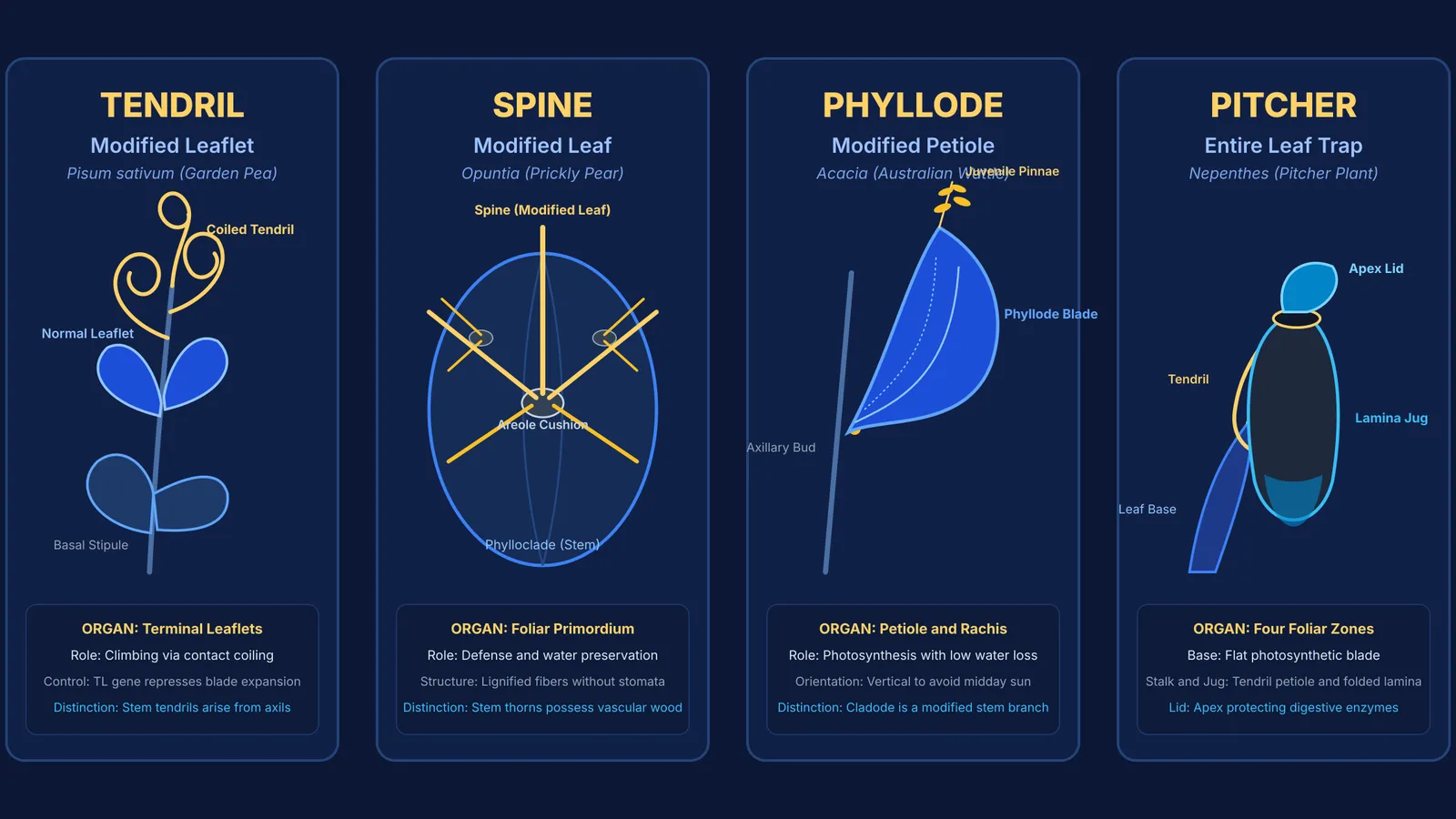
In the garden pea (*Pisum sativum*), the terminal leaflets of a pinnately compound leaf form slender, spirally coiled tendrils that climb by coiling around supports. Julie Hofer and colleagues in *The Plant Cell* (DOI: 10.1105/tpc.108.064071) showed that the *TENDRIL-LESS* (*TL*) gene represses blade development in the distal pinnae; inactive *TL* mutants produce ordinary leaflets instead. Conversely, climbing tendrils in cucumber, pumpkin and grapevine develop from axillary buds, representing modified lateral stems.
Cactus spines present a parallel distinction. In desert cacti like *Opuntia*, the flattened photosynthetic pads are modified stems called phylloclades. The true leaves are reduced to sharp spines on axillary short shoots called areoles. Erika Edwards and Michael Donoghue traced the evolutionary transition from leafy ancestral cacti (*Pereskia*) to stem-succulents with areolar spine clusters in *The American Naturalist* (DOI: 10.1086/504605). Investigating early spine ontogeny in *Plants* (DOI: 10.3390/plants13233406), Cristina Miravel-Gabriel and colleagues confirmed that spines differentiate into lignified fibers lacking stomata, shielding the succulent stem and curbing water loss. By contrast, defensive thorns in *Citrus* and *Bougainvillea* are modified stems arising from axillary buds.
What is an Australian acacia phyllode?
In arid climates, broad compound leaves lose excessive moisture through transpiration. Several Australian *Acacia* species (such as *Acacia auriculiformis*) solve this dilemma with a phyllode.
The tree sheds its juvenile compound leaflets early, while the petiole and rachis flatten vertically, synthesize chlorophyll, and form an isobilateral blade. Across Australia, over 90% of native Acacia species replace juvenile bipinnate foliage with adult phyllodes. Reporting in the *Annals of Botany* (DOI: 10.1093/aob/mcn210), Michael Forster and Stephen Bonser showed how species like *Acacia implexa* undergo this heteroblastic shift, adjusting specific leaf area and biomass allocation between leaf forms to withstand dry, exposed environments.
Oriented vertically, the phyllode avoids scorching midday radiation while intercepting low-angle morning and late-day light. Never confuse a phyllode (a modified petiole) with a phylloclade (a photosynthetic stem, as in *Opuntia*) or a cladode (a photosynthetic branch of limited growth, as in *Asparagus*). Compare these forms in our overview of stem modifications.
How do insectivorous plants convert leaves into traps?
Carnivorous plants inhabit waterlogged, acidic soils where nitrates are scarce, remodeling leaves into nutrient-absorbing traps.
The pitcher plant (*Nepenthes*) exhibits a four-part foliar division of labor:
The flattened leaf base conducts basic photosynthesis.
The petiole coils as a supportive tendril.
The lamina expands into a hollow, fluid-filled digestive jug.
The leaf apex forms an overarching lid (operculum) that keeps out rain.
Jeremy Dkhar and Ashwani Pareek reported in *Scientific Reports* (DOI: 10.1038/s41598-019-42779-6) that pitcher morphogenesis in India's endemic *Nepenthes khasiana* is directed by leaf polarity genes (*NkAS1* and *NkREV*), which suppress normal blade outgrowth to fold the hollow trap. Other species adopt different foliar mechanics: Venus flytrap (*Dionaea*) snaps a two-lobed lamina shut with trigger hairs, while aquatic bladderwort (*Utricularia*) uses underwater leaf segments as vacuum suction bladders.
How can you diagnose unknown plant organs on exams?
To determine whether an unknown structure is foliar or cauline on CBSE or NEET-UG questions, apply this four-step diagnostic key:
Check the axil: If a dormant bud sits in the organ's upper angle with the stem, it is a leaf. If the structure emerges out of the axil, it is a modified branch.
Check for nodes: Stems possess nodes, internodes, and scale leaves (as on ginger rhizomes or *Opuntia* pads); leaves never do.
Check apical growth: Stems have apical buds capable of continued branching, whereas foliar tendrils and spines exhibit determinate growth that ends at a tip.
Check vascular symmetry: Stems display radially arranged vascular bundles; foliar petioles and phyllodes show bilateral or isobilateral bundle patterns.
Connecting these patterns to floral features like floral placentation deepens anatomical fluency. The Fermi Concept Library maps every concept in physics, chemistry, biology, mathematics and computing, showing how structural modifications fit ecological niches. To master tricky exam questions, the Fermi Problem Library has worked problems with a step-by-step solver that explains the reasoning rather than printing an answer. If you hesitate between foliar and cauline structures, Fermi's AI tutor can work out what you already know and build a plan for the session, guiding you through diagnostic anatomy problems.


