On this page
If a NEET-UG or board question asks what normal urine contains, the examiner wants four things: water, urea, salts and pigment. They also want two things that should be missing: glucose and protein. Here are NCERT's numbers and a worked example.
What is normal human urine made of?
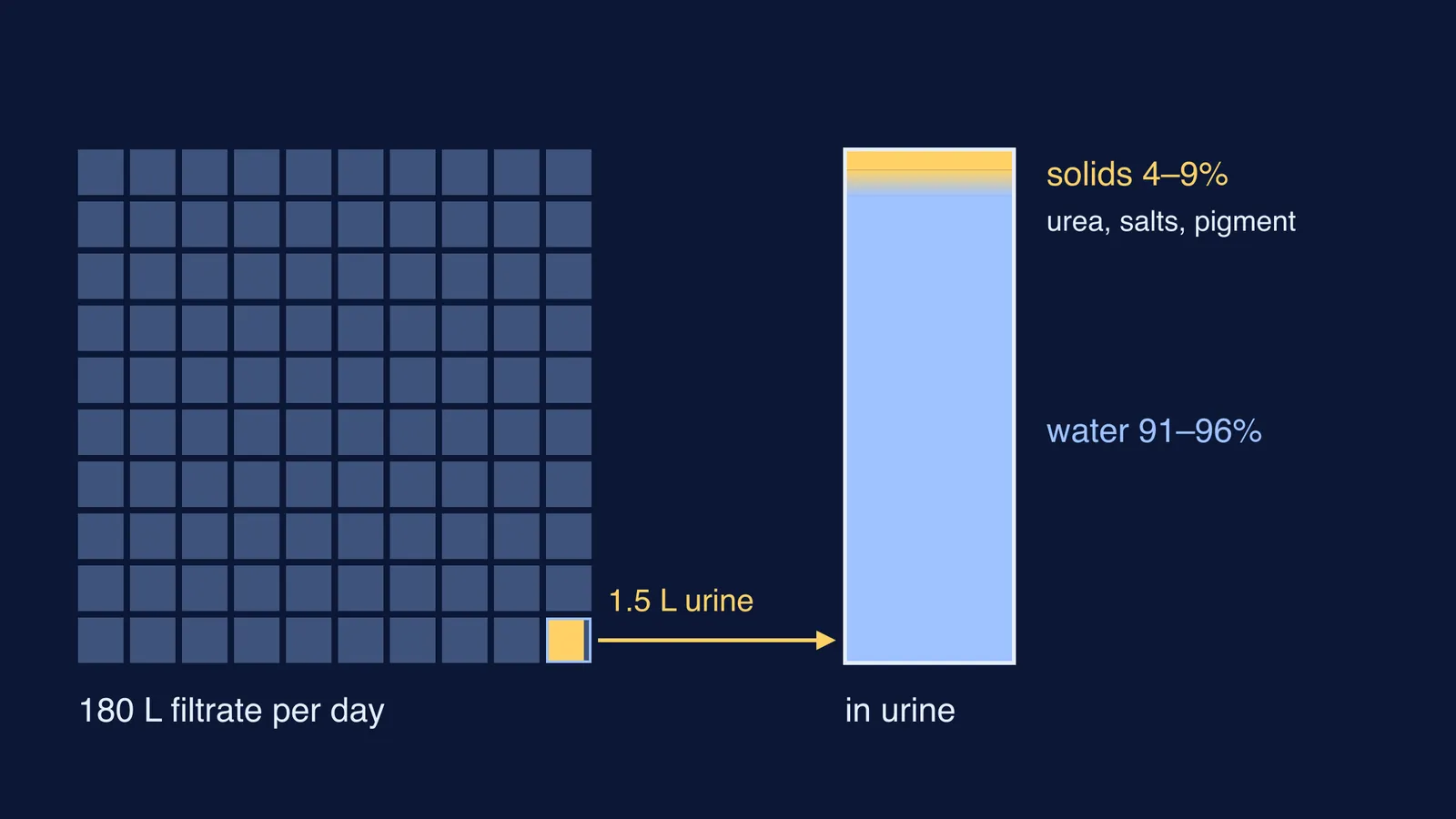
Urine is 91 to 96 per cent water, according to a 2015 review of urine and faeces composition by Rose and colleagues in Critical Reviews in Environmental Science and Technology. The rest is dissolved solids, and the same review describes them:
Urea, the main organic solid, making up over 50 per cent of the total organic solids in urine.
Salts and ions, chiefly sodium and potassium, which come largely from what you eat and drink.
Smaller nitrogen wastes such as creatinine and uric acid, in much smaller amounts.
The last ingredient is pigment. Urine is yellow because of urobilin. A University of Maryland and NIH team reported in Nature Microbiology in January 2024 that gut microbes use an enzyme, bilirubin reductase, to turn bilirubin from old red blood cells into colourless urobilinogen, which then breaks down into yellow urobilin (paper record). You may also see the yellow pigment called urochrome in question banks, so recognise both names.
How much urine does a person pass in a day, according to NCERT?
The numbers to learn are in section 16.6 of NCERT Class 11 Biology, Chapter 16, Excretory Products and their Elimination:
An adult excretes, on average, 1 to 1.5 litres of urine per day.
Urine is a light yellow, watery fluid, slightly acidic at about pH 6.0, with a characteristic smell.
On average, 25 to 30 g of urea is excreted per day.
The same chapter says the kidneys filter about 180 litres of filtrate a day (a GFR of about 125 ml per minute). Since only about 1.5 litres leaves as urine, nearly 99 per cent of the filtrate is reabsorbed. More in our post on glomerular filtration rate and the 180 litres a day figure.
Why should glucose and protein be absent from normal urine?
The two are missing for two different reasons, and mixing up the reasons is where students lose marks.
Protein is kept out at the filter. NCERT describes glomerular filtration as ultrafiltration: almost all the constituents of plasma pass into Bowman's capsule except the proteins (NCERT Chapter 16). MedlinePlus, from the US National Library of Medicine: the kidneys' tiny filters stop large protein molecules from leaving in urine, so there is normally very little protein. A large amount, called proteinuria, may mean a kidney problem.
Glucose gets through the filter and is taken back. Glucose does enter the filtrate, but the tubule cells reabsorb it actively; NCERT says the PCT reabsorbs nearly all of the essential nutrients. MedlinePlus says normal urine contains very little or no glucose, and diabetes is the most common cause of high urine glucose. NCERT names the condition glycosuria and links it, with ketone bodies in urine (ketonuria), to diabetes mellitus. For more on the PCT, read functions of the PCT and DCT in the nephron.
Worked example: what do NCERT's numbers tell you?
Try this with only the figures from NCERT Chapter 16.
Share of filtrate reabsorbed. 1.5 L out of 180 L is 1.5 / 180 = 0.0083, under 1 per cent. So about 99.2 per cent is reabsorbed, which matches NCERT's "nearly 99 per cent".
Urea per litre of urine. At the low end, 25 g in 1.5 L is about 16.7 g per litre. At the high end, 30 g in 1 L is 30 g per litre.
What this tells you. Less urine with the same urea means more concentrated urine. NCERT says human kidneys can make urine nearly four times as concentrated as the initial filtrate. The counter current mechanism makes this possible by keeping the fluid around the tubules at about 300 mOsmol per litre in the cortex, rising to about 1200 mOsmol per litre in the inner medulla.
How do you write this answer in an exam?
For a two- or three-mark answer, with numbers from the NCERT chapter:
Name the normal constituents: water, urea, salts (such as Na+, K+, Cl- and phosphate), and pigment.
Give NCERT's numbers: 1 to 1.5 L per day, 25 to 30 g urea per day, pH about 6.0, light yellow.
Name the abnormal constituents: glucose (glycosuria) and ketone bodies (ketonuria) are indicative of diabetes mellitus; a large amount of protein may point to a kidney problem.
Give the reason in one line each: protein is not filtered; glucose is filtered but reabsorbed.
If ultrafiltration or reabsorption still feels hazy, the Fermi Concept Library has a lesson for each idea in biology, showing where it fits in the map. To practise numericals like the worked example, the Fermi Problem Library has a step-by-step solver that explains the reasoning rather than printing an answer.
Next, see how things go wrong in our explainer on uremia, renal calculi and glomerulonephritis.