

On this page
The kidneys filter a massive volume of blood to keep the body's internal environment stable. On average, 1100 to 1200 ml of blood flows through the kidneys every minute. This is roughly one-fifth of the total blood pumped by each ventricle of the heart in a minute.
From this blood, the kidneys extract a protein-free fluid called the glomerular filtrate.
What is the glomerular filtration rate?
The glomerular filtration rate (GFR) is the total amount of filtrate formed by all the nephrons in both kidneys per minute. In a healthy individual, the GFR is approximately 125 ml per minute.
If you multiply this rate over 24 hours, the kidneys produce roughly 180 litres of filtrate a day. However, you only excrete about 1.5 litres of urine daily. This means that nearly 99 per cent of the filtrate is reabsorbed by the renal tubules and returned to the blood.
What are the three layers of the filtration membrane?
Filtration takes place in the renal corpuscle, which consists of a tuft of capillaries called the glomerulus enclosed by a cup-like sac called Bowman's capsule. For fluid to move from the blood into the capsule, it must pass through the glomerular filtration barrier.
This barrier is made of three distinct layers:
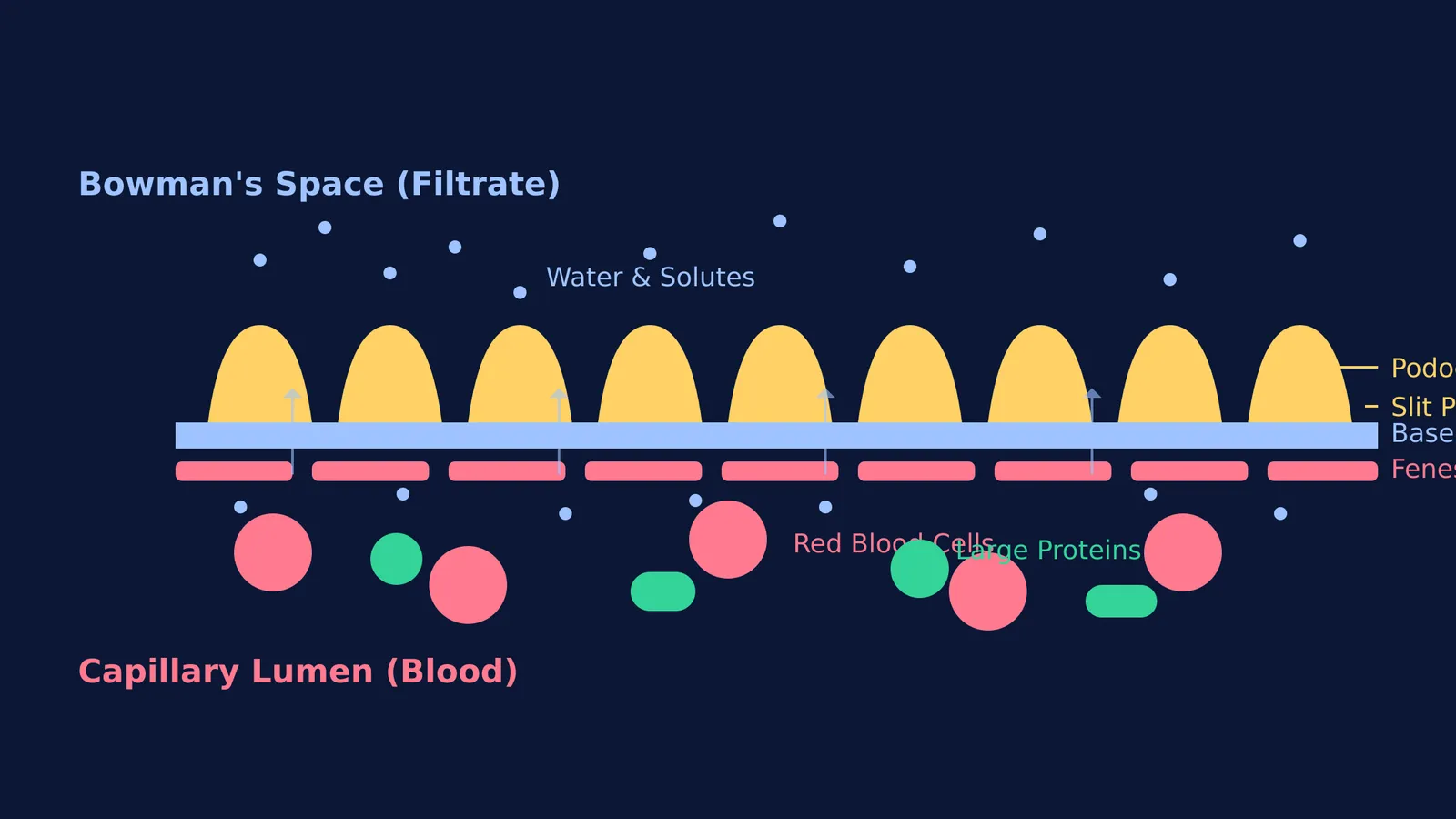
Endothelium of glomerular blood vessels: The innermost layer consists of the capillary walls. Unlike normal capillaries, these endothelial cells have thousands of tiny pores called fenestrae. They allow water and small solutes to pass through but hold back red blood cells, white blood cells and platelets.
Basement membrane: A thin, non-cellular layer sits between the endothelium and the epithelium. It acts as a dense physical and chemical barrier. Its negative charge repels large plasma proteins, preventing them from leaking into the urine.
Epithelium of Bowman's capsule: The outer layer is formed by specialised cells called podocytes.
If you have concept gaps when visualising microscopic anatomy, the Fermi Concept Library contains every concept in physics, chemistry, biology, mathematics and computing, each with its own lesson and its place in the map.
How do podocyte slit pores work?
The word "podocyte" means foot-cell. These epithelial cells wrap their long, finger-like projections (foot processes) around the capillaries of the glomerulus.
They do not form a solid sheet. Instead, the foot processes interlock in an intricate manner, leaving minute spaces between them. These gaps are called filtration slits or slit pores.
Blood is filtered so finely through these three layers that almost all the constituents of the blood plasma—except the large proteins—pass into the lumen of Bowman's capsule. Because of this thorough sieving, the process is known as ultrafiltration.
When you make wrong-method mistakes on past exam papers about ultrafiltration, the Fermi Problem Library has worked problems with a step-by-step solver that explains the reasoning rather than printing an answer.
How does the body regulate a GFR of 125 ml per minute?
The kidneys have built-in mechanisms to ensure the GFR stays constant, even when your overall blood pressure fluctuates. The most important of these is the juxtaglomerular apparatus (JGA).
The JGA is a specialised sensitive region formed where the distal convoluted tubule touches the afferent arteriole. A fall in the glomerular filtration rate activates the JG cells to release an enzyme called renin. Renin triggers a chain of events (the renin-angiotensin mechanism) that stimulates glomerular blood flow and brings the GFR back to normal.
(Related reading: Regulating kidney function: ADH, the RAAS and ANF explained)
Checklist: Spotting trick questions on GFR
Examiners for tests like NEET often test your precise reading of these facts. Use this checklist to catch common traps:
Blood vs Filtrate: Are they asking how much blood flows through the kidney (1100 to 1200 ml/min) or how much filtrate is formed (125 ml/min)?
Minute vs Day: Check the units. The rate is 125 ml per minute, but 180 litres per day.
Which layer has podocytes? Podocytes are epithelial cells of Bowman's capsule. They are not part of the capillary endothelium.
What gets through? The filtrate contains everything in blood plasma except proteins. If an option says it contains proteins or red blood cells, it is wrong.
If you do not know where to start your revision for the excretory system, Fermi's AI tutor can work out what you already know and build a plan for the session, so you sit down to a clear next step.
(For more on the history of this anatomy, read about William Bowman and the capsule that filters blood in the kidney, or learn about how different animals handle waste in Ammonotelic, ureotelic and uricotelic animals: why waste differs.)


