On this page
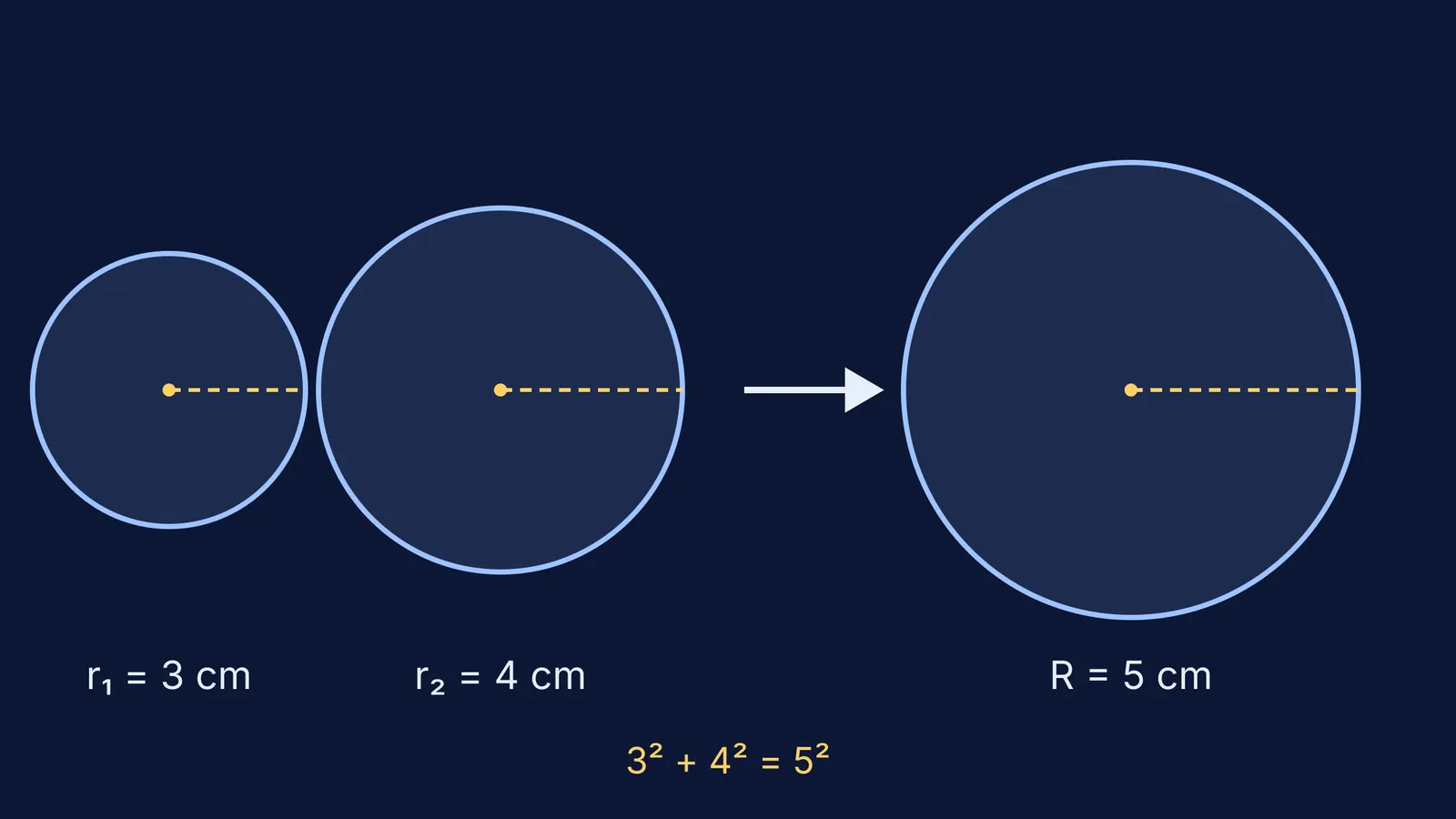
When two soap bubbles merge, the new bubble's volume is not the sum of the old volumes. In vacuum at fixed temperature, the answer is cleaner: R² = r1² + r2². Here is the derivation, a worked 3 cm and 4 cm example, and what changes in ordinary air.
What is the pressure inside a soap bubble?
A soap bubble is a thin film with two surfaces, one inside and one outside. Surface tension pulls on both (HyperPhysics, bubble pressure), so the gauge pressure inside a spherical soap bubble of radius r is 4T/r, where T is the surface tension (OpenStax College Physics 2e, section 11.8). A liquid drop has only one surface, so its excess pressure is 2T/r; our explainer on excess pressure in a drop and a soap bubble works through that difference.
So smaller bubbles have higher pressure inside, and in vacuum the whole pressure of the trapped air is 4T/r.
How do you derive R² = r1² + r2²?
The ideal gas law is PV = nRT, and at constant temperature the pressure of a fixed amount of gas is inversely proportional to its volume (OpenStax College Physics 2e, section 13.3). So at one fixed temperature, the amount of gas n is proportional to PV.
When the bubbles merge isothermally, no air escapes, so the amount of gas is conserved:
Before: n1 + n2 is proportional to P1V1 + P2V2.
After: n is proportional to PV.
Conservation: P1V1 + P2V2 = PV.
Now substitute P = 4T/r and V = (4/3)πr³ for each bubble:
(4T/r1)(4/3)πr1³ + (4T/r2)(4/3)πr2³ = (4T/R)(4/3)πR³
Every term carries the same factor (16/3)πT. Cancel it and you are left with r1² + r2² = R², so R = √(r1² + r2²). Surface tension drops out, so you never need its value.
What is the radius when bubbles of 3 cm and 4 cm coalesce?
Put r1 = 3 cm and r2 = 4 cm into the result:
R² = 3² + 4² = 9 + 16 = 25 cm²
R = 5 cm
You can check this with real numbers. OpenStax lists the surface tension of typical soapy water as 0.0370 N/m (OpenStax, Table 11.3). With that value:
Pressure in the 3 cm bubble: 4 × 0.0370 ÷ 0.03 ≈ 4.93 Pa
Pressure in the 4 cm bubble: 4 × 0.0370 ÷ 0.04 = 3.70 Pa
Pressure in the 5 cm bubble: 4 × 0.0370 ÷ 0.05 = 2.96 Pa
Take the common factor (4/3)π out of every volume and work in cubic centimetres. Before merging, PV is 4.93 × 27 + 3.70 × 64 ≈ 133 + 237 = 370. After merging, it is 2.96 × 125 = 370. The amount of gas matches.
The new volume (125 units) is larger than the old total (91 units) because the gas now sits at lower pressure. And the total film area, 4π(3² + 4²), equals 4π(5²): in vacuum, merging keeps the surface area unchanged.
Why is it not R³ = r1³ + r2³?
R³ = r1³ + r2³ is the rule for liquid drops, because a liquid barely compresses. A gas's volume changes with pressure. A quick way to choose:
Liquid drops merging: volume conserved, R³ = r1³ + r2³.
Soap bubbles merging in vacuum, isothermal: amount of gas conserved, R² = r1² + r2².
Soap bubbles merging in air: (P0 + 4T/r1)r1³ + (P0 + 4T/r2)r2³ = (P0 + 4T/R)R³, where P0 is the outside pressure.
In air, P0 is about 1.01 × 10⁵ Pa (OpenStax College Physics 2e, section 11.4), while surface tension of 0.0370 N/m (OpenStax, Table 11.3) adds under 5 Pa to a 3 cm bubble. Atmospheric pressure is about 20,000 times larger, so for 3 cm and 4 cm bubbles in air the answer is close to the cube-root rule: R ≈ ∛91 ≈ 4.50 cm, not 5 cm.
The same pressure reasoning explains what happens when two soap bubbles are connected by a tube. For the energy side of the film, see work done in blowing a soap bubble.
How should you practise merging problems?
Use four steps for drops, bubbles and gas containers:
Say in words what stays the same: volume, amount of gas, or energy.
Write the pressure for each object, including any outside pressure.
Substitute and cancel common factors before you use numbers.
Sanity-check: the smaller bubble has the higher pressure, and the new radius lies between the larger old radius and the sum of the two.
If step 1 is where you get stuck, the Fermi Problem Library has worked problems with a step-by-step solver that explains the reasoning rather than printing an answer. If the gap is surface tension itself, the Fermi Concept Library gives each concept its own lesson.
Write the conservation statement first, and the algebra will follow.