On this page
A common JEE and board-exam question goes like this: two rods of different metals are heated together, yet the difference between their lengths never changes. What must their lengths be? The answer is one line, L1α1 = L2α2, but it is worth seeing why it works.
Why does the length difference stay constant at all temperatures?
Start with the rule for linear expansion. When a rod of length L is heated by ΔT, it grows by ΔL = αLΔT, where α is the coefficient of linear expansion of the material (OpenStax University Physics, Volume 2).
Now take two rods, lengths L1 and L2, heated by the same ΔT. Their new lengths are L1(1 + α1ΔT) and L2(1 + α2ΔT). Subtract one from the other:
New difference = (L1 − L2) + (L1α1 − L2α2)ΔT
The first bracket is the old difference. The second bracket is the only part that depends on temperature. If you want the difference to be the same for every ΔT, that second bracket must be zero:
L1α1 = L2α2
In words: both rods must grow by the same amount for each degree of heating. If rod 1 adds 0.4 mm and rod 2 adds 0.4 mm, the gap between their ends simply slides along without changing size. That is all the condition says.
Which rod must be longer?
Rearrange the condition as L1/L2 = α2/α1. The lengths are in the inverse ratio of the coefficients. So the rod with the smaller α is always the longer one.
This gives you a quick check before you calculate anything. Steel expands less than copper per degree: OpenStax lists iron or steel at 12 × 10⁻⁶ per °C and copper at 17 × 10⁻⁶ per °C (OpenStax, Table 1.2). So in any steel-copper version of this problem, the steel rod must be the longer one. If your answer makes copper longer, something has gone wrong.
Worked example: steel and copper with a 10 cm difference
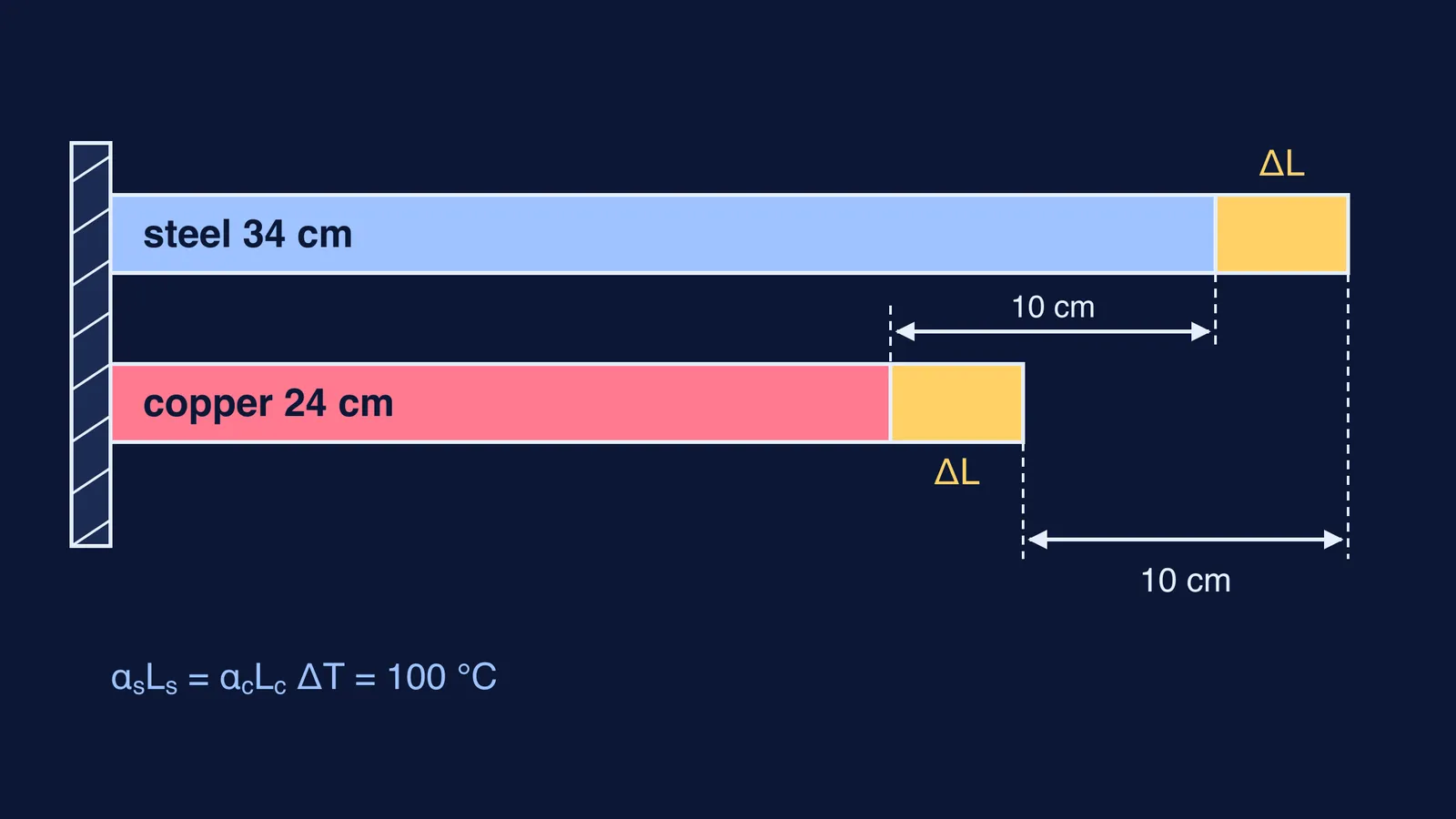
Problem: a steel rod and a copper rod must differ in length by 10 cm at all temperatures. Find both lengths. Use α(steel) = 12 × 10⁻⁶ per °C and α(copper) = 17 × 10⁻⁶ per °C, the values in OpenStax Table 1.2.
Write the condition: Ls × 12 × 10⁻⁶ = Lc × 17 × 10⁻⁶, so 12Ls = 17Lc.
Use the quick check: steel has the smaller α, so steel is longer. Write Ls − Lc = 10 cm.
Substitute Ls = Lc + 10: 12(Lc + 10) = 17Lc, so 120 = 5Lc and Lc = 24 cm.
Then Ls = 34 cm.
Verify: steel grows 34 × 12 × 10⁻⁶ = 408 × 10⁻⁶ cm per °C; copper grows 24 × 17 × 10⁻⁶ = 408 × 10⁻⁶ cm per °C. Equal, so the 10 cm gap holds.
Heat both by 100 °C and each rod gets longer by 0.0408 cm, about 0.4 mm. The steel rod becomes 34.0408 cm, the copper rod 24.0408 cm, and the difference is still exactly 10 cm.
Why do textbooks give different answers to the same question?
Because the α values differ slightly between tables. The HyperPhysics expansion table at Georgia State University lists steel at 13 × 10⁻⁶ per °C and copper at 17 × 10⁻⁶ per °C at 20 °C. With those numbers the same 10 cm problem gives a 42.5 cm steel rod and a 32.5 cm copper rod. Both answers are right for their data, so always use the values printed in the question.
There is also a fine print. OpenStax notes that α varies slightly with temperature, but treating it as constant is accurate enough for most practical purposes (OpenStax). So "the same at all temperatures" really means "the same over any range where α stays steady", which is exactly what exam problems assume.
What are the common mistakes to avoid?
Setting L1 = L2 or α1 = α2. The condition is about the products, not the separate quantities.
Making the higher-α rod longer. Check the direction before solving.
Mixing units. Keep both lengths in the same unit; α cancels its own power of ten on both sides.
Forgetting to verify. Multiply each length by its α; the two products must match.
The same "make the temperature terms cancel" trick appears in two resistors in series that don't change with temperature. For more practice on ΔL = αLΔT itself, see thermal expansion problems: linear, area and volume, and for where α comes from, how to find the coefficient of linear expansion by experiment.
If you set up the right equation but keep picking the wrong rod as longer, the Fermi Problem Library has worked problems with a step-by-step solver that explains the reasoning rather than printing an answer. If the gap is in the idea of α itself, the Fermi Concept Library gives thermal expansion its own lesson and shows where it sits among related concepts.