On this page
You count 4 beats per second between a 256 Hz standard fork and an unknown fork B. The beats tell you how far apart the forks are, but not which one is higher. Waxing or filing B moves its frequency in a known direction, and whether the beats speed up or slow down then picks the sign. Here is the rule, a worked example, and the case that trips people up.
How do beats give the frequency difference?
NCERT's Class 11 Physics textbook defines it this way: beats arise when two waves of slightly different frequencies and comparable amplitudes are superposed, and the beat frequency is ν_beat = ν1 ~ ν2 (NCERT Class 11 Physics, Waves). The same chapter shows waves of 11 Hz and 9 Hz giving beats at 2 Hz. It also notes that artists tuning their instruments with each other keep going until they cannot hear any beats.
The symbol ~ means "positive difference". So 4 beats per second with a 256 Hz fork gives two candidates: 256 − 4 = 252 Hz or 256 + 4 = 260 Hz. Counting beats alone can never choose between them. If the link between frequency and pitch feels shaky, first revise how wave speed, frequency and wavelength connect.
Does wax increase or decrease a tuning fork's frequency?
Wax decreases it. A tuning fork's pitch depends on the length and mass of its prongs, and "filing the ends of the prongs raises the pitch" (Wikipedia: Tuning fork). Wax stuck on a prong adds mass, so the prong vibrates more slowly and the frequency falls. Filing the prong ends removes mass, so the frequency rises (Sarthaks: wax and filing explained).
NCERT uses the same reasoning with a sitar string in Example 14.6: tightening string B lowered the beats from 5 to 3, so B had moved closer to A and was the lower one (NCERT Class 11 Physics, Waves). Wax and filing work the same way.
Worked example: 256 Hz fork, 4 beats, then wax
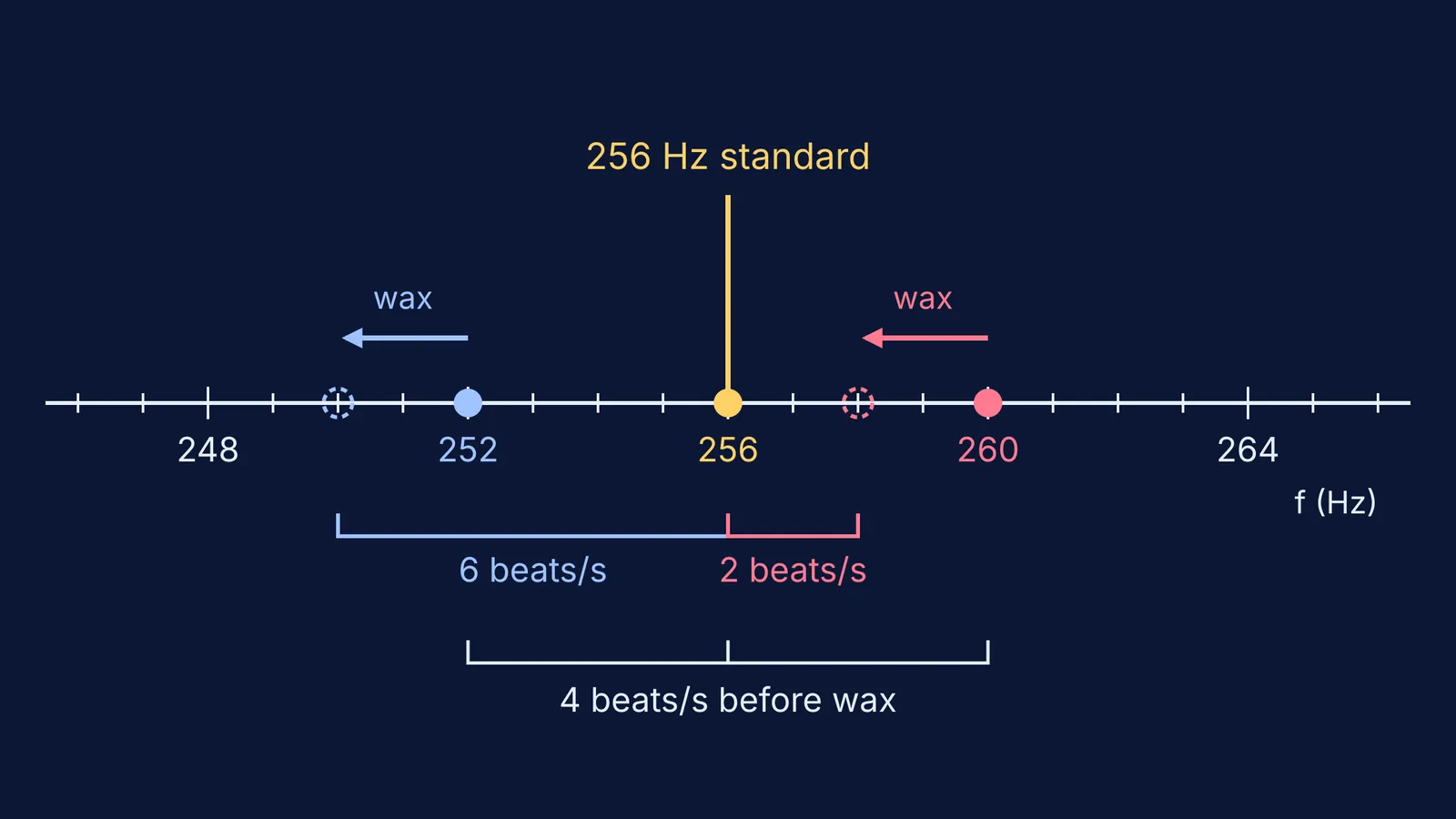
Problem: a 256 Hz standard fork makes 4 beats per second with fork B. B is loaded with a little wax and the beats drop to 2 per second. Find the frequency of B.
Write both candidates from ν_beat = ν1 ~ ν2 (NCERT): B = 252 Hz or B = 260 Hz.
Note the direction: wax lowers B's frequency by a small amount.
Test B = 252 Hz. Lowering it to about 250 Hz moves it away from 256, so the gap grows to about 6 and the beats would increase.
Test B = 260 Hz. Lowering it to about 258 Hz moves it towards 256, so the gap shrinks to about 2 and the beats would decrease.
The beats decreased, so B = 260 Hz.
If the beats had risen instead, say to 6 per second, the answer would be 252 Hz. The 2 Hz shift here is only an illustration. The method needs only the direction, not the size.
How do you decide plus or minus every time?
Use this rule when the change is made to the unknown fork B and the standard frequency is f:
Wax on B, beats increase: B = f − beats.
Wax on B, beats decrease: B = f + beats.
Filing B, beats increase: B = f + beats.
Filing B, beats decrease: B = f − beats.
Wax on B, beats stay the same: B = f + beats.
The last line is NCERT Exemplar problem 15.20. A 512 Hz fork gives 5 beats with B, and after B is waxed the beats are again 5 (NCERT Exemplar Physics, Waves). The official answer is 517 Hz (NCERT Exemplar answer key). B started 5 Hz above, and the wax pulled it down past 512 to 5 Hz below. The gap stayed the same size but changed side.
What mistakes cost marks on this question?
Changing the wrong fork. If the 256 Hz standard is waxed instead of B, reverse the reasoning. Waxing the standard with more beats afterwards means B = 260 Hz.
Stopping at 256 ± 4. Examiners want one value with a reason.
Mixing up filing and wax. Wax adds mass and lowers the frequency; filing removes mass and raises it.
To practise similar questions, try the Fermi Problem Library. It has worked problems with a step-by-step solver that explains the reasoning rather than printing an answer. If waves are easier to see than to read, the Fermi Simulation Lab has interactive simulations for ideas like these.
The same habit of picking the right sign helps on how temperature changes organ pipe frequency and on more beat frequency problems with tuning forks.