
On this page
Three shooters, A, B and C, each fire once at a target. Their hit chances are 1/2, 1/3 and 1/4, and they shoot independently. What is the probability that the target is hit, and that exactly two of them hit it? We work both, then list all eight outcomes so you can check every number.
What is the probability that at least one of three shooters hits the target?
The phrase “at least one hits” covers seven different outcomes: one hit (three ways), two hits (three ways) and all three hitting. The opposite event covers just one: everyone misses. So work out that single case and subtract it from 1. This is the method the NCERT Class 12 Mathematics probability chapter uses for independent events.
Find each miss probability: P(A′) = 1 − 1/2 = 1/2, P(B′) = 1 − 1/3 = 2/3, P(C′) = 1 − 1/4 = 3/4.
Multiply them to get the chance that all three miss: (1/2)(2/3)(3/4) = 6/24 = 1/4.
Subtract from 1 to get the chance of at least one hit: 1 − 1/4 = 3/4.
The target is hit with probability 3/4, or 75%.
Why does 1 − P(all miss) work?
The shortcut rests on two facts. First, the NCERT Class 12 textbook calls three events A, B and C mutually independent when every pair satisfies the product rule and P(A ∩ B ∩ C) = P(A)P(B)P(C). Second, the same chapter proves that if E and F are independent, then so are E and F′, and notes that E′ and F′ are independent too. That is why you are allowed to multiply the miss probabilities. Its Example 14 then shows that for two independent events, P(at least one of A and B) = 1 − P(A′)P(B′). The three-shooter answer is the same idea with one more factor.
The word “independent” in the question matters. If B aims only after watching A miss, the events are linked and the product rule no longer applies as written. To see why three events need more than pairwise checks, read our explainer on pairwise versus mutual independence.
The same complement trick works for repeated trials of one event. We cover that version in at-least-one-success problems using the complement rule.
What is the probability that exactly two shooters hit?
“Exactly two” has three cases, and each case also names who misses:
A and B hit, C misses: (1/2)(1/3)(3/4) = 3/24
A and C hit, B misses: (1/2)(2/3)(1/4) = 2/24
B and C hit, A misses: (1/2)(1/3)(1/4) = 1/24
These cases cannot happen together, so you add them: 3/24 + 2/24 + 1/24 = 6/24 = 1/4.
Question 14 of Exercise 13.2 of the NCERT chapter asks a two-person version, where two people try to solve a problem and you find the chance that exactly one of them solves it. Our walkthrough on the probability that exactly one event occurs solves it step by step.
How do you check the answer with all eight outcomes?
Each shooter either hits (H) or misses (M), so there are 2 × 2 × 2 = 8 outcomes. Here they are over a common denominator of 24, with letters in the order A, B, C.
H H H: (1/2)(1/3)(1/4) = 1/24
H H M: (1/2)(1/3)(3/4) = 3/24
H M H: (1/2)(2/3)(1/4) = 2/24
M H H: (1/2)(1/3)(1/4) = 1/24
H M M: (1/2)(2/3)(3/4) = 6/24
M H M: (1/2)(1/3)(3/4) = 3/24
M M H: (1/2)(2/3)(1/4) = 2/24
M M M: (1/2)(2/3)(3/4) = 6/24
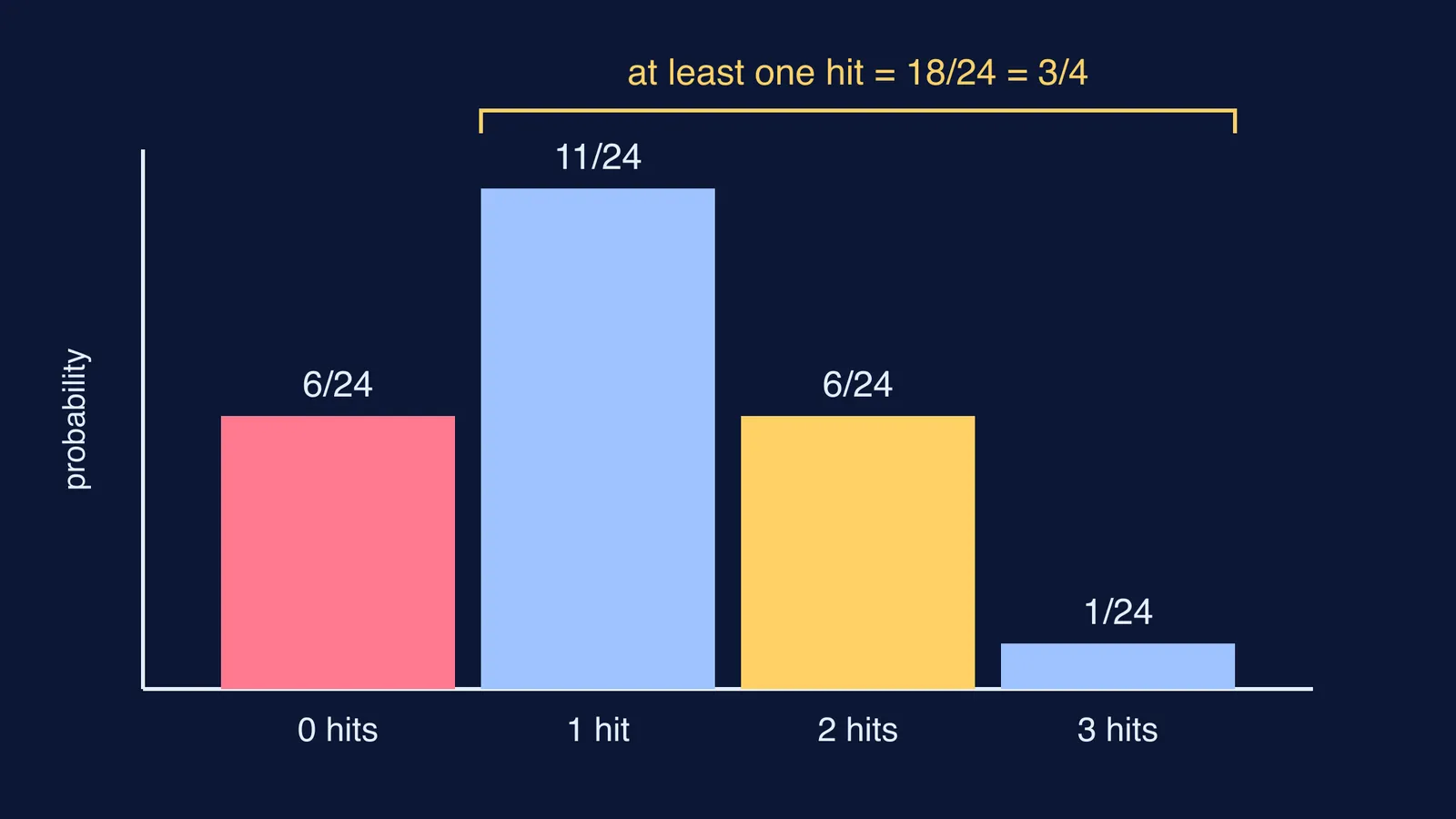
The eight rows add up to 24/24 = 1, as they must. Now group them by the number of hits:
0 hits: 6/24 = 1/4
1 hit: 6/24 + 3/24 + 2/24 = 11/24
2 hits: 3/24 + 2/24 + 1/24 = 6/24 = 1/4
3 hits: 1/24
This confirms the shortcut: 11/24 + 6/24 + 1/24 = 18/24 = 3/4, the same as 1 − 6/24.
Which mistakes cost marks on this problem?
Adding the hit probabilities. 1/2 + 1/3 + 1/4 = 13/12, which is more than 1. You can only add probabilities of events that cannot happen together.
Multiplying the hit probabilities. 1/24 is the chance that all three hit, not that at least one does.
Dropping the miss factor in “exactly two”. Writing (1/2)(1/3) for “A and B hit” counts outcomes where C hits too.
Try it yourself with hit chances of 0.4, 0.5 and 0.6. You should get 0.88 for at least one hit, since all three miss with probability 0.6 × 0.5 × 0.4 = 0.12, and 0.38 for exactly two.
If you get stuck on setting up the cases rather than on the arithmetic, the Fermi Problem Library has worked problems with a step-by-step solver that explains the reasoning rather than printing an answer. To revise independence from scratch, the Fermi Concept Library gives every mathematics concept its own lesson and shows where it fits in the map.