

On this page
When you learn probability for JEE or board exams, independence is one of the first big ideas. If event A does not affect the probability of event B, they are independent. Mathematically, this means P(A ∩ B) = P(A)P(B).
But what happens when you have three events: A, B and C?
Many students assume that if A is independent of B, B is independent of C, and A is independent of C, then all three must be completely independent of each other. This assumption is a classic trap in probability questions. As Wikipedia notes in its probability theory definitions), mutual independence implies pairwise independence, but pairwise independence does not imply mutual independence.
Here is the step-by-step proof of why this happens, using a simple two-coin experiment.
What does pairwise independent mean?
Pairwise independence means that if you look at any two events in a group, they are independent of each other.
For three events A, B and C, they are pairwise independent if:
P(A ∩ B) = P(A)P(B)
P(B ∩ C) = P(B)P(C)
P(A ∩ C) = P(A)P(C)
If these three equations hold true, the events are pairwise independent. However, this only tells us how the events behave in twos. It says nothing about how they behave when all three happen at once.
What makes events mutually independent?
For three events to be mutually independent, they must be pairwise independent *and* they must satisfy one extra condition:
P(A ∩ B ∩ C) = P(A)P(B)P(C)
This final rule checks if the combination of all three events behaves independently. If this equation fails, the events are not mutually independent, even if all the pairs pass their tests.
How does the two-coin example work?
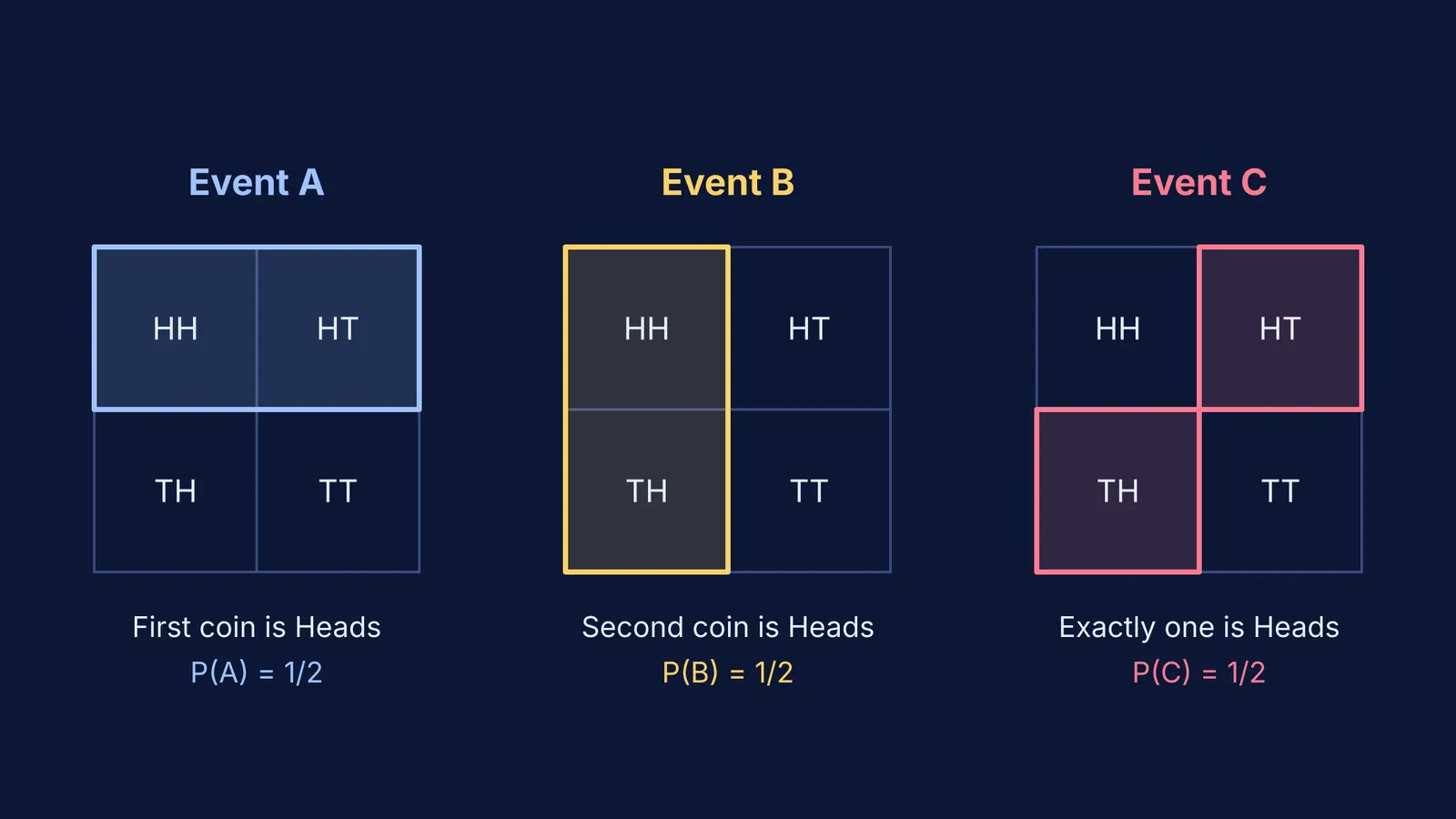
To see how events can be pairwise independent but not mutually independent, we use a simple probability space: flipping two fair coins.
The sample space has four equally likely outcomes: HH, HT, TH, and TT. Each has a probability of 1/4.
Let us define three events:
Event A: The first coin is Heads. The outcomes are HH and HT. P(A) = 2/4 = 1/2.
Event B: The second coin is Heads. The outcomes are HH and TH. P(B) = 2/4 = 1/2.
Event C: Exactly one coin is Heads. The outcomes are HT and TH. P(C) = 2/4 = 1/2.
Now, we check the pairs.
A and B: The only outcome where the first coin is Heads and the second coin is Heads is HH. P(A ∩ B) = 1/4. Since P(A)P(B) = 1/2 × 1/2 = 1/4, events A and B are independent.
A and C: The only outcome where the first coin is Heads and exactly one coin is Heads is HT. P(A ∩ C) = 1/4. Since P(A)P(C) = 1/2 × 1/2 = 1/4, events A and C are independent.
B and C: The only outcome where the second coin is Heads and exactly one coin is Heads is TH. P(B ∩ C) = 1/4. Since P(B)P(C) = 1/2 × 1/2 = 1/4, events B and C are independent.
Because every pair passes the test, these three events are pairwise independent.
Why does mutual independence fail here?
Finally, we test the mutual independence rule: P(A ∩ B ∩ C) = P(A)P(B)P(C).
What is the probability of A, B and C all happening together? For A ∩ B ∩ C to occur, the first coin must be Heads, the second coin must be Heads, and exactly one coin must be Heads. This is logically impossible.
Therefore, P(A ∩ B ∩ C) = 0.
However, P(A)P(B)P(C) = 1/2 × 1/2 × 1/2 = 1/8.
Since 0 does not equal 1/8, the events are not mutually independent. In reality, if you know that A and B have happened (both coins are Heads), you know for absolute certain that C cannot happen. The third event is entirely dictated by the first two.
Why does this distinction matter?
When creating statistical models, from predicting weather patterns to understanding genetic traits, assuming mutual independence makes the mathematics much easier. You can simply multiply all the individual probabilities together. However, if the events are only pairwise independent, multiplying all three probabilities will give you the wrong answer.
In exams like JEE Advanced, examiners often hide this exact trap in multiple-choice options. They will describe a scenario where three events clearly pass the pairwise test and then ask you to calculate the probability of all three occurring. If you jump straight to P(A) × P(B) × P(C), you will choose the incorrect option. This is why you must always test the final three-way intersection.
How should you approach probability problems?
When you face complex probability questions, do not assume mutual independence just because the pairs look independent. Always write down the sample space and check the three-way intersection.
If you find yourself guessing which rules apply, the Fermi Concept Library maps out every concept in mathematics, giving each idea its own lesson. When you sit down to practice, Fermi's AI tutor can work through problems alongside you, noticing where you are stuck and stepping in to explain if you mix up pairwise and mutual independence.
Read more about applying these ideas:


