On this page
The Three Gorges Dam on China's Yangtze River has an installed capacity of 22,500 megawatts (MW), the highest of any hydroelectric power station, according to Guinness World Records. That is 32 main turbines of 700 MW each plus two smaller 50 MW generators that power the plant itself. Below, we derive 700 MW per turbine from head and flow, then look at trapped silt and a tiny change in the length of the day.
How much power does the Three Gorges Dam make in a year?
Capacity is a rate (megawatts); what reaches homes is energy (terawatt-hours). The dam generated 101.6 TWh in 2018, and after the 2020 monsoon it produced nearly 112 TWh in a year (Wikipedia: Three Gorges Dam).
If all 22,500 MW ran for every hour of a year, the energy would be 22.5 GW × 8,760 h ≈ 197 TWh.
2018: 101.6 ÷ 197 ≈ 0.52, so the plant ran at about 52% of its maximum.
2020: 112 ÷ 197 ≈ 0.57, about 57%.
That ratio is the capacity factor. It stays well below 100% because the Yangtze's flow rises and falls with the seasons.
How do head and flow give 700 MW per turbine?
Falling water loses potential energy mgh. Each second, a mass ρQ falls, where ρ is the density of water (1,000 kg/m³) and Q is the flow in cubic metres per second. So the power is P = ηρgQH, where H is the head (the height the water drops) and η is the turbine-generator efficiency.
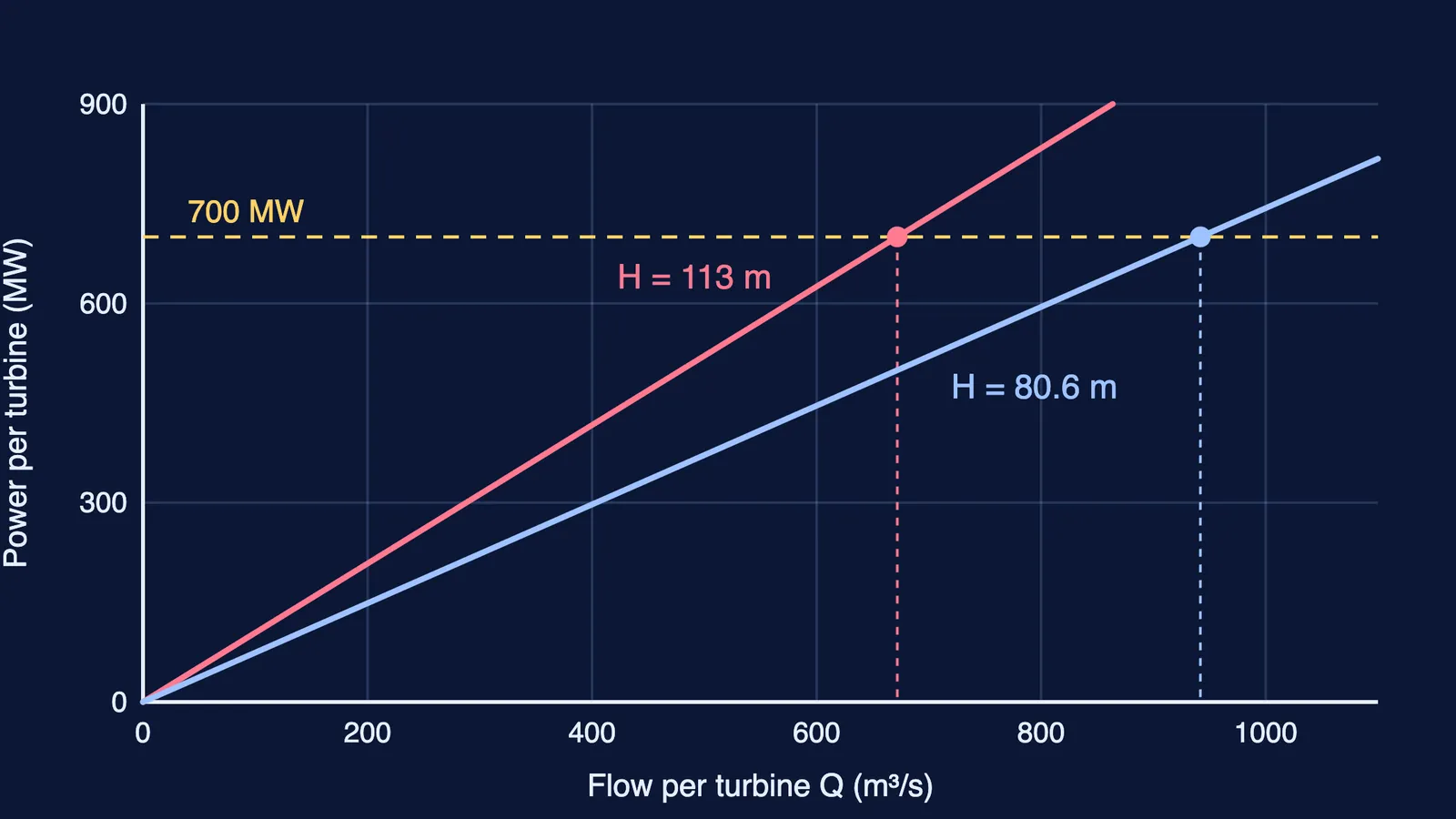
The rated head of the Three Gorges generators is 80.6 m and the maximum head is 113 m (Wikipedia: Three Gorges Dam).
Target: P = 700 MW = 7.0 × 10⁸ W.
Take η = 0.94, our assumption for a large turbine, not a published figure.
Power per cubic metre per second at 80.6 m: 0.94 × 1,000 × 9.81 × 80.6 ≈ 7.43 × 10⁵ W.
Divide: Q = 7.0 × 10⁸ ÷ 7.43 × 10⁵ ≈ 940 m³/s per turbine.
At the 113 m maximum head, the same 700 MW needs only about 670 m³/s.
The same Wikipedia article gives a real flow of 600 to 950 m³/s per turbine, depending on the head, so the estimate fits. Multiply by 32 turbines and the plant at full output passes roughly 30,000 cubic metres of water every second. Compare India's own plants in our post on how Bhakra and Tehri dams make electricity.
For ideas easier to see than to read, the Fermi Simulation Lab has interactive simulations.
What happens to the silt the Yangtze carries?
A reservoir slows the river, and slow water drops the sand and mud it was carrying. A 2016 study in Scientific Reports estimated that up to 1.73 billion tonnes of sediment was retained in the Three Gorges Reservoir from June 2003 to December 2014 (Zhou et al., 2016).
The same study linked the reservoir to a decline of 145.9 million tonnes a year in suspended sediment at Zhicheng, downstream, to less sediment flowing into Lake Dongting, and to less sediment settling in Lake Poyang (Zhou et al., 2016).
A 2023 study found that suspended sediment entering the Yangtze estuary from the main river fell by 68% in 2003 to 2020 compared with 1960 to 2002 (Yang et al., 2023). The authors also point to upstream reservoirs, soil and water conservation, climate change and sand mining, so not all of that drop is down to Three Gorges.
Less silt downstream means a riverbed that can be scoured and a delta that gets less new land.
Does the Three Gorges Dam really slow Earth's rotation?
Yes, by a tiny amount. In 2005 Benjamin Fong Chao, then a NASA scientist, calculated that the full dam could lengthen the day by 0.06 microseconds and move Earth's poles by about two centimetres (BBC Science Focus).
The physics is conservation of angular momentum, L = Iω. Holding a huge mass of water higher up, slightly farther from Earth's axis, raises Earth's moment of inertia I, so ω falls and the day gets longer. It is the same idea as a spinning skater who slows when the arms go out.
The fractional change in the day equals the fractional change in I: 0.06 × 10⁻⁶ s ÷ 86,400 s ≈ 7 × 10⁻¹³. For a sense of Earth's total spin, see our four-step estimate of Earth's angular momentum.
A four-step check for any dam
Use this on any big power-plant number:
Find the head H and the flow Q, then compute P = ηρgQH with η near 0.9.
Compare your P with the stated capacity. If they differ a lot, recheck units (MW versus MWh, metres versus feet).
Multiply capacity by 8,760 hours and divide the real yearly output by it to get the capacity factor.
Ask what the dam traps, such as silt, as well as what it makes.
If a step in a numerical like this goes wrong, the Fermi Problem Library has a step-by-step solver that explains the reasoning rather than printing an answer. To see how the rest of the platform teaches, take a tour of Fermi.