On this page
Heat magnesium carbonate and it gives off carbon dioxide hundreds of degrees below the temperature barium carbonate needs. The cause fits in one line: small cations pull the carbonate ion out of shape.
What is the order of thermal stability of alkaline earth carbonates?
The order is BeCO3 < MgCO3 < CaCO3 < SrCO3 < BaCO3, so thermal stability rises down group 2. Every one of them breaks down the same way, MCO3(s) → MO(s) + CO2(g), as Jim Clark sets out on Chemguide's page on group 2 thermal stability.
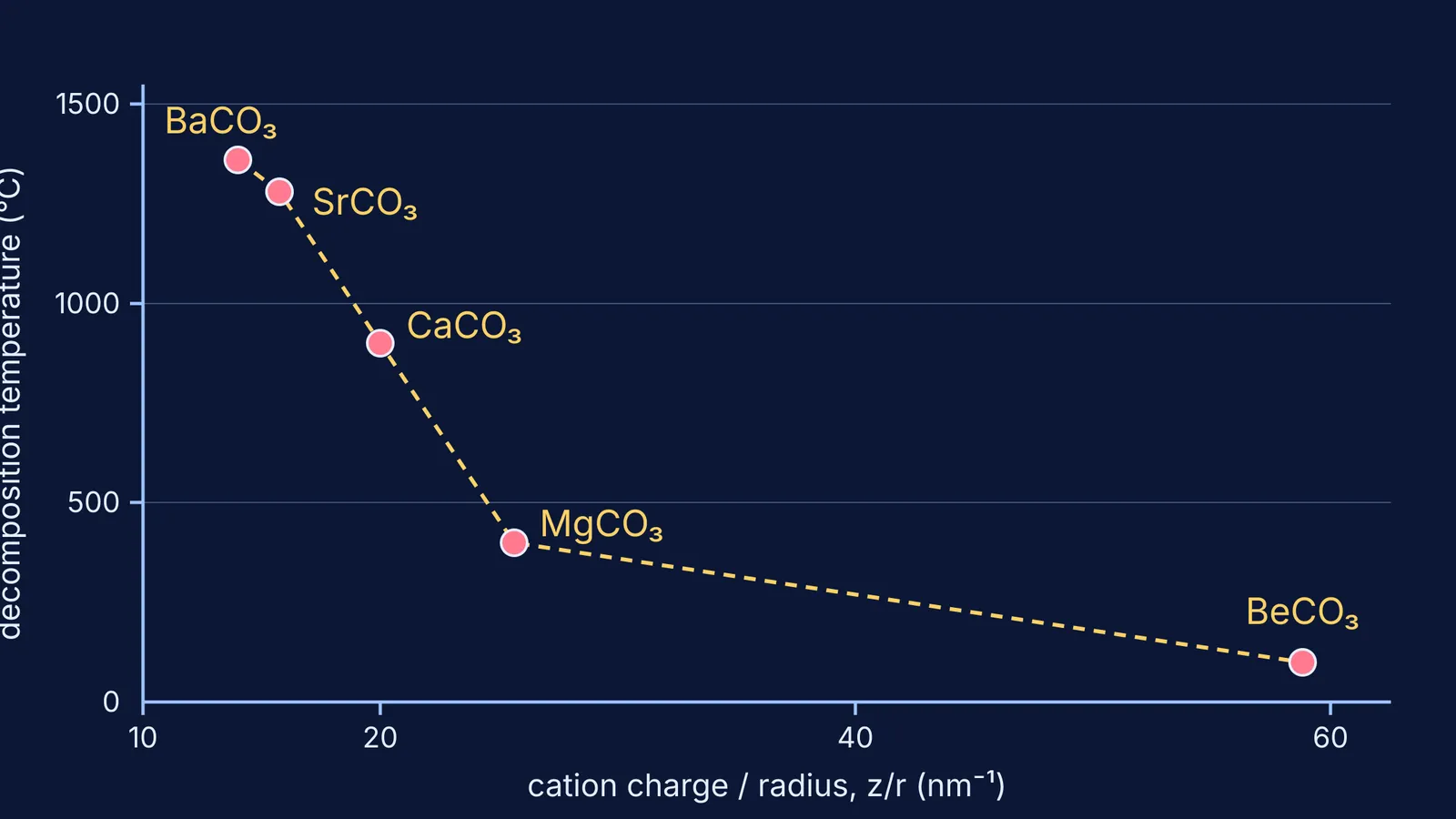
Doc Brown's s-block chemistry notes give decomposition temperatures of about 100 °C for BeCO3, 400 °C for MgCO3, 900 °C for CaCO3, 1280 °C for SrCO3 and 1360 °C for BaCO3.
The enthalpy change of decomposition climbs in step: +117 kJ/mol for MgCO3, +178 kJ/mol for CaCO3, +235 kJ/mol for SrCO3 and +267 kJ/mol for BaCO3, according to Chemguide.
Treat the temperatures as approximate: Doc Brown calls them "typical quoted" values.
Why does cation size decide the decomposition temperature?
Polarising power is a cation's ability to attract and distort the electron cloud of a nearby anion, and it grows as the charge rises or the radius shrinks (Doc Brown).
All five cations carry the same 2+ charge, so radius does the work. Doc Brown lists the radii as 0.034 nm for Be2+, 0.078 nm for Mg2+, 0.100 nm for Ca2+, 0.127 nm for Sr2+ and 0.143 nm for Ba2+, against 0.176 nm for the carbonate ion itself (source).
Using those radii, charge divided by radius (z/r) is about 59 nm⁻¹ for Be2+, 26 for Mg2+, 20 for Ca2+, 16 for Sr2+ and 14 for Ba2+. Be2+ scores more than four times Ba2+.
The carbonate ion's negative charge is spread over three oxygen atoms. A small 2+ ion has "a lot of charge packed into a small volume of space" and has "a marked distorting effect" on negative ions near it, in Chemguide's words. It pulls the carbonate ion's electrons towards itself, the ion is polarised, and less heat is needed to split off CO2 and leave the oxide. A large Ba2+ ion barely distorts the carbonate, so the ion holds together until the temperature is far higher.
This is the same polarisation idea behind Fajans' rules on covalent character. Beryllium sits at the extreme, which is part of why beryllium behaves differently from the rest of group 2.
Is there an energy explanation too?
Yes. The thermodynamic version compares lattice enthalpies: as the cation gets bigger, the oxide's lattice enthalpy falls faster than the carbonate's, because the oxide ion (0.140 nm) is much smaller than the carbonate ion (Chemistry LibreTexts, adapted from Chemguide).
For small Mg2+, forming the oxide gains a lot of lattice energy, so decomposition is easier. For Ba2+ the gain is smaller, the reaction is more endothermic, and it needs more heat. The same size-mismatch logic explains why group 2 sulphates get less soluble while hydroxides get more soluble.
How do you rank carbonates you have not memorised?
Question: arrange SrCO3, MgCO3, BaCO3 and CaCO3 by increasing decomposition temperature.
Check the charge. All four are 2+, so it cannot separate them.
Order the radii: Mg2+ < Ca2+ < Sr2+ < Ba2+, using the values above.
Smallest radius means highest polarising power, which means least stable. So the order is MgCO3 < CaCO3 < SrCO3 < BaCO3, and MgCO3 loses CO2 most easily.
Sanity-check with one pair of numbers: about 400 °C for MgCO3 against 1360 °C for BaCO3 (Doc Brown).
The same reasoning works in group 1. Doc Brown notes that lithium carbonate readily decomposes to Li2O and CO2, while the other group 1 carbonates are quite stable to red heat; Li+ is the smallest ion in its group, so it has the highest polarising power there.
How should you write it in an exam?
Give the trend, the equation and the reason. Adapt this:
Trend: thermal stability of group 2 carbonates increases down the group, BeCO3 < MgCO3 < CaCO3 < SrCO3 < BaCO3.
Equation: on heating, MCO3 → MO + CO2.
Reason: down the group the cation radius increases while the charge stays 2+, so polarising power falls. A smaller cation distorts the carbonate ion's electron cloud more and weakens it, so that carbonate decomposes at a lower temperature.
Extra point: down the group the oxide's lattice enthalpy falls faster than the carbonate's, so decomposition becomes more endothermic.
If this trend keeps getting tangled with the solubility trends, the Fermi Concept Library gives each chemistry concept its own lesson and its place in the map, so you can see where polarising power fits. For practice, the Fermi Problem Library has worked problems with a step-by-step solver that explains the reasoning rather than printing an answer.
Learn the order and the one-line reason, then check one pair of temperatures before you write.