On this page
Picture two white solids heated in two test tubes. Both break apart. One stays broken; the other puts itself back together as soon as it cools. That single difference is the whole answer to "thermal decomposition vs thermal dissociation", and once you see it you can classify any example you are given.
What is thermal decomposition?
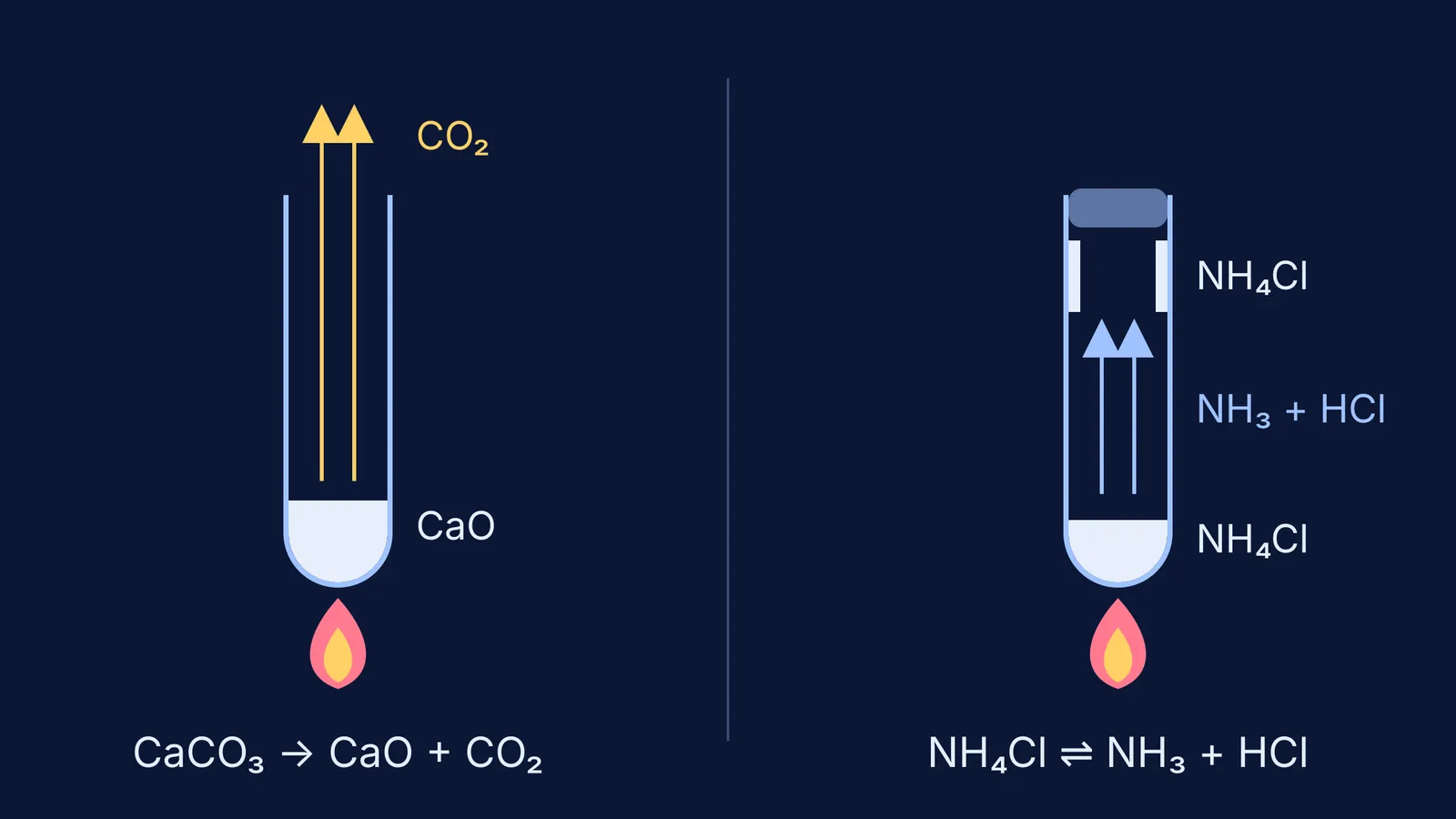
Thermal decomposition is the breaking of one compound into simpler substances by heat, with no recombination when the products cool. The textbook case is limestone: calcium oxide is made by heating calcium carbonate above 825 °C, by the reaction CaCO₃ → CaO + CO₂ (Wikipedia: Calcium oxide). The carbon dioxide leaves as a gas, and the white solid left behind is quicklime, a different substance from the chalky powder you started with.
Lead nitrate is the other favourite. On heating, 2Pb(NO₃)₂ → 2PbO + 4NO₂ + O₂ (Wikipedia: Lead(II) nitrate_nitrate)), and the reddish-brown gas you see is nitrogen dioxide (Wikipedia: Nitrogen dioxide). Cool the tube and you do not get lead nitrate back. For more salts and what each one gives off, see our guide to what happens when nitrates and carbonates are heated.
What is thermal dissociation?
Thermal dissociation is a reversible splitting by heat: the compound breaks into simpler molecules when hot, and they recombine into the original compound when they cool. Ammonium chloride is the standard example, NH₄Cl ⇌ NH₃ + HCl, and its data table lists it as decomposing at 337.6 °C at 1 atm (Wikipedia: Ammonium chloride).
In the school lab experiment, the white solid is heated in a test tube with a loose plug of cotton wool. The solid at the bottom disappears, and a white solid forms on the glass near the cotton wool, "where it is cool enough for the ammonia and hydrogen chloride to recombine" (Creative Chemistry). This is why ammonium chloride looks as if it sublimes, and why heating can separate it from common salt; our walkthrough of separating ammonium chloride and salt by sublimation shows the set-up.
Phosphorus pentachloride behaves the same way. It exists in equilibrium with PCl₃ and chlorine, and at 180 °C about 40% of it is dissociated (Wikipedia: Phosphorus pentachloride).
What is the difference between thermal decomposition and thermal dissociation?
Four points cover almost every version of this question:
Direction: decomposition goes one way; dissociation goes both ways.
On cooling: decomposition products stay apart; dissociation products recombine into the original compound.
What you recover: decomposition leaves a different substance in the tube (CaO, PbO); dissociation gives back the same compound you heated.
Equation: a single arrow (→) for decomposition; a double arrow (⇌) for dissociation.
Is heating limestone really one-way?
Here is a point most notes skip, and a sharp student may ask about it. Calcium carbonate's breakdown is not one-way in principle. Its standard Gibbs energy of reaction falls to zero at about 848 °C, the temperature at which the reaction is at equilibrium under standard conditions (Wikipedia: Calcination). Once cooled, quicklime left in air reacts with carbon dioxide and, given enough time, turns completely back into calcium carbonate unless it is slaked with water (Wikipedia: Calcium oxide).
So why do textbooks call it decomposition? Because in an open tube or a lime kiln the carbon dioxide escapes, and the products do not recombine on cooling the way ammonia and hydrogen chloride do inside the same tube. The school classification describes what you observe when you heat and then cool the substance, not whether a reverse reaction is impossible. If a teacher asks, say exactly that. What happens to quicklime next is in our post on how quicklime and water make slaked lime and whitewash.
How do you write this answer in an ICSE exam?
A short-answer plan that covers what the question is testing:
Define both terms in one sentence each, using the words "reversible" and "on cooling".
Give one balanced equation for each, with → for decomposition and ⇌ for dissociation.
State the observation that proves it: a residue and an escaping gas for CaCO₃; a white solid reappearing on the cool part of the tube for NH₄Cl.
A model answer you can adapt: "Thermal decomposition is the breaking of a compound into simpler substances by heat, which do not recombine on cooling, e.g. CaCO₃ → CaO + CO₂. Thermal dissociation is the reversible breaking of a compound by heat into simpler molecules, which recombine on cooling to form the original compound, e.g. NH₄Cl ⇌ NH₃ + HCl."
Two slips to avoid. Writing NH₄Cl → NH₃ + HCl with a single arrow contradicts your own definition. Calling ammonium chloride's change plain sublimation misses that the solid is actually splitting and reforming.
If reversible reactions and equilibrium still feel shaky, the Fermi Concept Library covers every concept in chemistry, each with its own lesson and its place in the map. When you want practice, the Fermi Problem Library has worked problems with a step-by-step solver that explains the reasoning rather than printing an answer.
Next time a question heats something, run the cooling test first, then choose your arrow.