On this page
The Voice of the Rain is a short poem by Walt Whitman, printed with Chapter 3 of the Class 11 English textbook Hornbill (NCERT Hornbill, Chapter 3). In a few lines it holds a conversation, a science lesson and an idea about art. Here is its meaning, its water cycle, its devices and how to answer within CBSE's word limits.
What is The Voice of the Rain about?
The poet speaks to a soft, falling shower and asks it a simple question: who are you? To his surprise ("strange to tell"), the rain replies, and the rest of the poem is its answer, which the poet says he has translated for us.
The rain calls itself the "Poem of Earth". In plain words, it says:
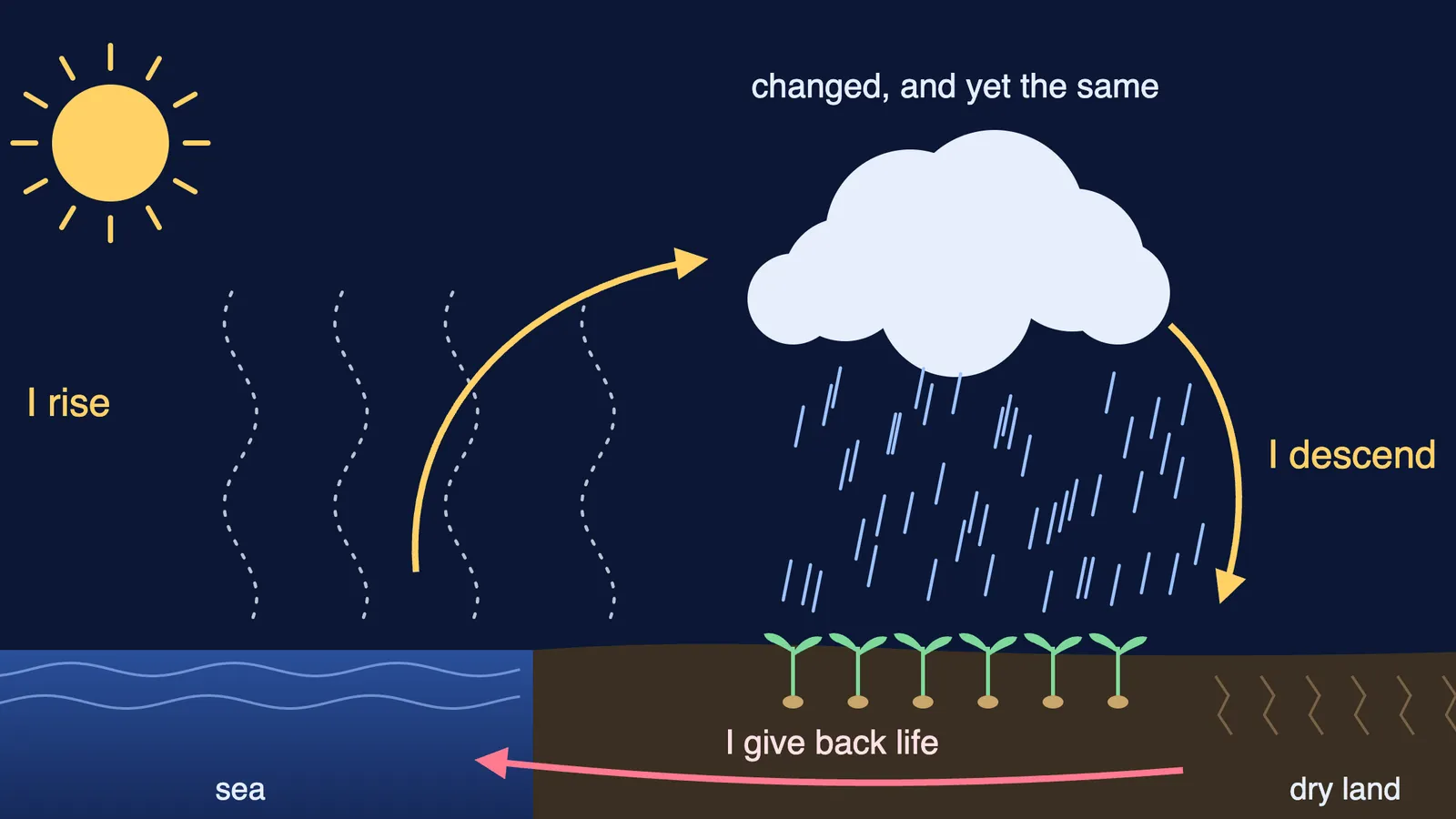
I rise forever from the land and the deep sea, so fine that no one can touch me ("impalpable").
I go up to the sky, where I take a vague new shape, "altogether changed, and yet the same".
I come down to wash ("lave") the droughts, the dry dust and tiny particles of the planet.
Without me, many things on Earth would stay "seeds only, latent, unborn": alive in possibility, but not yet growing.
Day and night I give life back to the place I came from, and I clean it and make it beautiful.
The last two lines sit in brackets. They compare the rain with a song: a song leaves the poet who made it, travels, is noticed or ignored, and finally returns "duly with love". Many readers take the brackets as a quiet aside from the poet.
How does the poem show the water cycle?
Whitman never uses scientific words, but the rain's journey follows the stages you study in science. NOAA describes the water cycle as the continuous movement of water within the Earth and atmosphere (NOAA, The water cycle). Its page explains that water evaporates when it absorbs energy, that vapour condenses into droplets to form clouds, and that water falls back as rain or other precipitation, then flows over land or soaks into the soil (NOAA).
Put the two side by side:
Evaporation: the rain rises, unseen, from land and sea.
Condensation: in the sky it takes a vague form, changed in shape but still water.
Precipitation: it falls on dry, dusty ground.
Runoff and soaking in: it waters seeds and returns to the land it rose from, ready to rise again.
Science makes the changed-yet-same line literal: vapour, cloud droplet and raindrop are all the same substance, water, first as a gas and then as a liquid. If you want the science half clear before you write about the poetry half, our study guide on water in the atmosphere for Class 11 covers humidity, clouds and rainfall, and the Fermi Concept Library has every concept in physics, chemistry, biology, mathematics and computing, each with its own lesson and its place in the map.
What are the poetic devices in The Voice of the Rain?
Personification: the rain speaks, answers questions and describes its own work.
Dialogue: the poet asks, the rain answers.
Metaphor: the rain calls itself a poem of the Earth.
Paradox: the rain is wholly changed yet unchanged, which sounds contradictory but is true.
Contrasts: rise and descend, day and night, heaven and earth, noticed and ignored.
Inversion: word order is flipped for emphasis, putting the adjective before "I rise".
Archaic words: thou, art, lave and reck'd give an old, solemn tone.
Free verse: no fixed rhyme or metre, which is typical of Whitman.
How to answer The Voice of the Rain in the CBSE exam
For 2026-27, the CBSE English Core (301) syllabus lists The Voice of the Rain under Hornbill (CBSE English Core curriculum 2026-27). It can appear in three question types:
One poetry extract (out of two) from Hornbill, worth 3 marks.
Short answers: two questions, one from prose and one from poetry, 40-50 words each, 3 marks each.
One long answer from Hornbill prose or poetry, 120-150 words, 6 marks.
A worked short answer (about 45 words), for a question on why the rain calls itself a poem: Like a poem, the rain is born from the Earth, travels far, changes form and comes back to give something. A song returns with love to where it was born; the rain returns to the soil as life. Both create, beautify and come home.
A 6-mark plan (120-150 words): open with the frame (the poet's question, the rain's reply); give one paragraph on the water cycle and one on the comparison with song; close on nature and art giving back to their source. Name two devices with a phrase each.
The same skill works for Hornbill prose; see our guide to The Portrait of a Lady Class 11 summary and themes, or this line-by-line explanation of The Ball Poem for another short poem read closely.