On this page
John Berryman’s The Ball Poem is the fifth of ten poems from First Flight on the CBSE Class 10 English Language and Literature curriculum for 2026-27. It runs to 18 lines with no stanza breaks in the NCERT First Flight text. A boy loses a ball, but the ball is not the point. The boy is meeting loss for the first time, and learning that he has to carry it himself.
Who wrote The Ball Poem?
John Berryman was an American poet, born John Smith in McAlester, Oklahoma, on 25 October 1914, according to his biography at the Academy of American Poets. His collection 77 Dream Songs, published in 1964, was awarded a Pulitzer Prize, and he died in 1972. The same biography says he never recovered from the childhood shock of losing his father.
What does The Ball Poem mean, line by line?
Line numbers and word meanings follow the NCERT text and glossary.
Lines 1 to 4: the ball is gone
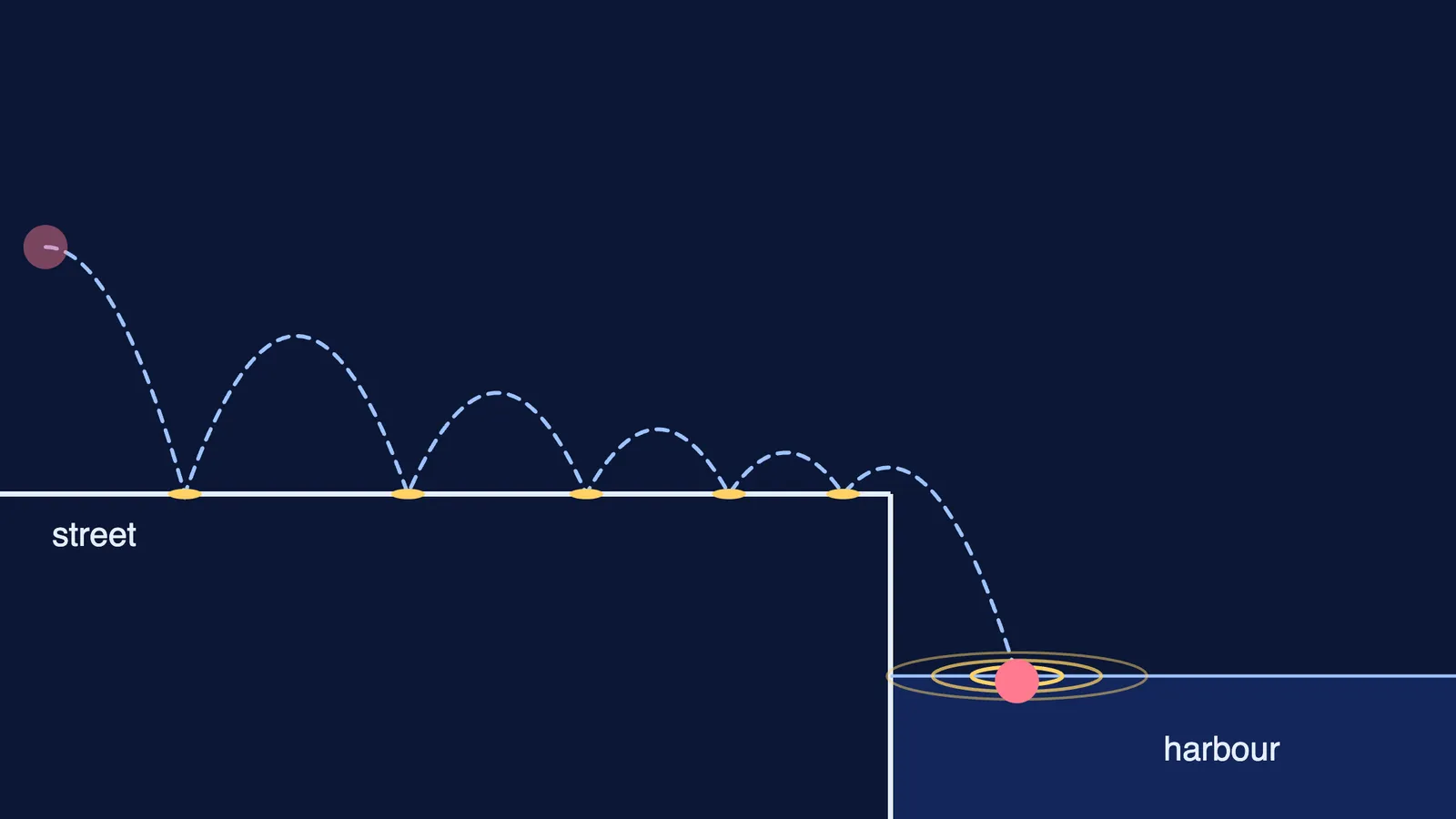
The speaker asks what the boy can do now. He saw the ball go “merrily bouncing” down the street, then “merrily over” into the water. Using “merrily” twice makes the loss sudden: fun one moment, gone the next.
Lines 5 to 10: grief, and an adult who stays back
Saying that there are other balls is no use. An “ultimate shaking grief” holds the boy still. He stands “rigid, trembling”, staring down at the harbour where his young days seem to have gone, as if his childhood went into the water with the ball. The speaker decides not to intrude on him. Even a dime (ten US cents, says the NCERT glossary) for another ball is “worthless”, because a replacement would skip the lesson.
Lines 11 to 13: first responsibility
Now the boy “senses first responsibility” in “a world of possessions”. What we own can be lost, and living with that is our own job. The line telling the little boy that balls will always be lost is the hardest line: loss is a lasting part of life, not bad luck.
Lines 14 to 18: how to stand up
“Money is external.” It can replace an object, not a feeling. Behind his “desperate” (hopeless) eyes the boy is learning “the epistemology of loss”. Epistemology is the study of knowledge, so the phrase means understanding what it is to lose something. The poem ends on the lesson every person must learn, many of us more than once: how to stand up.
What are the themes of The Ball Poem?
Loss: the first real loss of childhood, and the knowledge that it will not be the last.
Growing up: the boy moves from adults fixing things to coping himself.
Responsibility: owning things means you can lose them, and handling that is up to you.
The poem can bring up a loss of your own. If something is weighing on you, talk to someone you trust, or call Tele MANAS on 14416, the government’s free mental health helpline.
What questions come from The Ball Poem in the board exam?
Under the CBSE 2026-27 curriculum, Language through Literature carries 40 of the paper’s 80 marks. A poetry extract is worth 5 marks, short answers from First Flight are 40-50 words, and one long answer from First Flight is about 100-120 words for 6 marks. From this poem, expect:
an extract, for example lines 5 to 10 or 14 to 18, with questions on meaning, a word or a device;
a short answer, which may draw on the NCERT “Thinking about the Poem” questions;
a long answer beyond the text, such as writing as the boy.
Devices worth naming: repetition (“What, what”, “merrily”, “balls, balls”, “how to stand up”); the ball as a symbol of childhood; enjambment, where sentences run on past the end of a line; and the absence of a fixed rhyme scheme.
A worked 40-50 word answer
NCERT asks: why does the poet say he will not intrude on the boy, and why doesn’t he offer money for another ball?
Model answer: The poet wants the boy to face his loss himself. A new ball, bought for a dime, would replace the object but teach him nothing. By staying back, the poet lets the boy learn responsibility and how to stand up after losing something.
A plan for the 6-mark answer
Open with one sentence that answers the question directly.
Make two points, each tied to a short quotation, such as “Money is external” and “how to stand up”.
Link the idea to life: a lost phone, a friendship, a match.
End with what the boy learns, and stop near 120 words (the CBSE curriculum says about 100-120).
See also how to read and appreciate any poem, our A Letter to God summary and themes, and moving from MCQ prep to written board answers.
When you switch back to maths or science, Fermi’s AI tutor can work out what you already know and build a plan for the session, so you sit down to a clear next step. Tonight, read the poem aloud once and write the 40-word answer above from memory.