

On this page
A poem appreciation question asks you to show that you noticed how a poem works, not only what it says. In Classes 6 to 8 most answers look at four things: rhyme, rhythm, imagery and the poet's message. Below is a reading method for any poem, and a worked answer on a short public-domain poem.
What does a Class 7 poem appreciation need to include?
NCERT's Learning Outcomes at the Elementary Stage says a Class 7 learner “reads aloud stories and recites poems with appropriate pause, intonation and pronunciation”.
The same document says the Class 7 learner “thinks critically, compares and contrasts characters, events, ideas, themes and relates them to life”. For Class 6, its suggested classroom work includes reading “prose, poetry, play for understanding and appreciation”.
A good appreciation covers four elements:
Rhyme: which line endings sound alike, written as a rhyme scheme such as aabb or abab.
Rhythm: the beat you hear when you read aloud, where the strong syllables fall, and whether it feels fast, slow, calm or jerky.
Imagery: words that make you see, hear, touch, smell or taste something, including similes and personification.
Message: what the poet wants you to feel or think, in your own words.
How do you read a poem before writing about it?
Give the poem five quick passes before you write a word.
Read it aloud once for sense: who is speaking, where are they, and what is happening?
Mark the rhyme: put the same letter beside line endings that sound alike.
Tap the beat: read again and clap on the strong syllables. Notice if the beat repeats.
Underline pictures: any line you could draw, hear or feel. Circle words that surprise you.
Ask “so what?”: write the poet's message in one sentence, then find the line that proves it.
Worked example: how to appreciate “From a Railway Carriage”
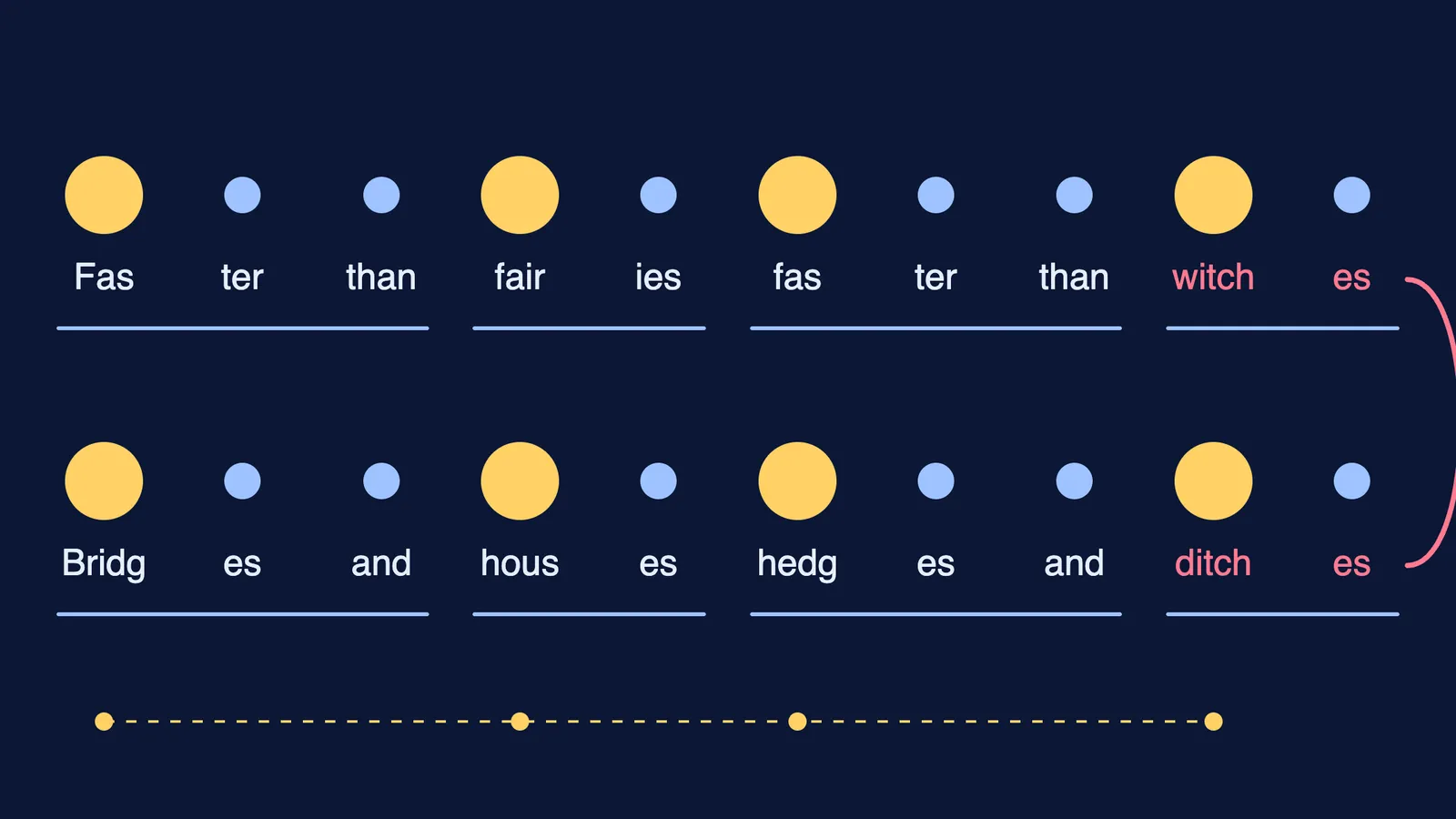
Robert Louis Stevenson's “From a Railway Carriage” appears in *A Child's Garden of Verses*, which you can read free on Project Gutenberg. It has two stanzas of eight lines each and describes the view from a speeding train. It opens: “Faster than fairies, faster than witches, / Bridges and houses, hedges and ditches”.
Here is a model answer, one short paragraph per element.
Rhyme. The poem is written in rhyming couplets (aabb): “witches” rhymes with “ditches” and “battle” with “cattle”. Each pair closes quickly and the next begins, just as one sight outside the window is replaced by the next.
Rhythm. Read aloud, the first line goes FAS-ter than FAIR-ies, FAS-ter than WITCH-es: a strong beat, then light ones, again and again. It sounds like train wheels clattering over the rails, so we feel the speed instead of being told about it.
Imagery. The poet uses a simile, the sights “Fly as thick as driving rain”, and personification: “Painted stations whistle by”. In the second stanza we catch glimpses of a child “who clambers and scrambles”, a tramp who “stands and gazes” and “a cart run away in the road”.
Message. The last line, “Each a glimpse and gone forever!”, holds the poem's idea. From a moving train, life is a stream of moments you cannot hold on to, so the poem invites us to enjoy each one as it flashes past.
What are common mistakes in poem appreciation?
Retelling the poem line by line instead of saying how it works.
Naming a device (“there is alliteration”) without quoting the words.
Stating the rhyme scheme without saying why it suits the poem.
Guessing at the poet's life to explain the message; stay with the words on the page.
Writing one long block; four short paragraphs are easier for you to plan and for a teacher to mark.
If you use an AI chatbot to check your answer, verify every device it names against the actual line, as explained in our guide to checking AI's figures of speech in NCERT poems.
How can parents help with poems at home?
Read the poem aloud together and take turns, one line each. Then ask two questions: “Which line could you draw?” and “How did it make you feel?” Those answers are the imagery and message paragraphs in rough form. For more ideas, see how to get children interested in poetry in any language and how to help a child memorise a poem for recitation, which builds the same ear for rhythm.
If a blank page is also the problem in maths or science, Fermi's AI tutor can work out what you already know and build a plan for the session, so you sit down to a clear next step.
Try the five passes on the next poem in your English textbook, and write the four paragraphs before you look at any guide.


