

On this page
Your child has a poem to recite in assembly next week. The usual plan, reading it over and over on the last night, is tiring and often falls apart in front of the class. Three small changes work better: smaller pieces, actions that carry the meaning, and short practice spread over several days.
Why does my child forget the poem halfway through?
The mind can only hold a little new material at once. Psychologist Nelson Cowan's review of short-term memory research concluded that adults hold about four chunks at a time (Cowan, 2001, Behavioral and Brain Sciences). A whole stanza read in one go is far more than that for a six-year-old, so the second half pushes out the first.
The fix is pieces small enough to hold, linked one after another, so the poem becomes a short chain of two-line chunks. A second reason: many children memorise sounds, not meaning. If your child doesn't know what 'dusk' means, the line has nothing to hang on.
How do I break a poem into chunks?
Read the whole poem aloud together once, ask 'What happens in this poem?' and explain any word your child can't picture.
Split the poem into pairs of lines, usually where a rhyme closes or a sentence ends.
Learn one pair until your child can say it without looking, then add the next pair and say both together.
Each time, start from the top. The opening gets the most practice, which helps a nervous child begin strongly.
Does acting out a poem help children remember it?
Studies of young children learning new words point that way. In a 2015 study, 111 preschool children from 15 childcare centres learned 14 Italian words over four weeks; those who acted out the words' meanings with whole-body movements had the highest learning outcomes, ahead of seated gesturing and plain repetition (Mavilidi and colleagues, Educational Psychology Review). A 2026 study of 89 children aged three to six found that a story told with gestures showing its meaning improved their word learning and story comprehension, compared with the same story without gestures (Lutz and Lenhart, Journal of Early Childhood Education Research).
So give each chunk one simple action that shows what it means, and let your child invent it. Choosing an action means they have thought about the words. Here is how it looks with a rhyme most families know:
'Twinkle, twinkle, little star' (open and close your fingers) / 'How I wonder what you are' (palms up, puzzled face).
'Up above the world so high' (stretch up on tiptoe) / 'Like a diamond in the sky' (make a diamond with thumbs and fingers).
On the day, the actions can shrink to small hand movements.
How many days before the recitation should we start?
Start about a week ahead if you can. A 2013 review of ten study techniques rated distributed practice, meaning practice spread out over time, as one of only two with high utility across ages and abilities (Dunlosky and colleagues, Psychological Science in the Public Interest). In a study of 36 children aged five to seven, those given science lessons spaced out in time applied the ideas better than those given the lessons back to back (Vlach and Sandhofer, Child Development). Our explainer on how spaced repetition scheduling works covers the same idea for older students.
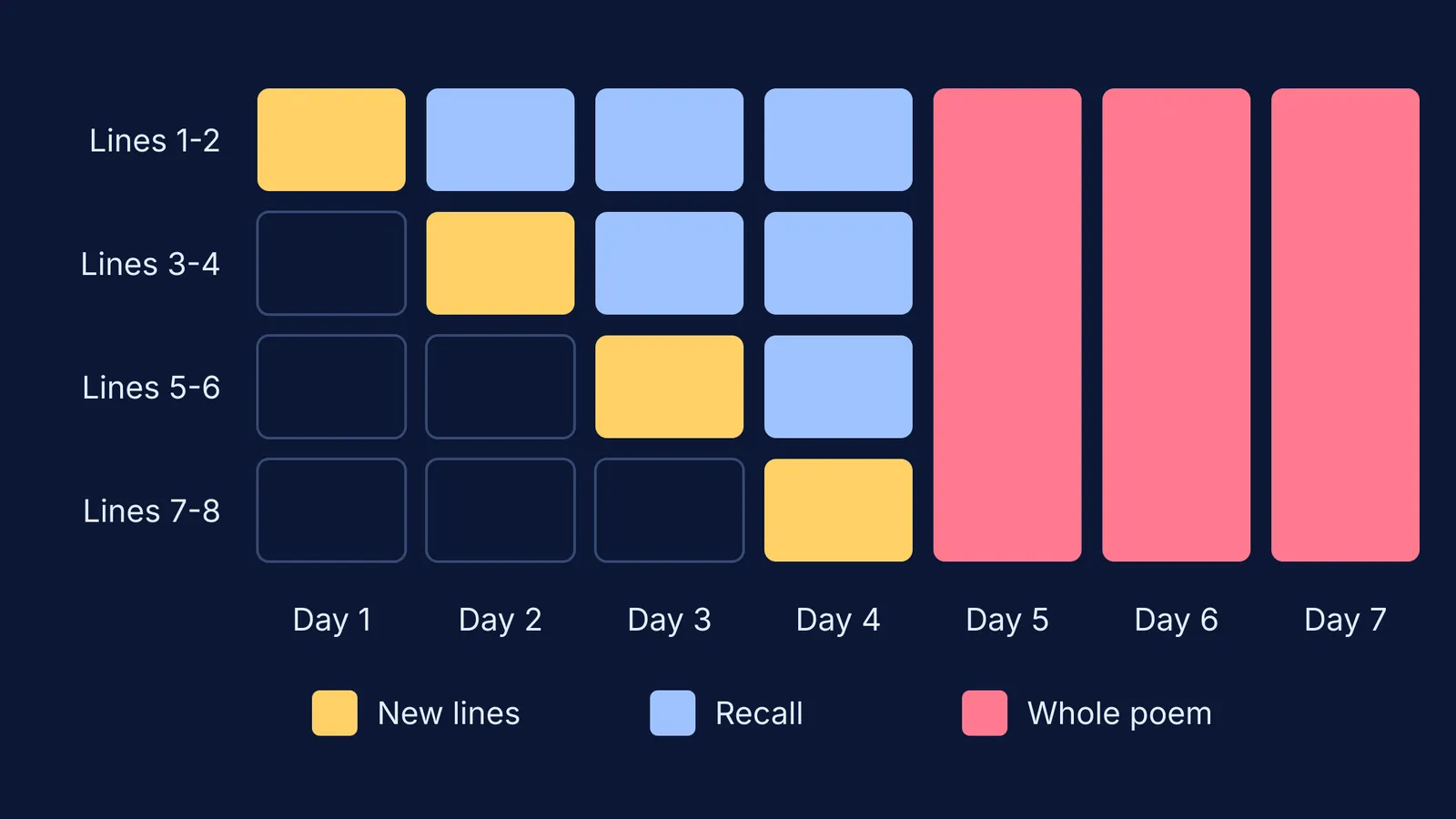
A one-week plan for an eight-line poem, 5 to 10 minutes a day:
Day 1: read and talk about the poem; learn lines 1 and 2 with actions.
Day 2: recall lines 1 and 2; learn lines 3 and 4.
Day 3: recall lines 1 to 4; learn lines 5 and 6.
Day 4: recall lines 1 to 6; learn lines 7 and 8.
Days 5 and 6: say the whole poem from memory once or twice.
Day 7: one calm run-through in the morning, then the recitation.
Always try from memory before looking: that is practice testing, the other high-utility technique in the same review.
How can I make recitation less stressful for my child?
Rehearse for a small, friendly audience: grandparents on a video call, a sibling, a row of soft toys.
Practise walking up, saying the title and poet's name, and pausing at the end.
Agree a plan for a blank: take a breath, do the action for the next line, start that line.
Praise the practice, not the talent, as our post on how to praise children's effort explains: 'You practised a little every day, and it showed.'
Keep it a shared game, the way shared reading with young children works best.
If stage fright is intense, lasts for weeks, or shows up as stomach aches or refusing school, talk to the class teacher and your child's doctor. The toll-free, round-the-clock Tele MANAS helpline, 14416, is there if you need to talk to someone.
When the material later becomes science, Fermi's AI tutor works in the same spirit, checking understanding as it goes. For this week, find the first two lines and choose an action together.


