On this page
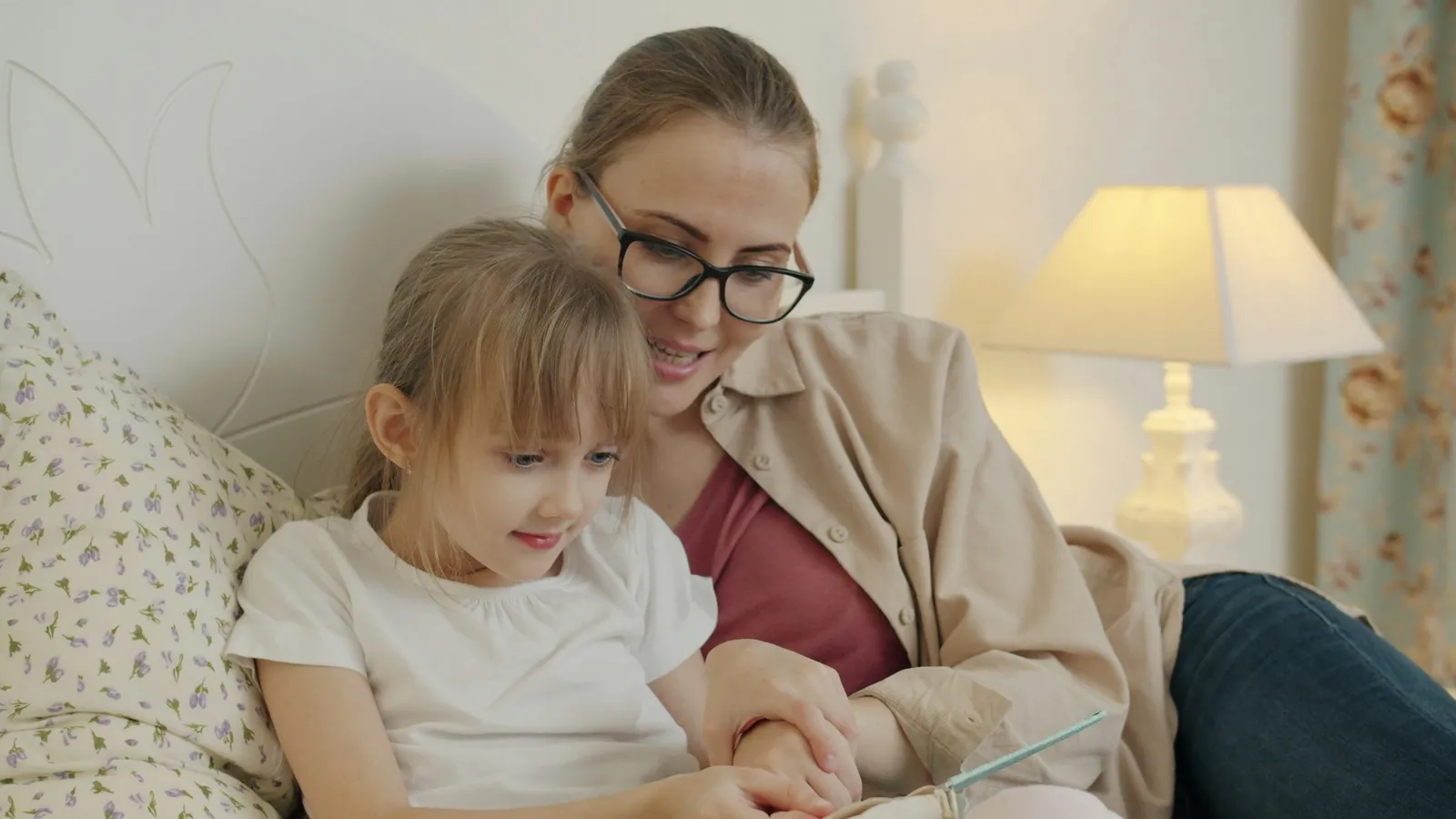
Reading aloud to young children is good. Reading with them, so that the child does more of the talking, may be better for their language. That is the idea behind dialogic reading, an approach that grew out of research by Grover (Russ) Whitehurst and colleagues in the 1980s. It needs no special books, only a change in who talks.
What is dialogic reading?
The What Works Clearinghouse, the US Department of Education's evidence review service, describes dialogic reading as an interactive shared picture book reading practice in which the adult and the child switch roles, so that the child learns to become the storyteller while the adult acts as an active listener and questioner. According to the report, the first published study of the approach, by Whitehurst and colleagues (1988), appeared in Developmental Psychology under the title "Accelerating language development through picture book reading".
What does the evidence show?
The 2007 What Works Clearinghouse report found that four studies of dialogic reading met its evidence standards and one met them with reservations. Together they included over 300 preschool children, most from economically disadvantaged families; to be eligible, studies had to be in English, in centre-based settings, with children aged 3 to 5. The report rated dialogic reading as having positive effects on oral language, with an average improvement index of +19 percentile points, and no discernible effects on phonological processing (awareness of the sounds within words). The report also describes a conflict-of-interest safeguard: Whitehurst was then director of the Institute of Education Sciences, and he and Christopher Lonigan, who had written several of the studies, were kept out of decisions about those studies.
Reading more in general also matters over the long run. A meta-analysis of 99 studies by Mol and Bus (2011) found that print exposure in preschool and kindergarten explained 12% of the variance in children's oral language skills, and the authors suggest shared book reading may be the start of a continuum of reading experiences that support language and reading throughout development.
So dialogic reading has good evidence for oral language. For learning letter sounds, children need other activities too.
How to do it: the PEER sequence
The method uses a four-step sequence, described by the University of Nevada, Reno Extension and the CONNECT early-childhood modules, which credit Whitehurst with developing it:
Prompt the child to say something about the book.
Evaluate the response: confirm it, or gently correct it.
Expand it by rephrasing and adding a word or a detail.
Repeat the prompt so the child can try again with the richer version.
With a picture of a fire engine, that might sound like this:
Prompt: "What's that?"
Child: "Truck!"
Evaluate and expand: "Yes, it's a big red fire truck."
Repeat: "What kind of truck is it?"
The five kinds of prompt: CROWD
Completion: leave a blank at the end of a familiar sentence. "And he was still..."
Recall: ask about what happened earlier. "Can you remember the first food the caterpillar ate?" (for The Very Hungry Caterpillar)
Open-ended: "Tell me about what you see in this picture."
Wh- questions: what, where, when, why, who. "Why do you think she is crying?"
Distancing: link the book to the child's own life. "Have you ever been to a market like this one?"
The CONNECT handout notes that as a child becomes more familiar with a book, the adult moves to higher-level prompts, beyond naming objects to what is happening and how it relates to the child's own experiences. So start a new book with completion and simple wh- prompts, and save open-ended and distancing prompts for later readings.
A 15-minute routine
Choose a picture book with clear, busy illustrations. Rereading the same book over several days is fine and makes the higher-level prompts possible.
First reading: read it mostly as written, with a few completion prompts.
Next readings: add PEER sequences with recall and wh- prompts, roughly one every page or two.
Later readings: let your child "read" pages to you from the pictures, and ask distancing prompts.
Stop while it's still fun. Ten good minutes beat thirty reluctant ones.
The reviewed studies were in English, but the technique is simply conversation. Reading in the language you speak most comfortably lets you expand your child's answers naturally.
Common mistakes
Turning every page into a quiz. Keep it conversational, and skip prompts on some pages.
Correcting sharply. Evaluate warmly: "It does look like a dog, doesn't it? It's a wolf."
Asking only yes-or-no questions. These give your child little to say.
Changing books too fast. Familiar books are where children start to take over the telling.
For more, see our posts on reading for pleasure, maths talk with young children and encouraging curiosity at home.
Questions that start with a picture book often become science questions later. When your child is older, the Fermi Simulation Lab has interactive simulations for the ideas that are easier to see than to read.