On this page
You paste a stanza into a chatbot, ask for the figures of speech, and get a neat list back. The labels sound confident. Some of them may be wrong, and in a board exam a wrong label can cost you marks.
Why does AI get figures of speech wrong?
A chatbot generates likely-sounding text, and unless you ask, it does not show you that it checked a label against a definition. Elisa Sanchez-Bayona and Rodrigo Agerri tested large language models on metaphor tasks across several datasets and found that their performance depended more on surface features such as word overlap and sentence length than on the metaphor itself (Findings of ACL 2025). Their study tested understanding metaphors, not labelling school poems. But the lesson carries over: a model can spot the word "as", say "simile", and never ask what is being compared.
This matters for marks. In CBSE's 2026-27 English Core sample paper marking scheme, two of the six answers on the "A Thing of Beauty" extract (Question 7, option A) are explained through the metaphor in the lines, and the Literature section carries 40 marks.
What are a simile, a metaphor and personification?
A simile is "an expression comparing one thing with another, always including the words 'as' or 'like'" (Cambridge Dictionary: simile).
A metaphor is an expression "that describes a person or object by referring to something that is considered to have similar characteristics to that person or object" (Cambridge Dictionary: metaphor).
Personification is "the act of giving a human quality or characteristic to something which is not human" (Cambridge Dictionary: personification).
What is the three-question test?
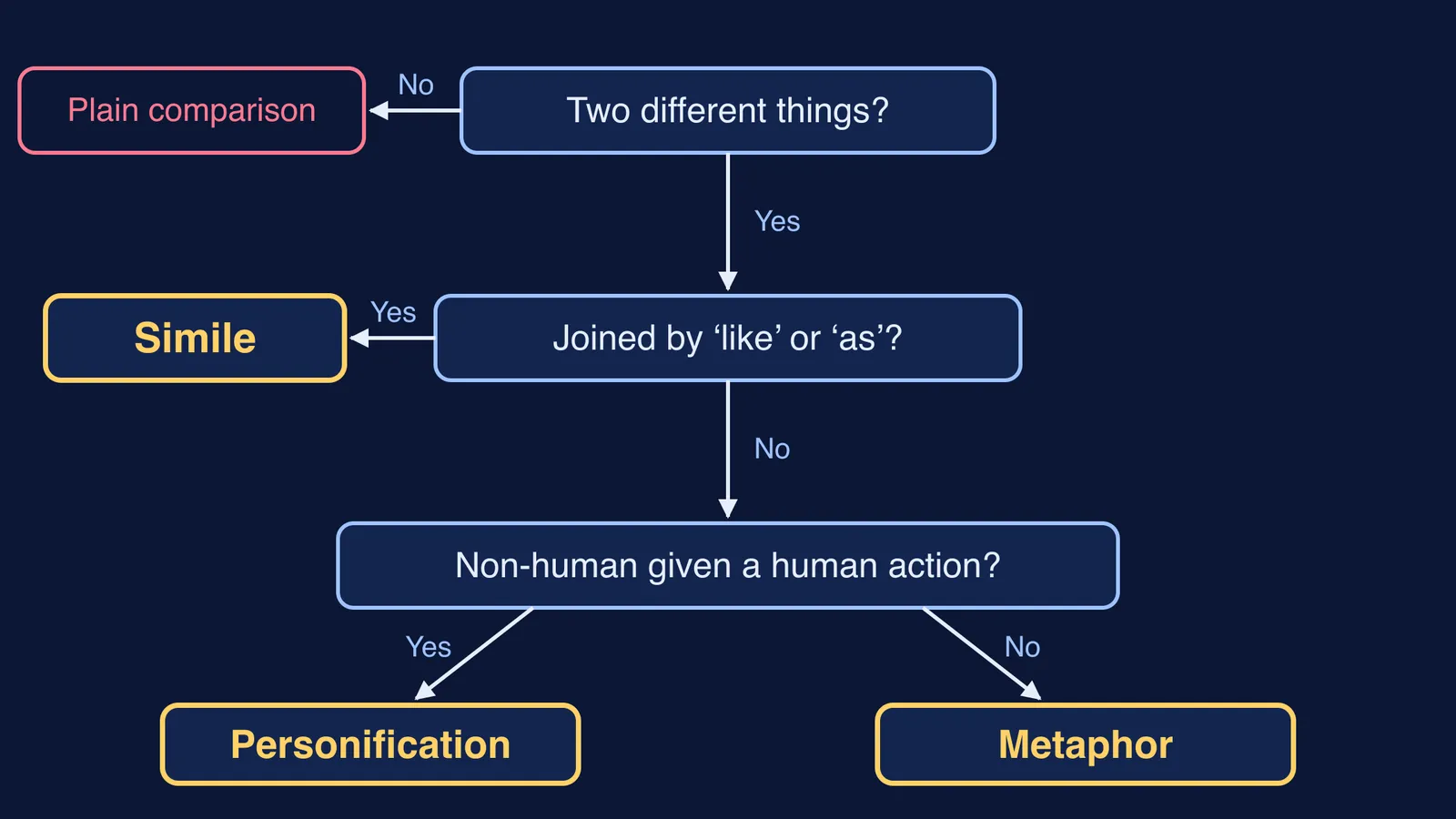
For every figure of speech the AI names, ask these in order:
What are the two things? Name the thing being described and the thing it is compared to. If you can only find one thing, or the same thing on both sides, it is a literal statement or plain comparison, not a simile or a metaphor.
Does "like" or "as" join them? If yes, it is a simile. If the poet simply speaks of one thing as if it were the other, it is a metaphor.
Is a non-human thing doing something only people do? If a tree, the wind or a season is given a human action or feeling, it is personification. If the subject is already a person, it cannot be.
Worked example: "My Mother at Sixty-six"
Kamala Das's poem is the first poem in Flamingo, one of NCERT's two Class 12 English Core textbooks. Here are five phrases from it, run through the test.
"her face ashen like that of a corpse": two things (the mother's face, a corpse's face), joined by "like". Simile.
"pale as a late winter's moon": two things (the mother, the moon), joined by "as". Simile. The textbook itself asks why the mother "has been compared to" the moon.
"she was as old as she looked": it has "as ... as", but it compares her age with her own appearance. There is only one person, so question 1 fails. Not a simile. This is the line a keyword-matching answer is most likely to get wrong.
"Young Trees sprinting": trees are given a human action, running a race (the textbook glosses "sprinting" as "short fast race, running"). No "like" or "as". Personification.
"the merry children spilling out of their homes": children are described as if they were a liquid pouring out. No "like" or "as", so it is a metaphor. It is not personification, because children are already human; question 3 fails.
How do you make a chatbot show its reasoning?
Don't just copy the list. Ask the chatbot to show its working, then check it. You can paste this:
"For each figure of speech in these lines, quote the exact words, name the two things being compared, say whether 'like' or 'as' joins them, and say whether a non-human thing is given a human action. If you are unsure, say so."
Then run the three questions on its reply. A simile or metaphor label with no named pair of things is a guess. It also helps to prompt the AI to say when it is unsure, and to write your final answer in your own words; here is why AI-worded answers can hurt you in board exams. Naming the device is only the start of a full answer, so read how to write English literature answers in board exams to explain its effect too.
Parents, you don't need to know poetry to help. Pick one line your child has labelled and ask the three questions out loud. If they can name the two things, that is a good sign they understand the device.
For STEM subjects, Fermi's AI tutor works on the same idea of making reasoning visible: rather than only answering questions, it decides whether to explain, ask or show, and checks understanding as it goes.
Next time a chatbot gives you a list of devices, pick one line and run the three questions before you write anything down.