

On this page
Writing a good English literature answer is not about recalling everything you know about a story. In board exams, evaluators look for specific points, structured clearly, within a strict time limit. Whether you are preparing for the CBSE or ICSE exam, understanding the evaluation criteria changes how you should read the question.
Here is how to structure your answers to hit the points examiners are looking for.
How do examiners score English literature answers?
Both the CBSE and CISCE (ICSE/ISC) boards publish documents that show exactly where marks are awarded and lost.
For the CBSE board, the focus is squarely on "value points" — the two or three specific facts or arguments the question asks for. Your expression marks depend on how logically you organise these points, while accuracy marks are reserved for answers free of major spelling or grammar mistakes. The evaluator is not looking for flowery language, but rather a direct response that clearly demonstrates you understand the text.
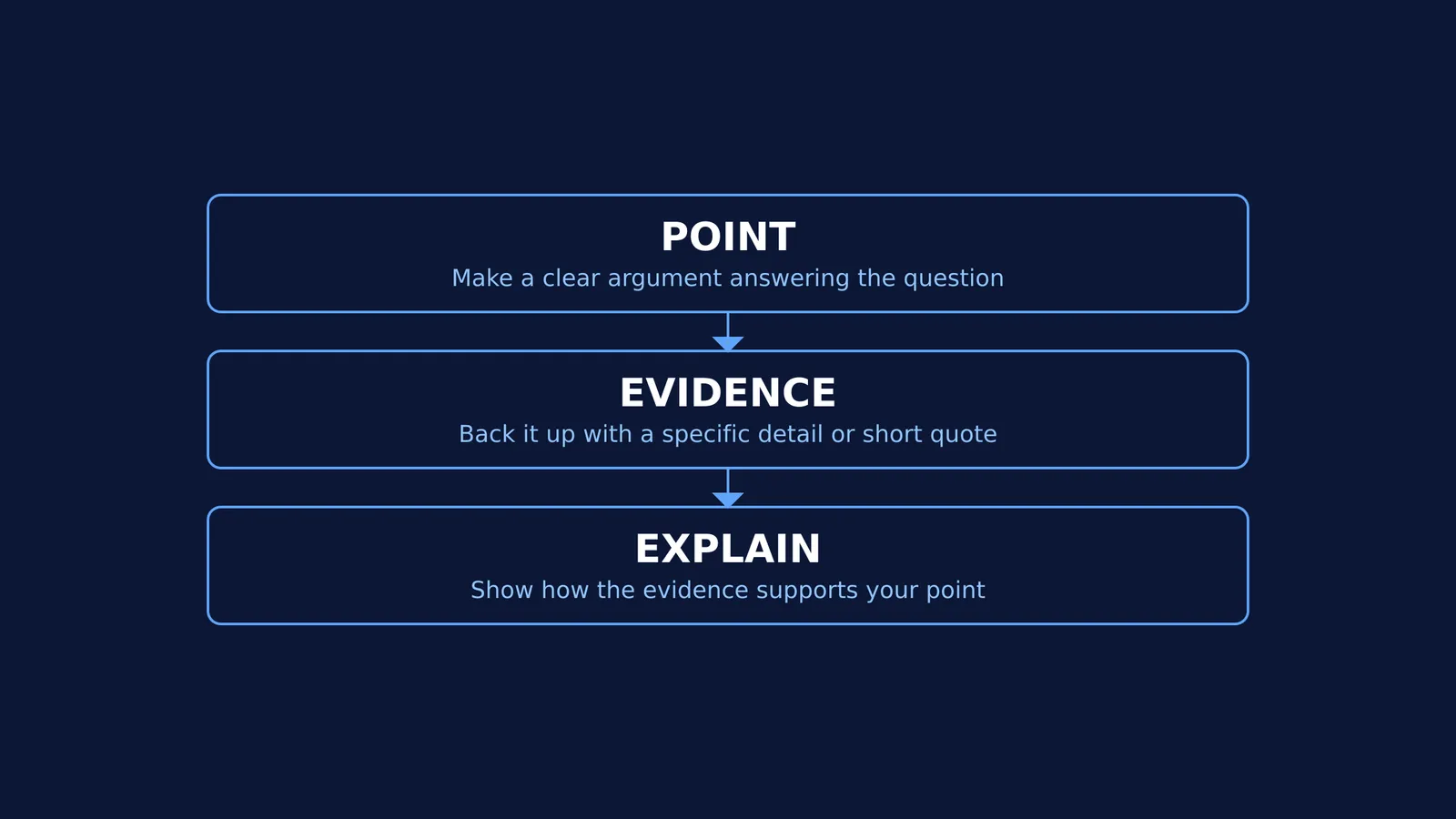
ICSE evaluation places a heavier emphasis on analytical depth and personal engagement with the text. A proven way to deliver this is the "PEE" structure:
Point: Make a clear argument or statement.
Evidence: Back it up with a specific detail or quote from the text.
Explain: Explain how the evidence answers the question.
If you are unsure whether your points are hitting the mark, Fermi's AI tutor can work through a scanned assignment with you, checking your reasoning and pointing out where a theme connection is missing.
How long should your answers be?
Stick strictly to the word limit given in the question. Writing more does not earn extra marks and costs you time that you need for the longer sections.
For CBSE short answer questions, the limit is usually 40 to 50 words. This means two or three sentences. Do not write an introduction. Start directly with the answer. For example, if asked why a character was sad, state the reason immediately and give one supporting detail.
For long answer questions (120 to 150 words), use a structured paragraph. Start with a one-sentence introduction that names the author and text. Follow with a body that contains your three or four value points, and finish with a one-sentence conclusion. If you are comparing two different texts—a common requirement in recent board exams—make sure you allocate your words evenly between both works. Spending 100 words on one poem and 20 words on the other will limit your content score, even if the analysis is excellent.
Do you need to quote the text?
Quotations are handled differently depending on your board, but the rule for using them is the same: keep them brief.
In the ICSE board, quoting the text is highly recommended and often necessary for full marks. In CBSE, it is optional but strengthens a long answer. Evaluators appreciate candidates who can support their arguments with direct textual evidence.
Never quote an entire stanza or a long paragraph. Examiners look for precision. Embed two or three important words into your own sentence. Instead of quoting a whole line of dialogue to show a character is angry, you might write: The character's decision to "storm out" shows his immediate frustration. This proves you know the text well enough to pick the exact words that matter without wasting your word count on simply copying the question paper.
For poetry, remembering specific phrases is crucial. Because poems rely heavily on imagery and specific word choices, an answer that paraphrases a poem will always score lower than one that references the poet's exact phrasing. As you prepare, you might find it helpful to look at how to analyse a mock test to see which quotes you consistently forget under timed conditions.
How do you link characters to the main theme?
Long answer questions often ask you to comment on a character's actions or motives. The mistake most students make is describing *what* the character did without explaining *why* it matters to the whole story. A plot summary is not an analysis.
When a question asks about a character, connect their action to the central theme of the text. If the story is about the loss of innocence, explain how the character's specific choice demonstrates that loss. If the theme is the conflict between tradition and modernity, show which side of the conflict the character represents.
A strong framework for this is the self-explanation effect. When studying, ask yourself why the author made a character act a certain way, rather than just memorising the plot. Use standard literary terms like "irony," "symbolism," or "foreshadowing" in your explanation. Naming the literary device shows the examiner you understand how the writer built the story, moving your answer from a simple summary to a critical response.
By keeping your answers direct, using brief embedded quotes, and tying character actions to larger themes, you give the examiner exactly what the marking scheme demands. Practising this structure before the exam ensures you will not waste time figuring out how to start writing when the clock is ticking.


