On this page
The tangent at a given point is usually a short question in a circles chapter, as long as you know which of two equations to write and can check the answer in seconds. Here are both forms, where they come from, and one example worked two ways.
What is the equation of the tangent to a circle at (x₁, y₁)?
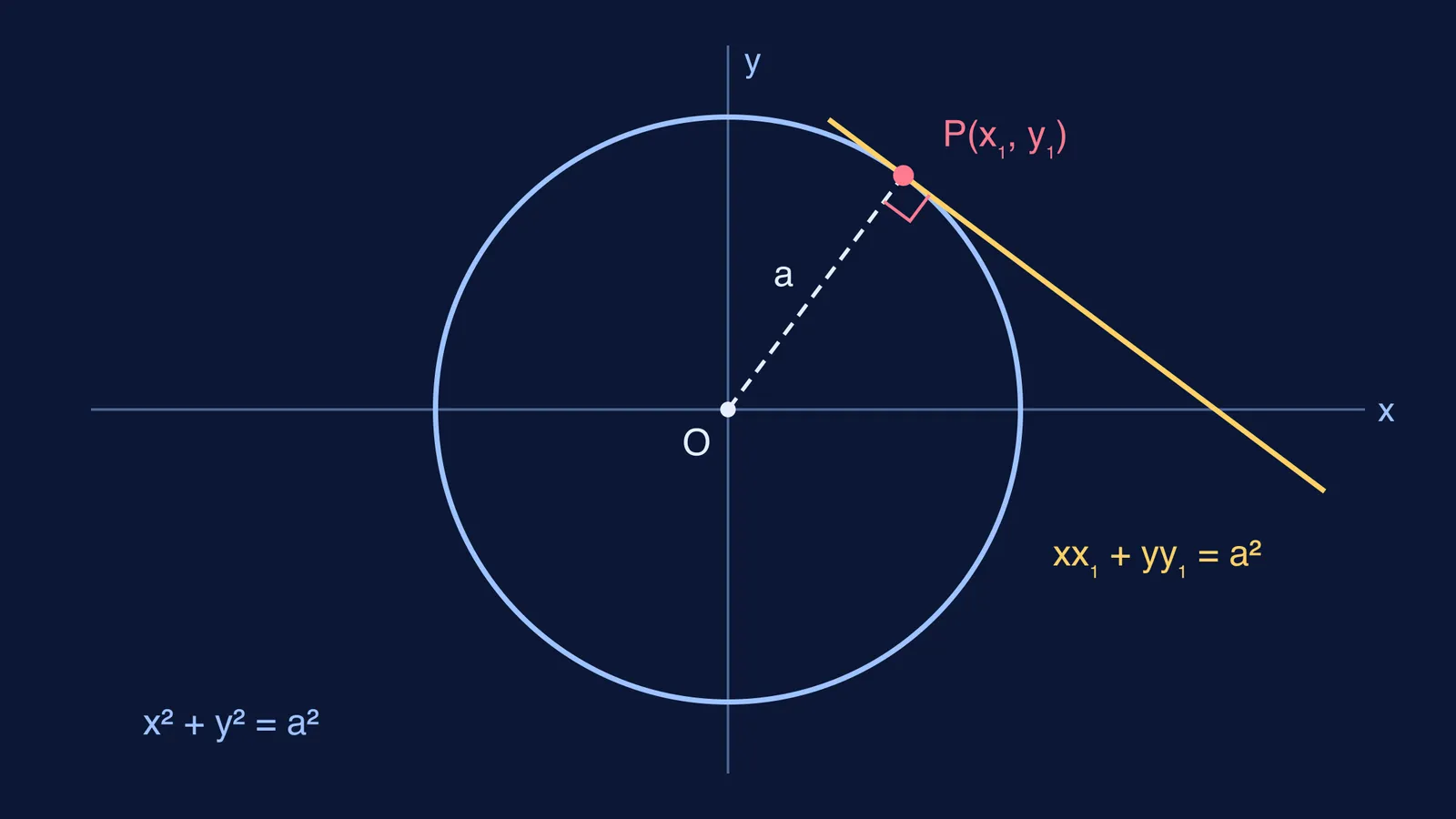
For the circle x² + y² = a² and a point P(x₁, y₁) on it, the tangent at P is xx₁ + yy₁ = a². Wikipedia's article on tangent lines to circles gives the same line and the reason: the vector OP from the centre is normal to the tangent.
Every tangent to a circle is perpendicular to the radius at the point of contact, as the same article on tangent lines states. That one fact is the whole derivation:
The slope of the radius OP is y₁/x₁.
The tangent is perpendicular to it, so its slope is −x₁/y₁.
Point-slope form gives y − y₁ = −(x₁/y₁)(x − x₁).
Multiply by y₁ and rearrange: xx₁ + yy₁ = x₁² + y₁².
P lies on the circle, so x₁² + y₁² = a².
The final form also covers the case the slope method cannot: at (a, 0) it gives x = a, a vertical tangent.
What is the tangent to the general circle x² + y² + 2gx + 2fy + c = 0?
For the general circle S = 0, the tangent at a point (x₁, y₁) on it is T = 0, where T = xx₁ + yy₁ + g(x + x₁) + f(y + y₁) + c.
You build T from S by four swaps, and c stays as it is:
x² becomes xx₁
y² becomes yy₁
2gx becomes g(x + x₁)
2fy becomes f(y + y₁)
Why does it work? The centre is (−g, −f), so the radius direction at P is (x₁ + g, y₁ + f), and the tangent is the line through P perpendicular to it: (x₁ + g)(x − x₁) + (y₁ + f)(y − y₁) = 0. Expand, then use x₁² + y₁² + 2gx₁ + 2fy₁ + c = 0 (P is on the circle) to replace x₁² + y₁². What is left is exactly T = 0.
In projective geometry, T = 0 is the polar of (x₁, y₁); the pole and polar article notes that when the point lies on the conic, its polar is the tangent there. If the derivation still feels shaky, the Fermi Concept Library gives every mathematics concept its own lesson and its place in the map.
Worked example: one tangent, two ways
Find the tangent to x² + y² − 4x + 6y − 12 = 0 at (5, 1).
Step 1: check the point. S₁ = 25 + 1 − 20 + 6 − 12 = 0, so it is on the circle.
Step 2: read off g, f, c. g = −2, f = 3, c = −12. Centre (2, −3), radius √(4 + 9 + 12) = 5.
Step 3: write T = 0. 5x + y − 2(x + 5) + 3(y + 1) − 12 = 0, which simplifies to 3x + 4y − 19 = 0.
Second way: move the origin to the centre. Put X = x − 2 and Y = y + 3. The circle becomes X² + Y² = 25 and the point becomes (3, 4), so the tangent is 3X + 4Y = 25. Substituting back gives 3x + 4y − 19 = 0 again.
How do you check a tangent answer quickly?
The point satisfies the line. 3(5) + 4(1) − 19 = 0.
The line's normal points at the centre. The normal (3, 4) matches the radius vector from (2, −3) to (5, 1). This is why the normal to a circle passes through its centre.
Distance from the centre equals the radius. |6 − 12 − 19| / 5 = 5. That is the condition for a line to be tangent to a circle, used as a check.
What mistakes cost marks here?
Forgetting the halves. 2gx becomes g(x + x₁), not 2g(x + x₁).
Dropping c. It is copied across unchanged.
Using T = 0 for an outside point. From outside, T = 0 gives the chord of contact, not a tangent.
A coefficient of x² that is not 1. Divide through by it before reading g, f and c.
Practise the swap on five circles with different signs, checking each with the three tests above. When a tangent question goes wrong and you cannot see why, the Fermi Problem Library has worked problems with a step-by-step solver that explains the reasoning, so you can find the step where your method went off.