

On this page
Finding the normal line to a curve typically requires calculus: differentiating to find dy/dx, evaluating the tangent gradient at the point of contact, taking its negative reciprocal, and applying the point-slope formula. For a circle, however, calculus is unnecessary. The normal at any point on the circumference always passes directly through its centre.
Understanding this geometric principle turns circle normal questions into rapid two-point solutions.
Why does the normal to a circle always pass through the centre?
In coordinate geometry, the normal to a curve at point P is defined as the line perpendicular to the tangent at P.
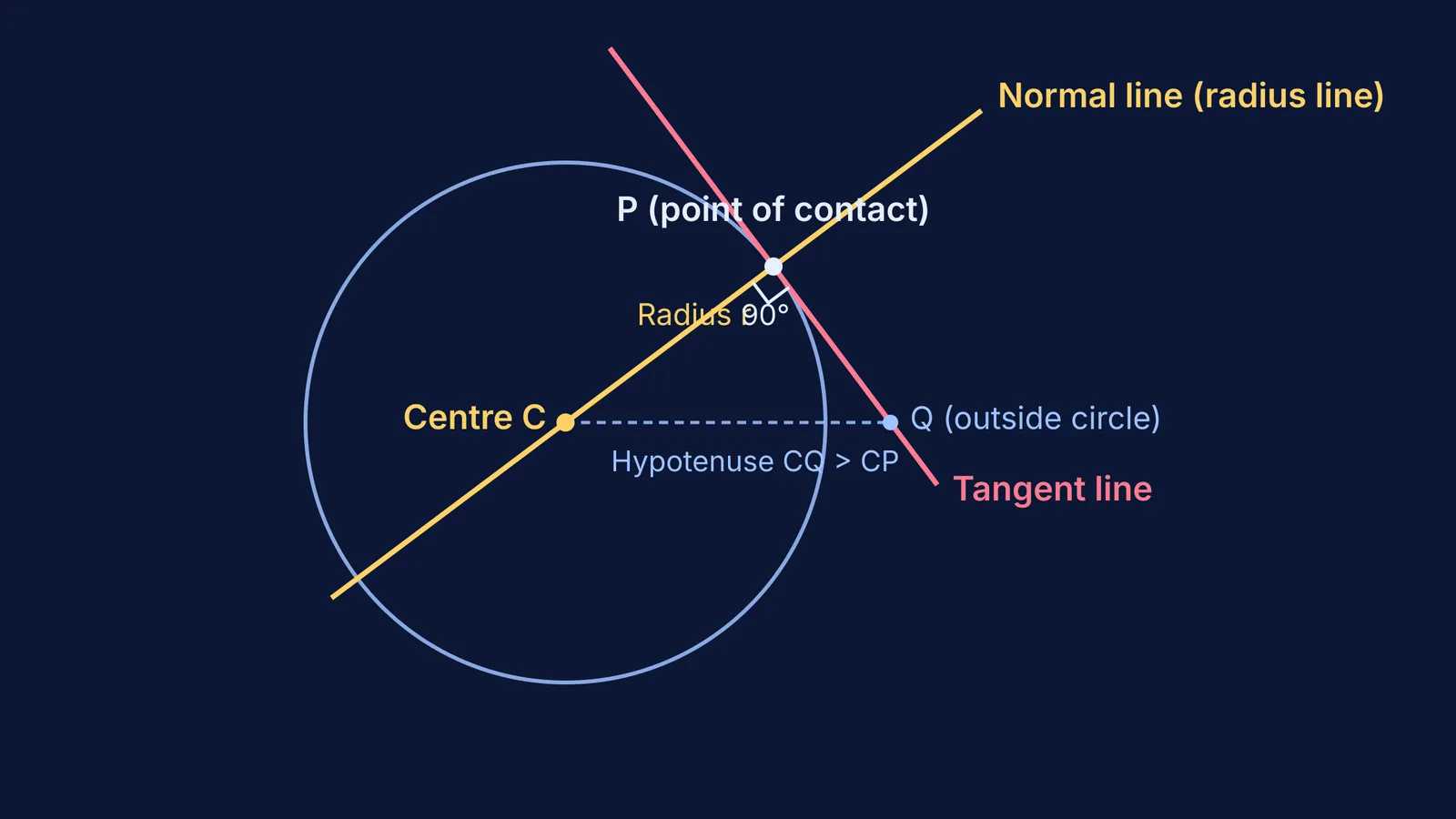
A tangent touches a circle at exactly one point P; every other point on the tangent line lies outside the circle. If you join the centre C to any other point Q along the tangent line, the distance CQ is strictly greater than the radius CP. Thus, CP is the unique shortest segment from C to the tangent line. In Euclidean geometry, the shortest distance from a point to a line is along the perpendicular. The official NCERT textbook portal records Theorem 10.1 in Class 10 Mathematics, establishing that the tangent at any point of a circle is perpendicular to the radius through the point of contact.
Because both the normal and the radius segment CP are perpendicular to the tangent at P, they form the exact same line. The normal at any point is simply the extended radius line, so it must pass through the centre C. For earlier chord and tangent theorems, our guide to circle tangents in Class 10 reviews these foundations in detail.
How does Euclid prove this property without calculus?
Long before calculus, Greek mathematician Euclid proved this property using deductive logic in his *Elements*.
In Book III Proposition 18, Euclid proves by contradiction that the radius drawn to the contact point is perpendicular to the tangent. If it were not, another segment from the centre to the tangent would form a right angle, making the radius the hypotenuse of a right triangle. That would contradict the fact that every other point on the tangent lies farther from the centre than the radius.
Building on this, Euclid establishes in Book III Proposition 19 that if a line is drawn perpendicular to a tangent at the contact point, the centre must lie on that line. If the centre lay elsewhere, drawing a radius would create two unequal right angles sharing a ray, violating the axiom that the part cannot equal the whole.
How do you find the normal using only the centre and point?
This geometric rule provides a direct shortcut when solving problems on circles in coordinate geometry. Instead of implicit differentiation, you find the normal using only the centre and the contact point.
For a circle in general form x² + y² + 2gx + 2fy + c = 0, the centre is C(−g, −f). The normal at P(x₁, y₁) is simply the line connecting C and P:
Identify circle and point: For x² + y² − 4x − 6y − 12 = 0, find the normal at P(5, 7).
Find the centre: Comparing coefficients gives 2g = −4 (g = −2) and 2f = −6 (f = −3), giving centre C(2, 3).
Compute the slope: The slope m of CP joining C(2, 3) and P(5, 7) is (7 − 3) / (5 − 2) = 4/3.
Write the line equation: Using point-slope form with C(2, 3), y − 3 = (4/3)(x − 2), which simplifies to 4x − 3y + 1 = 0.
Calculus requires evaluating dy/dx = (2 − x)/(y − 3) at (5, 7) to get −3/4, inverting to 4/3, and writing the line. The geometric method eliminates intermediate steps where sign slips occur. The Fermi Problem Library provides worked problems with a step-by-step solver that explains the reasoning rather than printing an answer, helping you master these shortcuts.
What happens in vertical and horizontal edge cases?
The two-point method also avoids the zero-division traps common in tangents and normals using derivatives.
For the circle (x − 2)² + (y − 3)² = 25, the point P(2, 8) sits at the top of the circumference:
Differentiating yields dy/dx = 0 at P. The normal slope is −1/0, which is undefined and leads to errors under exam timing.
Geometrically, the centre is (2, 3) and P is (2, 8). Both share x = 2, so the normal is immediately the vertical line x = 2.
Similarly, for a horizontal normal through (7, 3) and (2, 3), both points share y = 3, giving y = 3 directly.
Unlike ellipses or hyperbolas, whose normals do not converge to a single point, a circle's symmetry ensures all normals meet at its centre. The Fermi Concept Library covers every concept in physics, chemistry, biology, mathematics and computing, each with its own lesson and its place in the map. When practicing mixed coordinate geometry problems, Fermi's AI tutor works out what you already know, builds a plan for the session, and teaches through it so you can solve problems with speed and confidence.


