On this page
Faced with (cos x + sin x)/(cos x − sin x), many students start expanding. Divide the top and bottom by cos x instead, and the fraction folds into a single tangent. Here is why, with four common uses.
Where does the tan(π/4 + A) formula come from?
Start from the sum identity in the NCERT Class 11 Mathematics chapter on trigonometric functions: tan(x + y) = (tan x + tan y)/(1 − tan x tan y), valid when none of x, y and x + y is an odd multiple of π/2. The same chapter gives the difference form, tan(x − y) = (tan x − tan y)/(1 + tan x tan y).
Put x = π/4. Since tan(π/4) = 1, every "tan x" in those identities becomes 1:
tan(π/4 + A) = (1 + tan A)/(1 − tan A)
tan(π/4 − A) = (1 − tan A)/(1 + tan A)
Its real use runs in reverse: any (1 + t)/(1 − t), with t a tangent, folds back into one tangent.
How do you simplify (cos x + sin x)/(cos x − sin x)?
Divide the numerator and denominator by cos x (assume cos x ≠ 0 for now). You get (1 + tan x)/(1 − tan x).
Replace each 1 by tan(π/4): (tan π/4 + tan x)/(1 − tan π/4 · tan x).
Read it as the tan(x + y) identity. The result is tan(π/4 + x).
Check with a number. At x = π/6, cos x ≈ 0.866 and sin x = 0.5, so the fraction is about 1.366/0.366 ≈ 3.73. And tan(π/4 + π/6) = tan 75° = 2 + √3 ≈ 3.73. They agree.
Flip the signs and you get the partner: (cos x − sin x)/(cos x + sin x) = tan(π/4 − x). The two fractions are reciprocals, so tan(π/4 + x) · tan(π/4 − x) = 1.
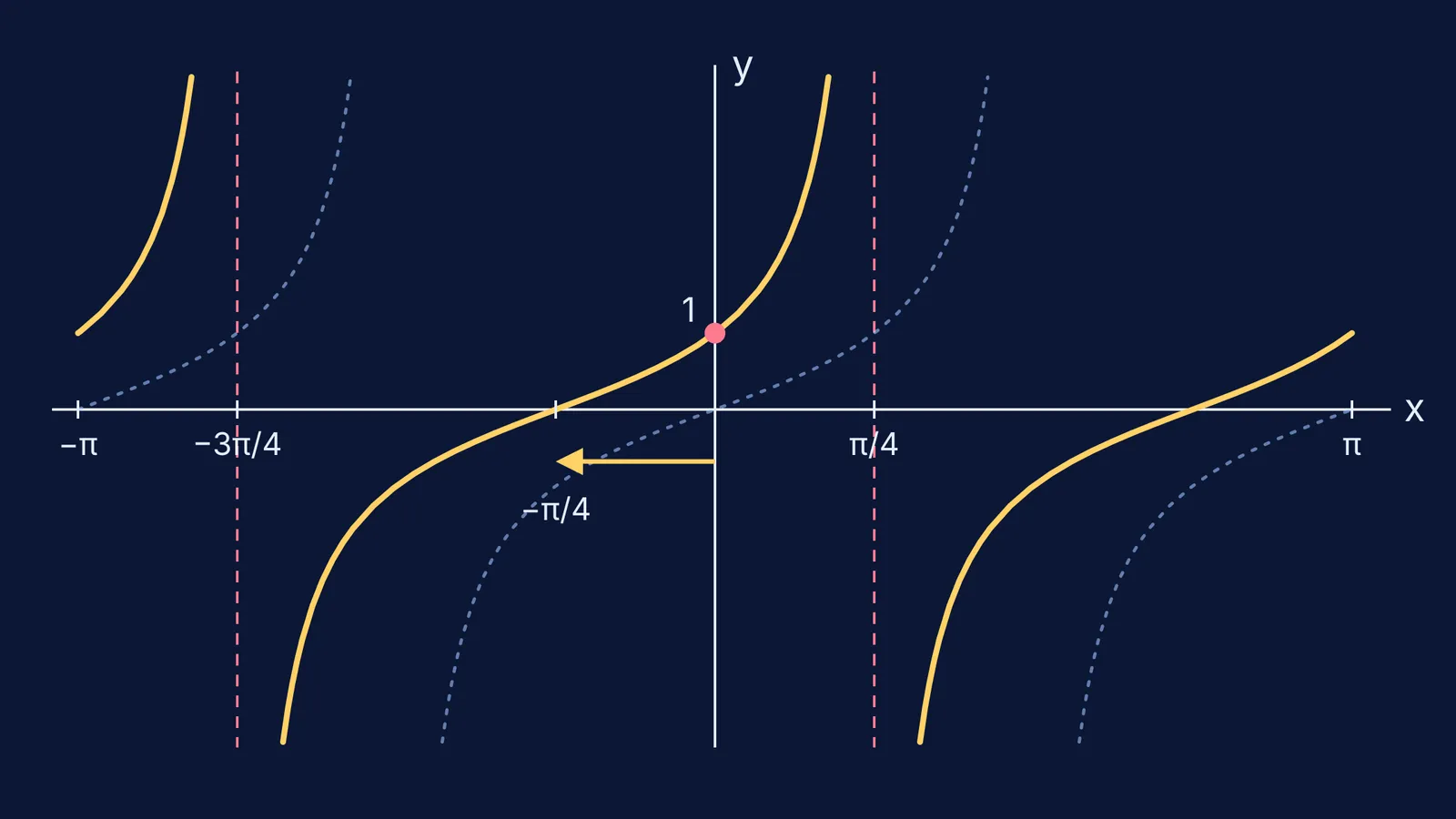
What about cos x = 0? At x = π/2 the fraction is (0 + 1)/(0 − 1) = −1, and tan(3π/4) = −1, so the result still holds. Exclude only x = π/4 + nπ, where cos x = sin x. The graph at the top is this curve: tan x slid left by π/4.
What else is the tan(π/4 ± A) formula used for?
Exact values. Example 12 in NCERT Class 11 Mathematics, Chapter 3 finds tan(13π/12) by reducing it to tan(π/12) = tan(π/4 − π/6), which gives 2 − √3. The same move gives tan 15° = (1 − 1/√3)/(1 + 1/√3) = 2 − √3, which is Exercise 3.3, question 5(ii).
Proofs. Exercise 3.3, question 7 asks you to prove tan(π/4 + x)/tan(π/4 − x) = ((1 + tan x)/(1 − tan x))². With the two forms above it takes one line.
Differences that become a double angle. Simplify (cos x + sin x)/(cos x − sin x) − (cos x − sin x)/(cos x + sin x). Over a common denominator, the top is (cos x + sin x)² − (cos x − sin x)² = 4 sin x cos x, and the bottom is cos²x − sin²x = cos 2x. So the answer is 2 sin 2x/cos 2x = 2 tan 2x.
Products equal to 2. If A + B = π/4, then tan(A + B) = 1, so tan A + tan B = 1 − tan A tan B. Add 1 + tan A tan B to both sides and factor: (1 + tan A)(1 + tan B) = 2. That is why (1 + tan 22°)(1 + tan 23°) = 2 without a calculator.
For the sine and cosine versions of the sum formula, see our explainer on the cos(A + B) formula and its uses. The same tangent-sum idea drives finding tan(A + B) when tan A and tan B are roots of a quadratic and proving tan 70° = tan 20° + 2 tan 50°.
Which mistakes cost marks with this formula?
Swapped signs. Plus on top gives π/4 + x; minus on top gives π/4 − x. Test at x = π/6, not x = 0 (both forms give 1 there): plus on top gives tan 75° ≈ 3.73.
Missing exclusions. State x ≠ π/4 + nπ when the question asks for the domain.
Taking the long road. Multiplying by the conjugate gives (1 + sin 2x)/cos 2x: correct, but not yet a single tangent.
If you switch methods halfway and lose the thread, the Fermi Problem Library has worked problems with a step-by-step solver that explains the reasoning rather than printing an answer. If the gap is the tan(x + y) identity itself, the Fermi Concept Library gives each mathematics concept its own lesson.
Next time a fraction has the same two terms on top and bottom, divide first and look for the 1.