On this page
The question looks like it needs a calculator. It doesn't. You need one identity, one fact about complementary angles and a few lines of algebra, and the same moves work on a whole family of exam questions.
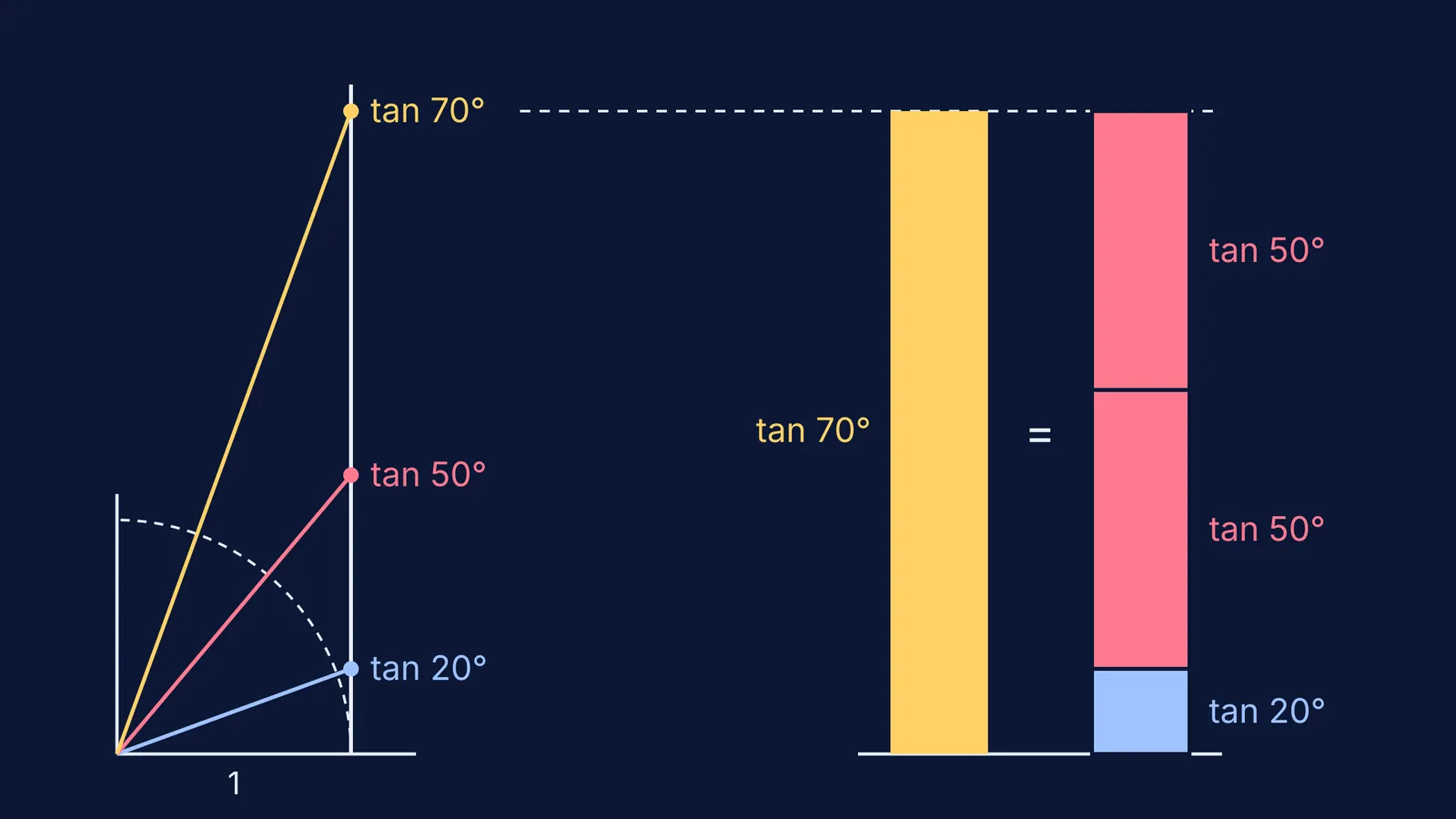
How do you prove tan 70° = tan 20° + 2 tan 50°?
Start from the identity tan(x − y) = (tan x − tan y)/(1 + tan x tan y), which NCERT lists as identity 11 in Chapter 3 of the Class 11 Mathematics textbook (NCERT, Trigonometric Functions, p. 60). Then:
Write 50° as a difference: 50° = 70° − 20°.
Apply the identity: tan 50° = (tan 70° − tan 20°)/(1 + tan 70° tan 20°).
Use tan 70° tan 20° = 1 (explained below), so the denominator is 1 + 1 = 2.
So tan 50° = (tan 70° − tan 20°)/2, or 2 tan 50° = tan 70° − tan 20°.
Rearrange: tan 70° = tan 20° + 2 tan 50°. Proved.
Check once on a calculator: tan 70° ≈ 2.7475, while tan 20° + 2 tan 50° ≈ 0.3640 + 2 × 1.1918 = 2.7476, equal up to rounding.
Why does tan 70° × tan 20° equal 1?
Because 70° and 20° are complementary: they add up to 90°. For any angle x, tan(90° − x) = cot x, so tan 70° = tan(90° − 20°) = cot 20° = 1/tan 20°. Multiply both sides by tan 20° and you get 1.
The clue is the pair that adds up to 90°. Our post on the pairing trick for sums like sin² 5° + sin² 10° + … + sin² 90° uses complementary pairs on longer sums and products.
Is there a second way to prove it?
Yes, and it follows a worked example in the same NCERT chapter. Example 14 there shows tan 3x tan 2x tan x = tan 3x − tan 2x − tan x by writing 3x = 2x + x and expanding tan(2x + x) (NCERT, Example 14, p. 65).
The same move works here with 70° = 50° + 20°:
tan 70° = (tan 50° + tan 20°)/(1 − tan 50° tan 20°).
Cross-multiply: tan 70° − tan 70° tan 50° tan 20° = tan 50° + tan 20°.
Replace tan 70° tan 20° with 1, so the second term on the left is just tan 50°.
That leaves tan 70° − tan 50° = tan 50° + tan 20°, which gives tan 70° = tan 20° + 2 tan 50°.
Both routes rest on the same two facts.
How do you spot the same trick in other questions?
Nothing in the proof depended on 70° and 20° in particular. If A + B = 90°, then tan A tan B = 1, and the tan(A − B) step gives a general rule: tan A = tan B + 2 tan(A − B), whenever A + B = 90° and every tangent in it is defined.
Test the rule before you trust it:
A = 60°, B = 30°: tan 60° = tan 30° + 2 tan 30° = 3/√3 = √3. Correct.
A = 75°, B = 15°: tan 75° = tan 15° + 2 tan 60°, that is 2 + √3 = (2 − √3) + 2√3. Correct.
A short checklist for any tan identity with odd-looking angles:
Look for one angle that is the sum or difference of two others.
Check whether a pair adds up to 90° (their tangents multiply to 1) or 45° (then tan A + tan B + tan A tan B = 1).
Write the compound-angle formula, substitute the special value and clear the fraction.
Rearrange into the form the question asks for.
If you get stuck at step 1 or 2, the Fermi Problem Library has worked problems with a step-by-step solver that explains the reasoning rather than printing an answer, so you can see why a particular split of the angles was chosen.
What mistakes cost marks on this proof?
Putting a minus sign in the denominator of tan(x − y). The denominator is 1 + tan x tan y; the minus belongs to tan(x + y) (NCERT, identities 10 and 11, p. 60).
Writing tan 70° tan 20° = 1 without the reason. Add the line tan 70° = cot 20°, so every step is justified.
Offering decimals as the proof. The calculator check is for your own confidence, not for the answer sheet.
To revise the formulas behind these identities, see our guide to the cos(A + B) formula, its proofs and the sin version, and the Fermi Concept Library has a lesson for each trigonometry concept and shows where it fits in the map. If you checked your proof with an AI tool, read how to check an AI's proof of a trigonometric identity first.