

On this page
If a question asks for sin² 5° + sin² 10° + … + sin² 90°, nobody expects you to know sin² 5°. It tests whether you see that the angles pair up to make 90°. The answer is 19/2, and the same idea shows that tan 1° × tan 2° × … × tan 89° = 1.
Why do θ and 90° − θ pair up?
Two identities do all the work, and both are proved in the NCERT Class 11 textbook, Chapter 3, Trigonometric Functions:
The complementary-angle identity, sin(90° − θ) = cos θ, is identity 6 in Section 3.4.
The Pythagorean identity, sin²θ + cos²θ = 1 for every real θ, is derived from the unit circle in Section 3.3.
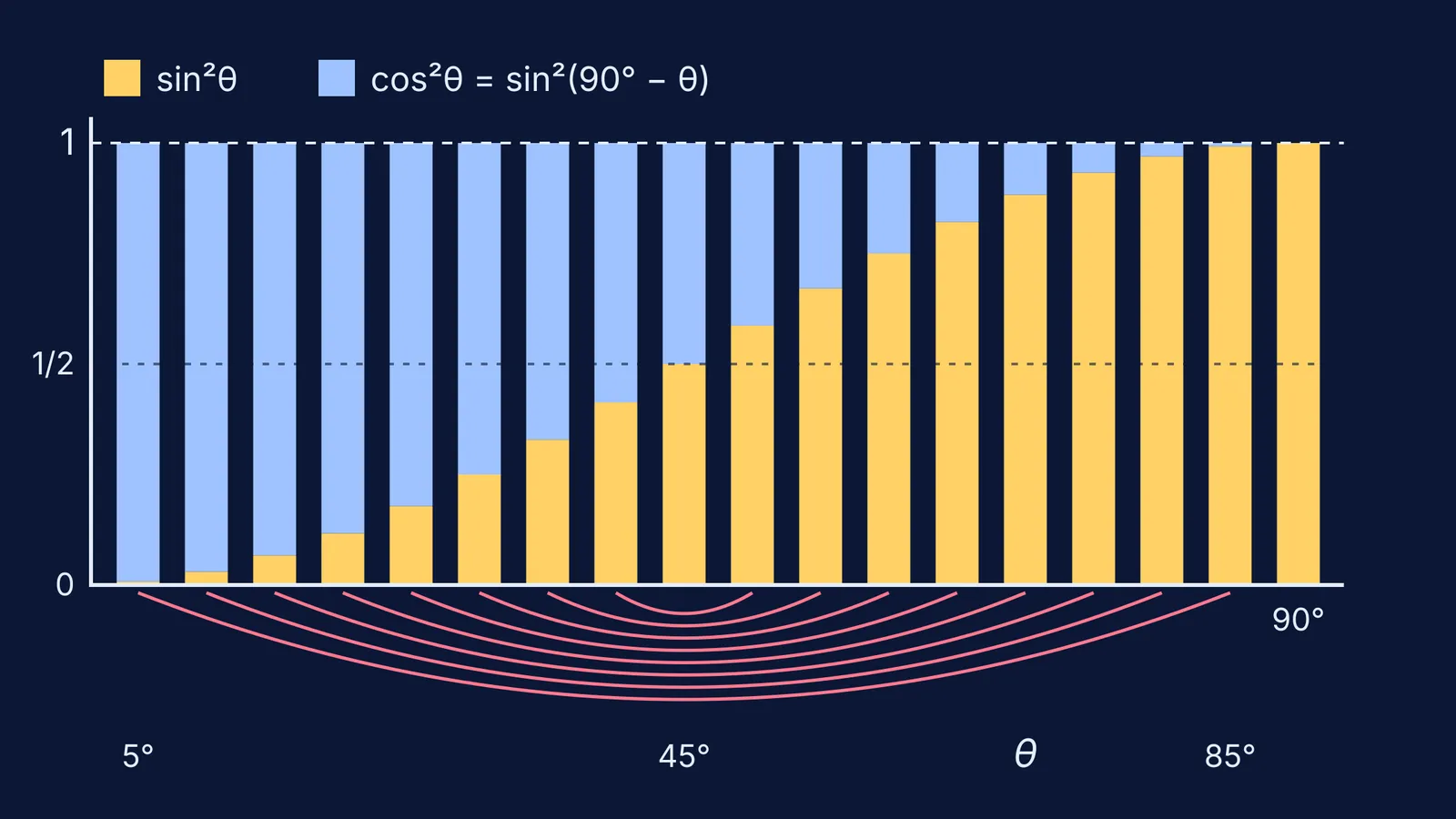
Put them together. Squaring the first gives sin²(90° − θ) = cos²θ, so sin²θ + sin²(90° − θ) = sin²θ + cos²θ = 1. Any two angles that add to 90° (complementary angles, the same pairs you met in complementary and supplementary angle problems in Class 7) contribute exactly 1 to a sum of squared sines.
How do you find sin² 5° + sin² 10° + … + sin² 90°?
Work through it in this order. The exact values in step 4 come from the value table in the same NCERT chapter.
Count the terms. The angles run 5°, 10°, …, 90° in steps of 5°, so there are 90 ÷ 5 = 18 terms.
Pair from the outside in: (5°, 85°), (10°, 80°), (15°, 75°), (20°, 70°), (25°, 65°), (30°, 60°), (35°, 55°), (40°, 50°). That is 8 pairs, each worth 1, so they give 8.
List the terms without a partner. 45° pairs with itself, and 90° would pair with 0°, which is not in the sum.
Evaluate them: sin² 45° = (1/√2)² = 1/2 and sin² 90° = 1² = 1.
Add: 8 + 1/2 + 1 = 19/2 = 9.5.
Now check the count: 8 pairs use 16 terms, and 2 leftovers make 18. If the numbers do not match, a term has gone missing.
What if the angles or the function change?
The same two identities handle each of these variations.
sin² 1° + sin² 2° + … + sin² 89°: 44 pairs, plus sin² 45° = 1/2 left in the middle, so the sum is 89/2.
cos² 5° + cos² 10° + … + cos² 90°: the same 8 pairs give 8, then cos² 45° = 1/2 and cos² 90° = 0, so the sum is 17/2.
sin² 0° + sin² 10° + … + sin² 90°: 10 terms make 5 complete pairs, (0°, 90°) through (40°, 50°). 45° is not in this list, so the sum is exactly 5.
Why is tan 1° tan 2° tan 3° … tan 89° equal to 1?
The tangent version of the complementary-angle rule is tan(90° − θ) = cot θ, listed under reflections in the list of trigonometric identities. It follows from NCERT's results by dividing sin(90° − θ) = cos θ by cos(90° − θ) = sin θ.
So tan θ × tan(90° − θ) = tan θ × cot θ = 1. The product has 89 factors. Pair them as (1°, 89°), (2°, 88°), …, (44°, 46°): that is 44 pairs, each with product 1. The middle factor tan 45° is also 1, so the whole product is 1.
Pairing works only when the operation matches an identity that gives a constant: squared sines add to 1, tangents multiply to 1, but tan 1° + tan 89° does not collapse, because tan θ + cot θ is not constant. Swapping x for π/2 − x does the same job in calculus, as in why the integral of sin 2x log tan x is zero.
How do you spot a pairing question in an exam?
Check these first.
The first and last angles add to 90°, or the list is symmetric about 45°.
The functions swap under the complement: sin with cos, tan with cot, sec with cosec.
The operation matches a constant identity: squares that add, or tan and cot that multiply.
You have listed the unpaired terms (45°, 0°, 90°) before adding.
If the angles are not symmetric about 45°, pairing will not help; look for a sum that cancels term by term instead, as in how cot x − tan x = 2 cot 2x telescopes trigonometric sums.
If you keep landing on 9 instead of 9.5, the Fermi Problem Library has worked problems with a step-by-step solver that explains the reasoning rather than printing an answer, so you can find the step where a term went missing. To revisit why sin(90° − θ) = cos θ on the unit circle, the Fermi Concept Library gives each mathematics concept its own lesson.
Try one now: cos² 1° + cos² 2° + … + cos² 90°. (It is 89/2, since cos² 90° adds nothing.)


