

On this page
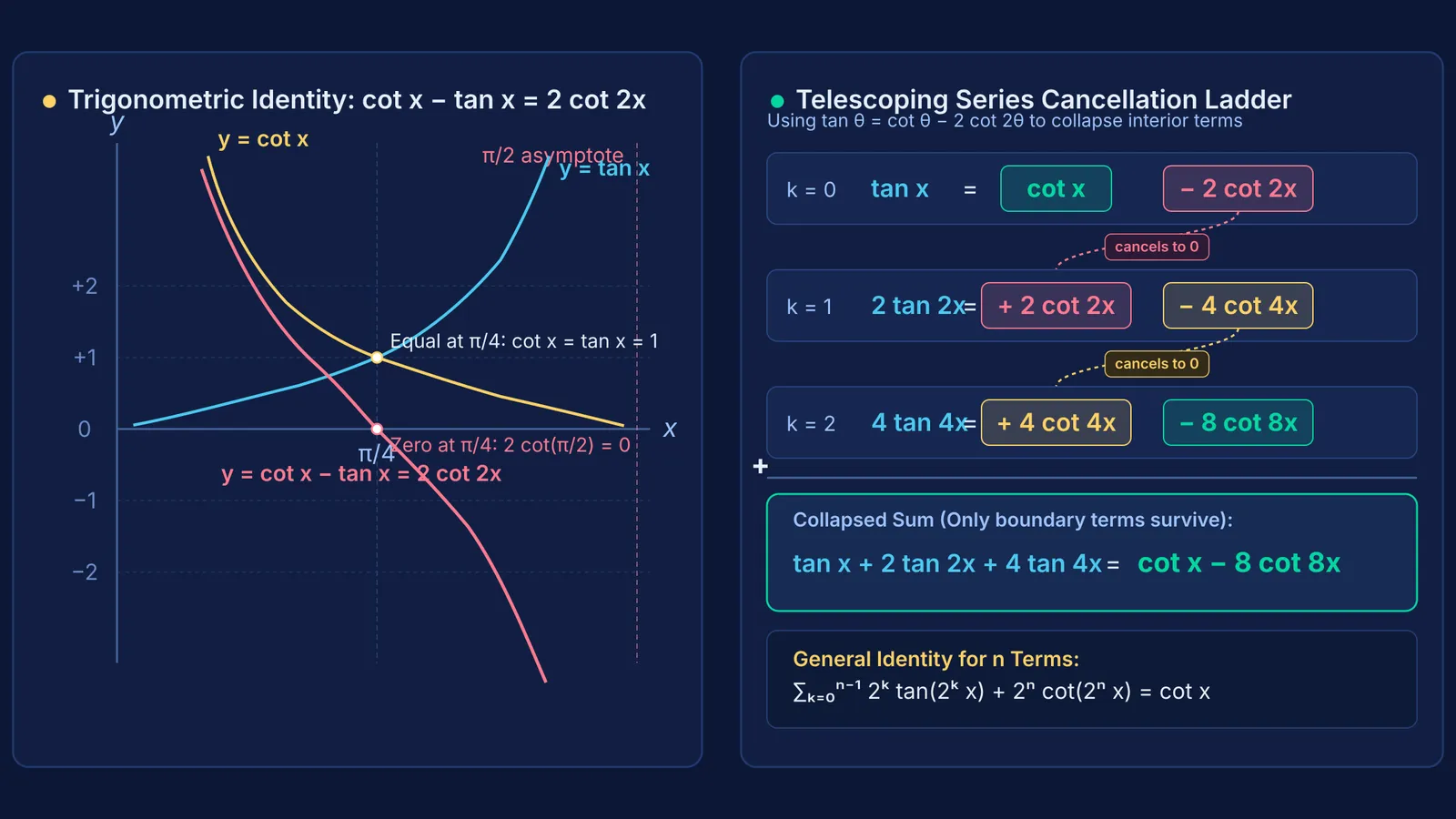
How do you prove that cot x − tan x equals 2 cot 2x?
Trigonometric equations in competitive examinations like JEE Main and JEE Advanced often appear intimidating because terms with escalating angles resist direct addition. Proving cot x − tan x = 2 cot 2x begins by writing both circular functions as ratios: cot x = cos x / sin x and tan x = sin x / cos x. Combining them over a common denominator gives: cot x − tan x = (cos x / sin x) − (sin x / cos x) = (cos² x − sin² x) / (sin x cos x).
The numerator matches the cosine double-angle identity cos 2x = cos² x − sin² x, while the denominator corresponds to (1/2) sin 2x from the sine double-angle formula sin 2x = 2 sin x cos x, as documented in OpenStax Precalculus. Substituting these double-angle expressions into the fraction yields: (cos² x − sin² x) / (sin x cos x) = cos 2x / ((1/2) sin 2x) = 2 (cos 2x / sin 2x) = 2 cot 2x.
This identity holds for all real angles where neither sin x nor cos x is zero, meaning x ≠ kπ/2 for any integer k. Similar techniques of breaking composite ratios into elementary parts appear when applying tan half-angle substitution.
Why does this identity create a telescoping sum?
A telescoping sum is a series where consecutive terms cancel each other out, leaving only the boundary terms intact, as defined on Wolfram MathWorld. Standard addition cannot easily simplify a sum of tangents whose arguments double, such as tan x + 2 tan 2x + 4 tan 4x. However, rearranging our proved relation yields: tan x = cot x − 2 cot 2x.
This rearrangement isolates tan x as a difference between a cotangent of angle x and a scaled cotangent of double angle 2x. In his 1893 Cambridge treatise Plane Trigonometry, British mathematician S. L. Loney demonstrated how writing individual trigonometric terms as differences transforms stubborn series into collapsible ladders.
When you double the argument by replacing x with 2x, the relationship becomes: tan 2x = cot 2x − 2 cot 4x. Multiplying both sides by 2 produces: 2 tan 2x = 2 cot 2x − 4 cot 4x. The trailing term of the first line (−2 cot 2x) and the leading term of the second line (+2 cot 2x) carry opposite signs, cancelling completely upon addition. The Fermi Problem Library provides worked problems with a step-by-step solver that explains the reasoning rather than printing an answer, highlighting how recognizing these difference structures simplifies multi-angle trigonometric expressions.
How do you evaluate tan x + 2 tan 2x + 4 tan 4x step by step?
Consider the standard examination challenge: evaluate the sum S = tan x + 2 tan 2x + 4 tan 4x. Applying the difference transformation systematically to each term establishes the telescoping cancellation:
Write the first term (k = 0): tan x = cot x − 2 cot 2x.
Write the second term (k = 1): 2 tan 2x = 2 cot 2x − 4 cot 4x.
Write the third term (k = 2): 4 tan 4x = 4 cot 4x − 8 cot 8x.
Adding these three equations vertically reveals the cancellation: S = (cot x − 2 cot 2x) + (2 cot 2x − 4 cot 4x) + (4 cot 4x − 8 cot 8x). The interior pairs (−2 cot 2x, +2 cot 2x) and (−4 cot 4x, +4 cot 4x) cancel to zero. Only the boundary terms remain: S = cot x − 8 cot 8x.
Questions in JEE Advanced often ask for S + 8 cot 8x. By substituting the simplified sum, the entire expression reduces directly to cot x. Similar product-to-difference mechanisms operate in product to sum formulas in trigonometry.
What happens when the angle is repeatedly halved instead of doubled?
The same identity applies when arguments are repeatedly halved rather than doubled. Replacing x with x/2 in cot x − tan x = 2 cot 2x produces cot(x/2) − tan(x/2) = 2 cot x. Rearranging to isolate tan(x/2) gives tan(x/2) = cot(x/2) − 2 cot x. Dividing by 2 yields: (1/2) tan(x/2) = (1/2) cot(x/2) − cot x.
Repeating this substitution for smaller submultiples generates a reverse telescoping sum: (1/4) tan(x/4) = (1/4) cot(x/4) − (1/2) cot(x/2), (1/8) tan(x/8) = (1/8) cot(x/8) − (1/4) cot(x/4).
Summing n terms from k = 1 to n cancels all intermediate cotangents, producing: Sₙ = (1/2ⁿ) cot(x/2ⁿ) − cot x.
As n approaches infinity, the angle x/2ⁿ tends toward 0. Because the limit of θ cot θ as θ approaches 0 equals 1, the leading term simplifies to (1/x) × 1 = 1/x. As outlined in OpenStax Calculus Volume 2, the partial sums converge to a finite limit when their tail terms stabilize, proving that the infinite sum of (1/2ᵏ) tan(x/2ᵏ) equals (1/x) − cot x. You can review how partial sums approach limits in our guide on what it means for a series to converge.
How should you spot and practice telescoping patterns for JEE?
Recognizing when to use cot x − tan x = 2 cot 2x in competitive exams comes down to four structural clues:
Angles double from term to term (x, 2x, 4x, 8x).
Coefficients double alongside the angles (1, 2, 4, 8) or halve alongside submultiples (1/2, 1/4, 1/8).
The series is an unsimplified sum of tangent terms rather than products of sines or cosines.
A trailing cotangent term with the maximum angle is added or subtracted to produce a single cot x result.
When you work through unfamiliar multi-angle expressions, Fermi's AI tutor notices where you get stuck, writes on a board, and checks understanding as you work through each algebraic transformation. You can also explore foundational derivations of circular functions in the Fermi Concept Library.


