

On this page
When solving trigonometry problems in Class 11 or preparing for competitive examinations such as JEE Main, encountering products of different trigonometric ratios complicates algebraic simplification. An expression such as 2 sin 5x cos 3x multiplies two oscillating waves of different frequencies. In algebra, products resist term-by-term manipulation, and in calculus, a product of two trigonometric functions cannot be integrated with elementary anti-derivative rules.
The standard solution is to convert the product into a sum of single sines or cosines. According to the official NCERT Class 11 Mathematics textbook (Chapter 3: Trigonometric Functions), trigonometric product-to-sum identities rewrite products of sine and cosine as linear combinations of individual functions whose angles are the sum and difference of the original arguments.
What is the product to sum formula for 2 sin A cos B?
The identity for the product of a sine and a cosine with different angles is:
2 sin A cos B = sin(A + B) + sin(A − B)
This formula is derived directly from the fundamental angle addition identities. As documented in OpenStax Precalculus 2e, adding the two compound angle expansions:
sin(A + B) = sin A cos B + cos A sin B
sin(A − B) = sin A cos B − cos A sin B
causes the cross terms cos A sin B to cancel, leaving sin(A + B) + sin(A − B) = 2 sin A cos B.
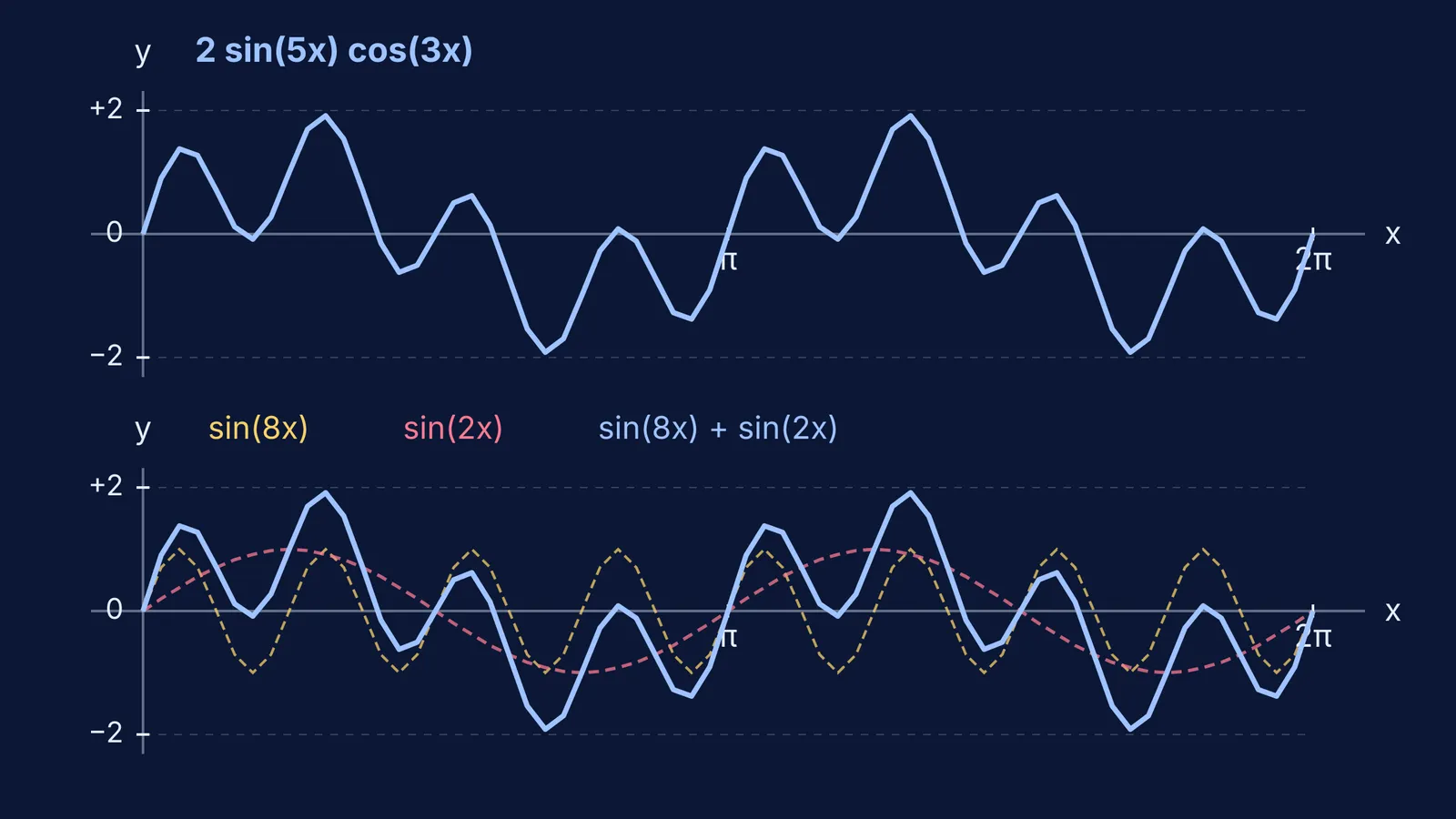
For the product 2 sin 5x cos 3x, setting A = 5x and B = 3x yields A + B = 8x and A − B = 2x. Therefore, 2 sin 5x cos 3x = sin 8x + sin 2x. If an expression lacks the leading factor of 2, simply multiply and divide by 2: sin 5x cos 3x = (1/2)[sin 8x + sin 2x].
The three companion product-to-sum formulas follow identical derivations:
2 cos A sin B = sin(A + B) − sin(A − B)
2 cos A cos B = cos(A + B) + cos(A − B)
2 sin A sin B = cos(A − B) − cos(A + B)
How do sum-to-product formulas work in reverse?
Every product-to-sum formula can be reversed into a sum-to-product formula. According to Wolfram MathWorld, these identities are historically known as prosthaphaeresis formulas or Simpson's formulas, developed in the late 16th century to replace laborious astronomical multiplications with simple table-based additions before John Napier invented logarithms in 1614.
To reverse 2 sin A cos B = sin(A + B) + sin(A − B), let C = A + B and D = A − B. Solving this linear system gives A = (C + D)/2 and B = (C − D)/2. Substituting these angles back into the identity produces the sum-to-product form:
sin C + sin D = 2 sin((C + D)/2) cos((C − D)/2)
The corresponding reverse identities are:
sin C − sin D = 2 cos((C + D)/2) sin((C − D)/2)
cos C + cos D = 2 cos((C + D)/2) cos((C − D)/2)
cos C − cos D = −2 sin((C + D)/2) sin((C − D)/2) = 2 sin((C + D)/2) sin((D − C)/2)
While product-to-sum identities expand a multiplication into separate terms, sum-to-product formulas factor an addition into a single product.
When should you use product-to-sum versus sum-to-product?
Choosing between the two directions depends on what operation you need to perform next:
Use product-to-sum for integration: You cannot directly integrate a product like sin 5x cos 3x using simple power rules. Converting to (1/2)[sin 8x + sin 2x] produces individual linear terms that integrate immediately. Similar linear transformations are used when integrating powers of sine and cosine.
Use product-to-sum for signal analysis: In physics and electronics, multiplying two sinusoidal signals produces amplitude modulation. Expanding the product reveals the two distinct frequency components (the sidebands at 8x and 2x), just as triple-angle formulas isolate harmonic components.
Use sum-to-product to solve trigonometric equations: When an equation is written as a sum equal to zero, such as sin 5x + sin 3x = 0, you cannot find roots easily. Converting it to 2 sin 4x cos x = 0 factors the expression into two independent conditions: sin 4x = 0 or cos x = 0.
Use sum-to-product to cancel trigonometric fractions: Fractions with sums in both numerator and denominator, such as (sin 5x + sin 3x)/(cos 5x + cos 3x), collapse into (2 sin 4x cos x)/(2 cos 4x cos x) = tan 4x. This factoring technique complements methods like telescoping cosine products.
When deciding which algebraic route to take on mixed trigonometric equations, the Fermi Problem Library provides worked problems with a step-by-step solver that explains the reasoning rather than printing an answer.
How do you integrate 2 sin 5x cos 3x step by step?
To see the practical power of product-to-sum conversion, consider the standard integral ∫ 2 sin 5x cos 3x dx:
Apply the product-to-sum identity: Replace 2 sin 5x cos 3x with sin(5x + 3x) + sin(5x − 3x), which simplifies to sin 8x + sin 2x.
Split the integral: Rewrite the expression as ∫ sin 8x dx + ∫ sin 2x dx.
Integrate each term: The anti-derivative of sin(kx) is −(1/k) cos(kx).
∫ sin 8x dx = −(1/8) cos 8x
∫ sin 2x dx = −(1/2) cos 2x
Combine terms and add the constant of integration: The complete result is −(1/8) cos 8x − (1/2) cos 2x + C.
Attempting to evaluate this integral using integration by parts creates a cyclical algebraic loop that requires significantly more calculation. Converting the product into a sum resolves the problem in two lines.
To explore how trigonometric transformations connect across algebra, calculus, and wave physics, students can review each topic in the Fermi Concept Library, which organizes every concept in physics, chemistry, biology, mathematics and computing, each with its own lesson and its place in the map.


