

On this page
Why does the integral of sin 2x log tan x equal zero?
Evaluating the definite integral ∫ from 0 to π/2 of sin(2x) ln(tan x) dx by finding an antiderivative seems intimidating. The integrand combines a double-angle trigonometric term with the logarithm of a trigonometric ratio. Yet the problem yields cleanly to the reflection property of definite integrals, formalized as Property P4 in the NCERT Class 12 Mathematics textbook.
The property states that for any continuous function f(x) on [0, a], the integral of f(x) equals the integral of f(a − x), as documented in Wolfram MathWorld's guide to definite integrals. Let the given integral be:
I = ∫ from 0 to π/2 of sin(2x) ln(tan x) dx
Applying the substitution x ↦ π/2 − x gives:
I = ∫ from 0 to π/2 of sin(2(π/2 − x)) ln(tan(π/2 − x)) dx
Simplifying each factor reveals why the expression cancels:
The sine term becomes sin(π − 2x). Because sin(π − θ) = sin(θ), sin(π − 2x) = sin(2x), remaining completely invariant.
The tangent term becomes tan(π/2 − x) = cot(x) = 1 / tan(x). By the logarithm quotient rule, ln(cot x) = ln(1 / tan x) = −ln(tan x).
Substituting these back into the integral gives:
I = ∫ from 0 to π/2 of sin(2x) [−ln(tan x)] dx = −I
Adding I to both sides yields 2I = 0, which means I = 0. In four lines of algebra, the integral evaluates to zero without finding an antiderivative.
What is the geometric meaning behind the cancellation?
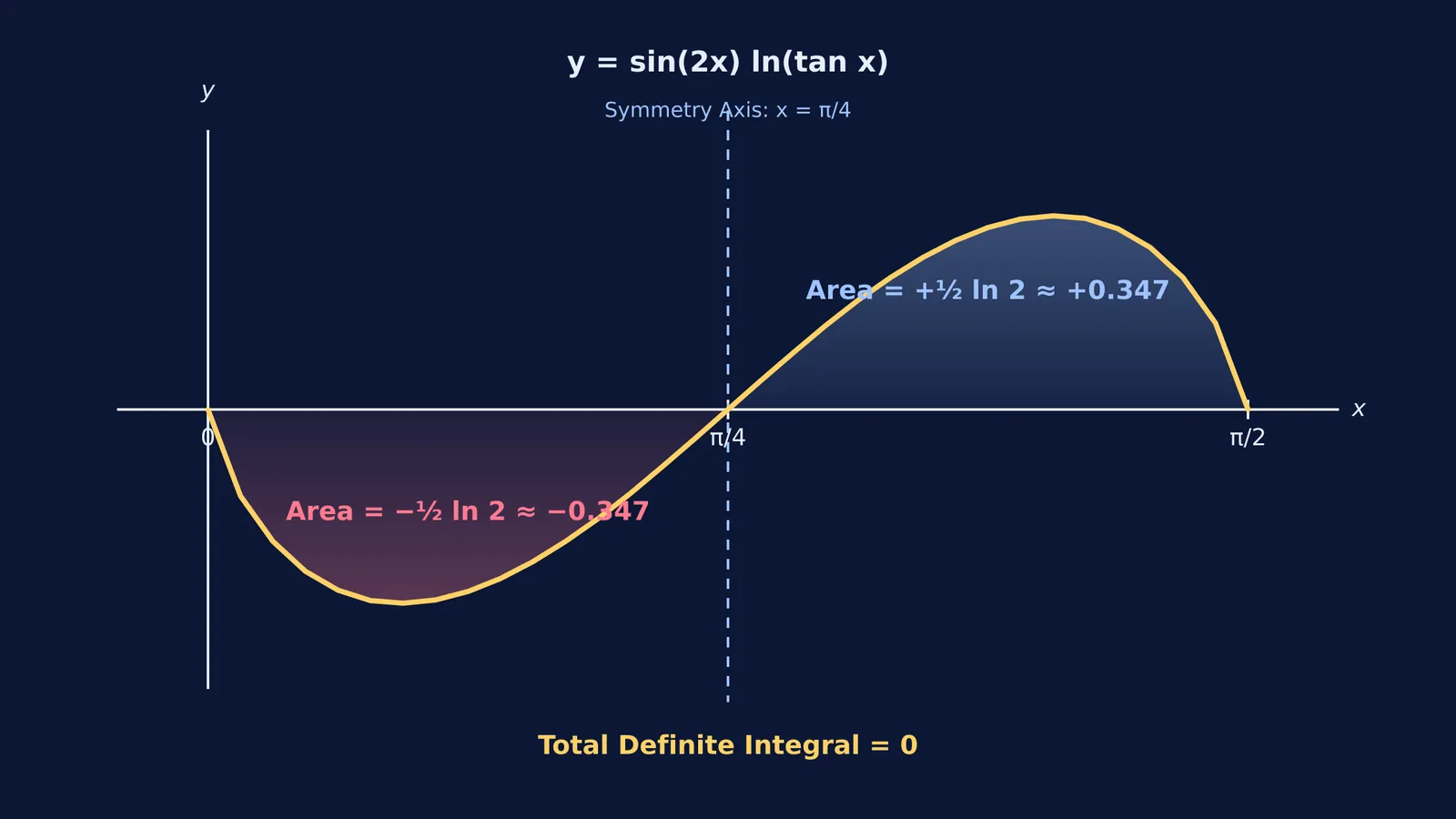
Algebraic cancellation reflects a visual symmetry. The substitution x ↦ π/2 − x is a reflection across x = π/4, the midpoint of the interval [0, π/2].
Examining the integrand across x = π/4 shows why the total area vanishes:
On (0, π/4), tan(x) < 1, so ln(tan x) < 0. Because sin(2x) > 0, the integrand is negative, forming a valley below the x-axis.
On (π/4, π/2), tan(x) > 1, so ln(tan x) > 0. Because sin(2x) > 0, the integrand is positive, forming a crest above the x-axis.
Setting u = x − π/4 shifts the midpoint to the origin. Here, sin(2x) = cos(2u), an even function of u. Conversely, ln(tan(π/4 + u)) is an odd function because tan(π/4 + u) = 1 / tan(π/4 − u). As explained in our guide to definite integral symmetry, the product of an even function and an odd function is strictly odd.
Because an odd function satisfies f(−u) = −f(u), every negative slice of area on (0, π/4) has an equal positive counterpart on (π/4, π/2). The two regions cancel out completely.
What happens at the boundaries where tan x becomes zero or infinite?
At x = 0, ln(tan x) approaches −∞, and at x = π/2, ln(tan x) diverges to +∞. This makes the integral improper, yet it converges cleanly.
Near x = 0, sin(2x) ≈ 2x and tan(x) ≈ x. The product 2x ln(x) approaches 0 by standard limits. By symmetry, the integrand also approaches 0 at x = π/2. Because the integrand extends continuously to both boundaries with value 0, the integral converges absolutely, as outlined in Wikipedia's treatment of substitution and bounded intervals.
Integrating by parts confirms the exact area of each half. With u = ln(tan x) and dv = sin(2x) dx, the antiderivative is F(x) = (1/2) ln(sin 2x) − (1/2) cos(2x) ln(tan x). Evaluating F(x) from 0 to π/4 gives −(1/2) ln 2 ≈ −0.34657. By symmetry, the integral from π/4 to π/2 gives +(1/2) ln 2 ≈ +0.34657. While integrating ln(cot x) alone over (0, π/4) yields Catalan's constant K ≈ 0.915965 (giving −K for ln(tan x)), as documented in Wolfram MathWorld's entry on Catalan's constant, the sin(2x) factor produces clean logarithmic halves that sum to zero.
How should you apply the reflection property in exam problems?
The reflection rule is a core technique in CBSE Class 12 exams, JEE Main, and JEE Advanced. When solving definite integrals, look for this pattern:
Identify complementary limits: Check whether the limits sum to π/2 or π, which naturally interchange sine and cosine or invert tangent.
Substitute x ↦ a + b − x: Check if the integrand flips its sign or swaps numerator and denominator. This approach also underpins the pairing trick for sums and integrals and the standard derivation of the integral of log sin x from 0 to π/2.
Add the two expressions: Write the transformed integral as I and compute 2I = I + I. If the integrand sums to zero, 2I = 0 proves the value is zero immediately.
When practice problems become tangled in algebra, the Fermi Problem Library offers worked problems with a step-by-step solver that explains the reasoning rather than printing an answer. For broader practice, the Fermi Concept Library covers every concept in physics, chemistry, biology, mathematics and computing, each with its own lesson and its place in the map.


