

On this page
Hunting for an antiderivative of ln sin x gets you nowhere. Instead, make the integral appear on both sides of an equation and solve for it.
What is the integral of log sin x from 0 to π/2?
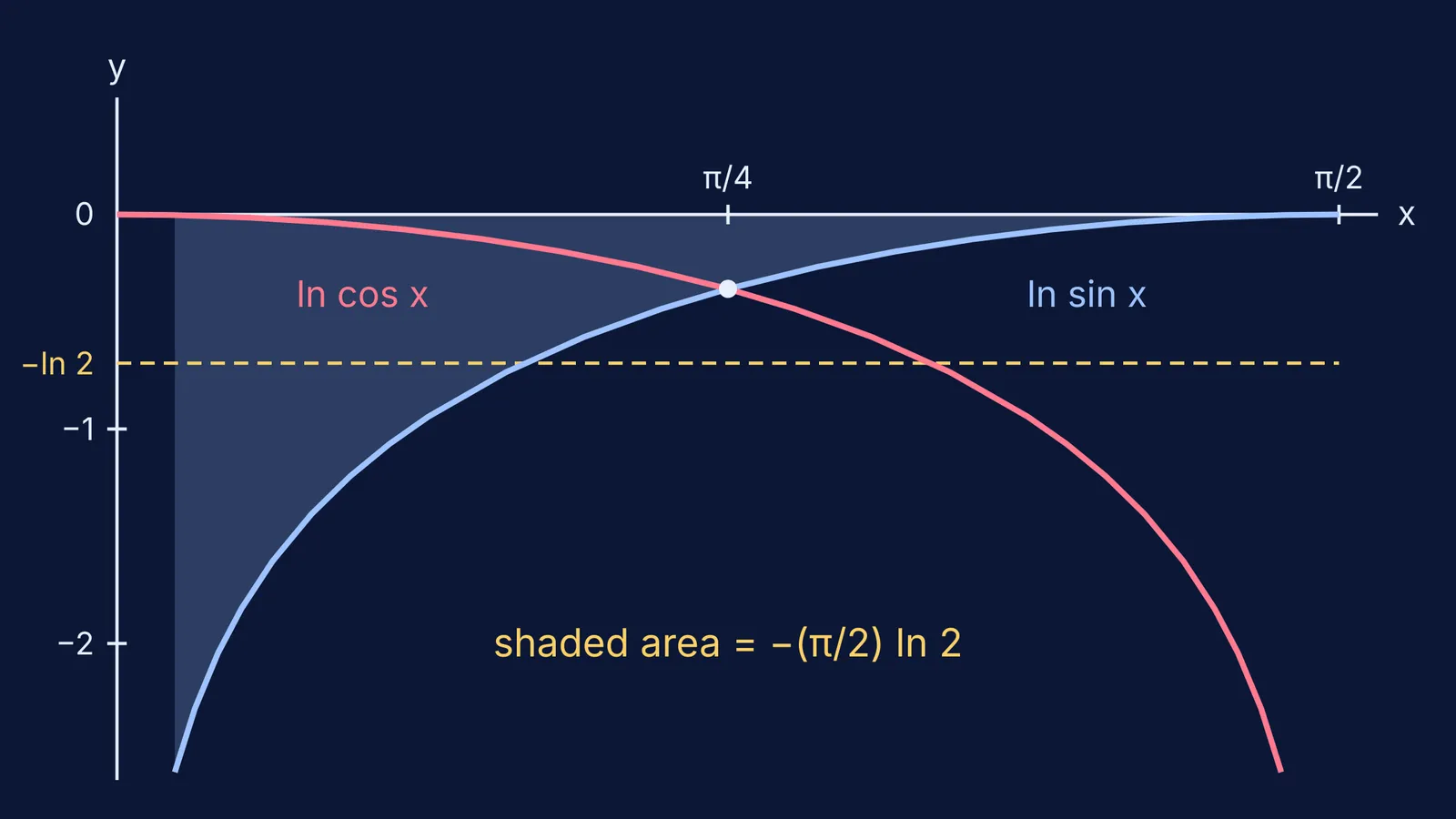
The value is ∫ from 0 to π/2 of ln(sin x) dx = −(π/2) ln 2, as stated on ProofWiki's page for this theorem. Numerically that is about −1.0888.
It is a solved example in the NCERT Class 12 Integrals chapter (Example 34, per Teachoo's walk-through), so it and its variants are worth knowing for board exams and JEE Main.
Two sanity checks. Here 0 < sin x ≤ 1, so ln sin x ≤ 0 and the answer must be negative. And though ln sin x falls to −∞ at x = 0, sin x behaves like x there, and ln x has a finite integral from 0 to 1, so the integral converges.
How do you derive −(π/2) ln 2 step by step?
Let I = ∫ from 0 to π/2 of ln sin x dx. You need the King property, ∫ from 0 to a of f(x) dx = ∫ from 0 to a of f(a − x) dx, and doubling: ∫ from 0 to 2a of f = 2∫ from 0 to a of f when f(2a − x) = f(x). Our post on definite integral properties that turn hard integrals easy covers both.
King property with a = π/2: sin(π/2 − x) = cos x, so I = ∫ from 0 to π/2 of ln cos x dx.
Add the two forms: 2I = ∫ from 0 to π/2 of ln(sin x cos x) dx.
Use sin x cos x = (sin 2x)/2: 2I = ∫ from 0 to π/2 of ln sin 2x dx − (π/2) ln 2.
Substitute t = 2x, so dx = dt/2 and the limits become 0 to π: the first integral is (1/2)∫ from 0 to π of ln sin t dt.
Doubling: sin(π − t) = sin t, so ∫ from 0 to π of ln sin t dt = 2I. Half of 2I is I.
So 2I = I − (π/2) ln 2, which gives I = −(π/2) ln 2.
Dividing by the interval length π/2 shows the average height of ln sin x here is exactly −ln 2: the dashed line in the diagram above.
Which other integrals reduce to it?
Each of these is one substitution or property away from I. Try each before reading the reduction.
∫ from 0 to π/2 of ln cos x dx = −(π/2) ln 2, from step 1. Wolfram MathWorld's log sine entry notes the log sine and log cosine integrals are equal on 0 to π/2.
∫ from 0 to π of ln sin x dx = −π ln 2, by doubling; MathWorld lists this as S₁.
∫ from 0 to π/2 of ln tan x dx = 0, since ln tan x = ln sin x − ln cos x.
∫ from 0 to π/2 of ln sin 2x dx = −(π/2) ln 2, from steps 4 and 5.
∫ from 0 to π of x ln sin x dx = −(π²/2) ln 2. Call it J; King with a = π gives J = ∫ (π − x) ln sin x dx, so 2J = π × (−π ln 2).
∫ from 0 to 1 of (ln x)/√(1 − x²) dx = −(π/2) ln 2. Put x = sin θ: dx = cos θ dθ cancels √(1 − x²) = cos θ, leaving I.
∫ from 0 to ∞ of ln(1 + x²)/(1 + x²) dx = π ln 2. Put x = tan θ: dx/(1 + x²) = dθ and ln(1 + tan²θ) = −2 ln cos θ.
How do you spot a log sine integral in an exam?
When an integral with a logarithm looks impossible, ask:
Is it a log of sin, cos or tan, or could a substitution make it one? √(1 − x²) suggests x = sin θ; 1 + x² suggests x = tan θ.
Are the limits 0 to a, so the King property applies?
After adding, does a double-angle identity combine the forms?
Does the original integral come back? Solve for I.
Is the sign right? A log of something between 0 and 1 is negative.
For a longer schedule, see our four-week integration practice plan with mixed sets.
If you get stuck where the integral reappears, the Fermi Problem Library has worked problems with a step-by-step solver that explains the reasoning rather than printing an answer. If the King property feels shaky, the Fermi Concept Library gives it its own lesson.
Tonight, close this page and derive I from step 1.


